Sri Guru Raghavendra Matrimony™ emblem
SRI GURU RAGHAVENDRA MATRIMONY™

The five crafts of the divine architect

Vishwakarma Matrimony

A community that traces its descent to Lord Vishwakarma, the divine architect, and that has shaped the temples, images, and fine work of the South for centuries deserves a matrimony space that asks the right questions first — craft, gotra, native region, and family character, all on the profile from the start.

Goldsmith — Kamsali / Ausula / TattanBlacksmith — Kammari / KollanCarpenter — Vadla / Vadrangi / AsariSculptor & Stonemason — Silpi / Kasi

Begin when you are ready

Register now, or read about the Vishwakarma heritage first

Creating an account takes a few minutes. If your family prefers to understand the space first, the sections below walk through the community's descent from Lord Vishwakarma, the five crafts and their names, the gotra system, and the temple and image craft the community holds dear.

Registrations from this page stay within the Vishwakarma section — every profile your family sees and contacts belongs to the community.
A heritage of the tool, the temple, and the lineage

A heritage your family carries every day

The Vishwakarma are the artisan community of the South — the goldsmiths and blacksmiths, carpenters, sculptors and coppersmiths whose hands have shaped the temples, images, and fine work of the land. By tradition they trace their descent to Lord Vishwakarma, the divine architect, through his five sons who are held to be the founders of the five crafts. The very name Panchala speaks of that mastery of five works.

Known as Vishwabrahmin, and by the honorific Achari or Asari, the community is one across the South under many regional names — Kamsala in the Telugu country, Kammalar in the Tamil land, Panchala in Karnataka, and Kammalan in Kerala. An alliance still opens the old way: which craft a family follows, its gotra, and the native region that holds its roots.

Sri Guru Raghavendra Matrimony presents those details on every profile, in the order your elders actually weigh them — so a Vishwakarma alliance begins informed, and with the dignity your family expects.

What families often ask first

What families often value first

  • Profiles state craft, gotra, and native region up front, so your family knows the essentials before the first conversation.
  • Families of all five crafts — goldsmith, blacksmith, carpenter, sculptor and coppersmith — will find their craft represented, each with its own option.
  • Registrations from this page stay within the Vishwakarma section, so every profile your family considers belongs to the community.

What your family will find inside

Everything your family checks, before the first phone call

These are the details Vishwakarma households settle first — and they are visible before any contact is exchanged.

Government ID verified members stand out

Members who complete Government ID verification carry a clear mark, giving your family added reassurance at a glance.

Filter by craft, gotra, and native place

Narrow the search by craft — goldsmith, blacksmith, carpenter, sculptor or coppersmith — and by gotra, native place, and family origin.

Education, work, and family background together

Degrees, professions, and family character read clearly on every profile, in the same order elders weigh an alliance.

Lineage recorded your way

Record your family's gotra as free text, exactly as your family names it, so the same-gotra check your elders rely on is settled up front.

Contact details are not shown openly

Phone numbers and email are not shown openly on profiles. A member uses the Reveal Contact feature to see another member's details and reach out directly when they are ready to take an introduction forward.

Interest is never lost

Shortlists and expressed interest stay saved, so your family can return to a promising profile after the household has talked it over.

Built around how Vishwakarma alliances actually happen

Whether your family's search stays within one craft and district or reaches across the South, the details that matter — craft, gotra, and native region — are always in view.

Why families feel at ease

Why Vishwakarma families feel at home

The details that decide an alliance sit together in one place, presented the way your family would present them.

A community-scoped beginning

Your search stays within the Vishwakarma community pool — the five artisan families — so every introduction starts from shared roots.

Every craft at home

Goldsmith and blacksmith, carpenter and sculptor, coppersmith and brazier are all welcome, each with its own craft option so families recognise and match within their own group.

Comfortable for parents and members alike

Whether the search is led by a parent, a sibling, or the member themselves, the profile reads clearly for all of them.

Move at your family's pace, with tradition honoured up front and you reach out when your family is ready.

Understanding the heritage

The divine architect and the five crafts

The Vishwakarma heritage begins with Lord Vishwakarma, the divine architect of the gods. By tradition the community traces its descent and its crafts to him, and holds its work at the forge, the loom of wood and stone, and the goldsmith's fire as an inheritance from the divine.

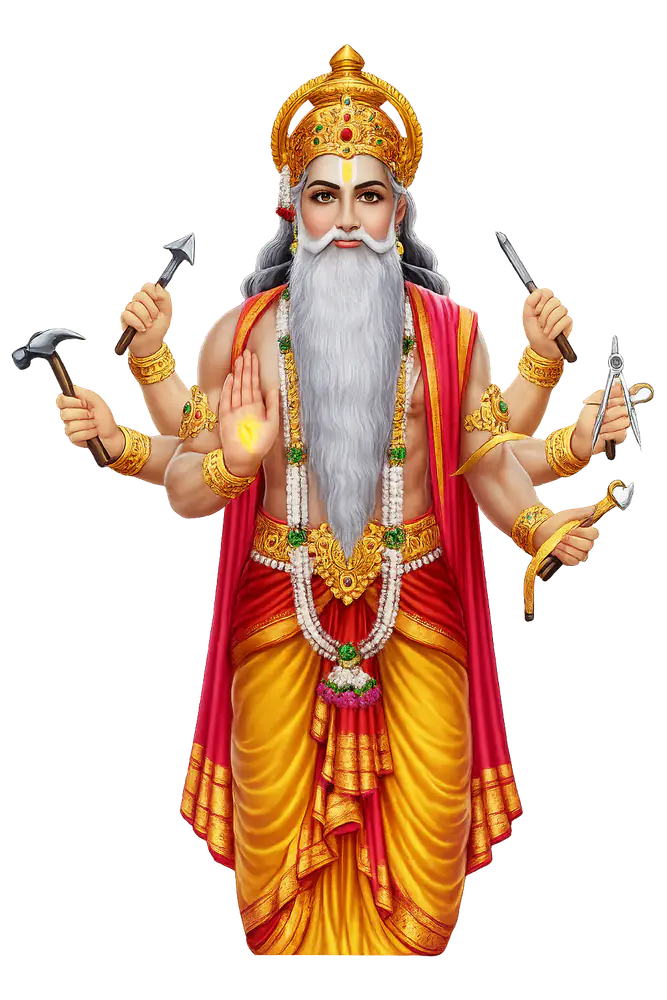
An image of Lord Vishwakarma, the divine architect, revered as the progenitor of the Vishwakarma artisan community

Lord Vishwakarma, the divine architect

In the Hindu tradition Vishwakarma is the craftsman of the gods — the maker of their chariots and weapons, the architect of the divine — often shown with many faces and hands, each holding a tool of the craft. The community reveres him as its progenitor and the source of its skill.

The five sons, the five crafts

Tradition holds that Vishwakarma's five sons — Manu, Maya, Tvashta, Shilpi and Vishvajna — founded the five artisan lineages: the blacksmith, the carpenter, the metal-caster, the sculptor, and the goldsmith. The name Panchala itself carries this mastery of the five works.

This origin is the community's revered tradition rather than documented history, and is shared here with reverence. No endorsement is implied, and devotional matters rest with each family and its elders.

One community, five crafts

The five sections and the names they carry across the South

The Vishwakarma community is one, organised into five craft sections that go by different names in each region. When you register you simply choose your craft — goldsmith, blacksmith, carpenter, sculptor or coppersmith — so if your family is known by a regional name like Kamsali, Kammari or Asari, the list below shows which craft that name belongs to. Families arrange their alliances by gotra rather than by craft, so the crafts stay one shared community.

Find your family's name — and the craft to choose

Look for your family's traditional name below to see which craft to pick when you register. Each craft carries its own names across the Telugu, Tamil, Kannada and Malayalam lands, and the craft named at the start of each line — Goldsmith, Blacksmith, Carpenter, and so on — is exactly the option you choose in the app.

  • Goldsmith — Kamsali, Ausula, Agasala (Telugu); Tattan (Tamil, Kerala); Akkasali (Kannada)
  • Blacksmith — Kammari (Telugu); Kollan (Tamil); Kammara (Kannada)
  • Carpenter — Vadla, Vadrangi (Telugu); Tachchan (Tamil); Asari (Kerala)
  • Sculptor & Stonemason — Silpi, Kasi (Telugu); Kal-Tachchan (Tamil); Kallasari (Kerala)
  • Coppersmith / Brazier — Kanchari, Kanchugara (Telugu); Kannan (Tamil); Musari, Chembotti (Kerala)

One community across the South

Under the shared names Vishwabrahmin and Panchala, the community is known as Kamsala in the Telugu country, Kammalar among the Tamils, Panchala in Karnataka, and Kammalan in Kerala — one people of the crafts, honoured for the work of its hands.

  • Kamsala — the Telugu country
  • Kammalar — the Tamil land
  • Panchala / Achari — Karnataka
  • Kammalan / Asari — Kerala

Names, customs, and emphasis vary by region and household; the crafts are named here with respect, as the many faces of one community.

Understanding the traditions

Gotra: how Vishwakarma families trace and match lineage

Before education, often before the horoscope itself, a Vishwakarma alliance turns to the family's gotra. It is the marker families use to keep an alliance outside the same ancestral line.

Marriage outside the same gotra

Two families of the same gotra are traditionally treated as one ancestral line, so alliances are sought outside it, while the match stays within the Vishwakarma community. The community holds five gotras founded by the five sons of Vishwakarma — Sanaga, Sanatana, Abhavansa, Prasnasa and Suparnasa.

  • Same gotra is avoided, like a shared ancestral line
  • The match stays within the community; the gotra is checked across families
  • Craft and gotra are usually weighed together in the alliance

How we record it

Vishwakarma lineage is recorded as a free-text gotra field, written the way your family already says it — so each family's and region's own vocabulary fits, with no single fixed list imposed.

  • Enter your gotra in your own words
  • Works the same for all five crafts of the community
  • The check your elders rely on can happen before any contact is exchanged

Households differ in how strictly they weigh the lineage line — some settle it first, others read it alongside the horoscope and the family's overall comfort.

A heritage of devotion

Vishwakarma Puja and the honouring of the tools

For a community of the crafts, devotion turns naturally to the tools of the trade. The Vishwakarma honour their divine progenitor and the instruments of their skill through the year, in homes and workshops alike.

Vishwakarma Jayanti and Ayudha Puja

The community honours Lord Vishwakarma on Vishwakarma Jayanti, kept around Kanya Sankranti in the middle of September, and at Ayudha Puja during Navaratri the tools and implements of the craft are cleaned, garlanded and worshipped — a prayer for skill, for safety, and for prosperity in the work of the hands.

The deities families hold dear

Alongside Lord Vishwakarma, many families of the community revere the Mother Goddess in her forms of Kamakshi and Kalikamba, honoured at Dasara and in the community's temples, and worshipped in homes with the wider Hindu tradition.

These deities and observances are mentioned with reverence and gratitude alone. No endorsement is implied, and devotional matters rest with each family and its elders.

Service to society

The hands that built the temples

From the gopuram that rises over a town to the bronze image carried in procession, the Vishwakarma have shaped the sacred art of the South for centuries — a quiet, enduring service that the whole land shares in.

Sthapatis and shilpis

The sthapatis and shilpis of the community are the traditional designers and makers of temple architecture, stone sculpture, and the metal images of the deities — a craft handed down through families and guided by the old canons of proportion and form.

The bronzes of Swamimalai

The bronze-icon makers of Swamimalai in Tamil Nadu — makers of Chola-style images by the ancient lost-wax method, a craft traced to the age of the Cholas and honoured with a Geographical Indication — belong to the community, carrying a thousand years of skill into the present day.

This craft heritage is recalled with pride and gratitude, as the community's own contribution to the culture of the land. No ranking of any community is intended.

Questions families ask

Common questions from Vishwakarma families

Will we only see Vishwakarma profiles here?

Yes. Registering through this page places your profile in the dedicated Vishwakarma section — the five artisan families — and every profile you see, match with, or contact belongs to it.

We are goldsmiths (or one of the other crafts) — is this our section?

Yes. All five crafts — goldsmith, blacksmith, carpenter, sculptor and coppersmith — are at home in the Vishwakarma section, each with its own option. You can register as your craft and search within the community, with your gotra and native region on every profile.

How is our family's lineage recorded?

Lineage is recorded as a free-text gotra field, so you can enter your gotra exactly as your family names it. Alliances traditionally avoid the same gotra, and there is no single fixed list imposed on the community.

Will our phone number be visible to everyone?

It is not shown openly on your profile. A member who wants to take an introduction forward can see your contact through the app's Reveal Contact feature and reach you directly, and Government-ID-verified badges help you know who you are speaking with.

Next step

Register or login when your family is ready to continue

Create your account and step into the Vishwakarma section of Sri Guru Raghavendra Matrimony, where craft, gotra, native region, and family background are part of every profile — for the five artisan families of Lord Vishwakarma, and your family sets the pace.