Sri Guru Raghavendra Matrimony™ emblem
SRI GURU RAGHAVENDRA MATRIMONY™

A marriage the sky and the earth are told of

Adi Dravidar Matrimony

The Adi Dravidar families this page is for are Tamil-speaking households across Tamil Nadu, with families long settled in Bengaluru and the Kolar Gold Fields and across the sea. When two of these families agreed a marriage, the old record has the girl's side say it aloud, so that the sky and the earth may know it. This page begins there, and then with the deity a household keeps and the place it comes from.

Adi Dravidar

Begin when you are ready

Register now, or read about Adi Dravidar heritage first

Creating an account takes a few minutes. If your family prefers to understand the space first, the sections below walk through the promise made so that the sky and the earth may know it, the bride's first step into the marriage house, the tali raised to the sky, the mother of each village, and the deity and place a family is known by.

Registrations from this page stay within the Adi Dravidar community — every profile your family sees and contacts belongs to it.
From the Tamil districts, and across the sea

A heritage your family carries every day

These are households of the Tamil country — from Vellore, Tiruvannamalai and Chengalpattu through Kanchipuram, Cuddalore and Viluppuram, the delta districts of Thanjavur and Tiruvarur, Salem, Tiruchirappalli, Coimbatore and Madurai, down to Tirunelveli and Kanyakumari. A great many now live in Chennai, families have been settled in Bengaluru and the Kolar Gold Fields for generations, and households went further still, to Sri Lanka, Malaysia, Singapore, Mauritius, South Africa and Fiji.

Adi Dravidar is the name these families chose for themselves a century ago, and it is the name this page uses.

So an alliance here begins with what an Adi Dravidar household names first: the deity of the house and the village the family belongs to — with the dignity your family expects.

What families often ask first

What families often value first

  • Your family deity is recorded in your own words, exactly as your household names it.
  • Your native district sits on every profile, so a family can see at a glance where another comes from.
  • Search by native place across Chennai, Vellore, Tiruvannamalai, Chengalpattu, Cuddalore, Thanjavur, Tiruchirappalli, Madurai, Tirunelveli, Bengaluru and beyond.

What your family will find inside

What an Adi Dravidar family checks first, in plain view

These are the details Adi Dravidar households settle first — and they are visible before any contact is exchanged.

Government ID verified members stand out

Members who complete Government ID verification carry a clear mark, giving your family added reassurance at a glance.

The family deity, written as your family says it

The deity a household keeps is often among the first things two families talk about. You write yours in your own words — there is no list you have to fit into.

Filter by native place and family origin

Narrow the search by native place — Chennai, Vellore, Tiruvannamalai, Chengalpattu, Kanchipuram, Cuddalore, Thanjavur, Tiruchirappalli, Madurai, Tirunelveli, Bengaluru and many more.

Education, work, and family background together

Degrees, professions, and family character read clearly on every profile, in the same order elders weigh an alliance.

Contact details are not shown openly

Phone numbers and email are not shown openly on profiles. A member uses the Reveal Contact feature to see another member's details and reach out directly when they are ready to take an introduction forward.

Interest is never lost

Shortlists and the profiles your family has already opened stay saved, so you can return to a promising profile after the household has talked it over.

Built around how Adi Dravidar alliances are made

Whether your family looks within its own district or across Tamil Nadu and beyond, the things families look for early — the deity of the house and the native district — are always in view.

Why families feel at ease

Why Adi Dravidar families feel at home

The details that decide an alliance sit together in one place, presented the way your family would present them.

Your family deity, exactly as you name it

Many households know their deity by a name that belongs to one village and no other. Whatever your family calls the deity it keeps, that is what the profile says.

Wherever the family has settled

Some families still live in the district their grandparents knew; others have been in Chennai, Bengaluru, Kuala Lumpur or Durban for generations. Both are just as welcome here — where the family comes from and where it lives now each have their own place on the profile.

Comfortable for parents and members alike

Whether the search is led by a parent, a sibling, or the member themselves, the profile reads clearly for all of them.

Move at your family's pace, with tradition honoured up front and you reach out when your family is ready.

When a marriage is agreed

So that the sky and the earth may know it

Before any wedding comes the moment two families agree, and the words spoken then are the place to begin.

The promise the girl's side speaks

In the old account, once the two sides have met and their elders have asked each other whether the match is one to recommend, the girl's side speaks the promise aloud: as long as stones and the Kaveri river exist, so that the sky goddess Akasavani and the earth goddess Bhumadevi may know it, so that the water-pot that will stand at the wedding and the sun and the moon may know it, so that this assembly may know it — I give this girl.

Told to everyone at once

Nothing about it is private. The promise is made to the sky and the earth, to the sun and the moon, to the pot that will stand at the wedding, and to every person sitting there — a marriage begun in front of everything that will witness it.

Then the betel, three times

Betel then passes between the two sides three times. Families across the Tamil country will know the gesture; it belongs to many households, and these are among them.

This is recorded of these households in one detailed account. Practice and emphasis differ from one district and one family to another.

The wedding morning

First into the house

On the wedding day, before the tali is tied, the bride is taken in procession to the marriage house, and she is the first to step inside.

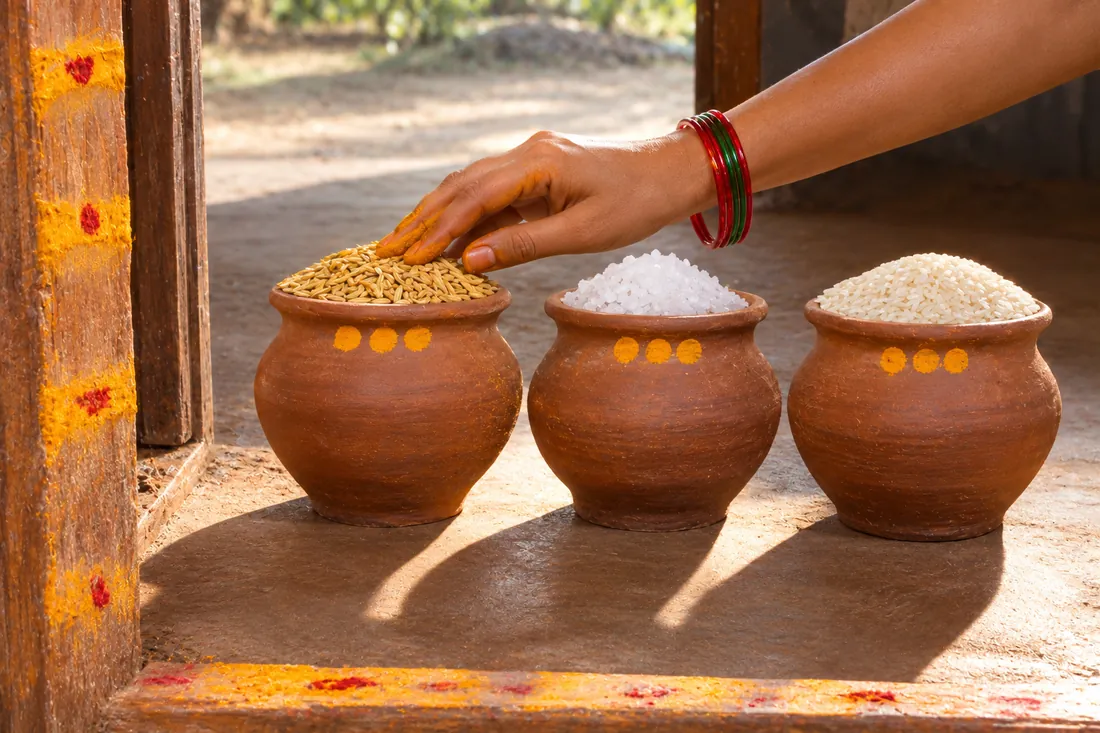
Three small earthenware pots of paddy, salt and raw rice just inside a village doorway, a bride's turmeric-stained right hand with red and green glass bangles touching the paddy

Paddy, salt and rice

Three pots stand waiting inside the house — one of paddy, one of salt and one of rice — and the bride is asked to touch them with her right hand. It is her first act in the house she is marrying into.

  • A pot of paddy
  • A pot of salt
  • A pot of rice

From the same account as the promise above. Families keep the wedding day in their own ways.

The wedding

The tali raised to the sky

One moment in an Adi Dravidar wedding is described so exactly that you can see the roof of the pandal it happens under.

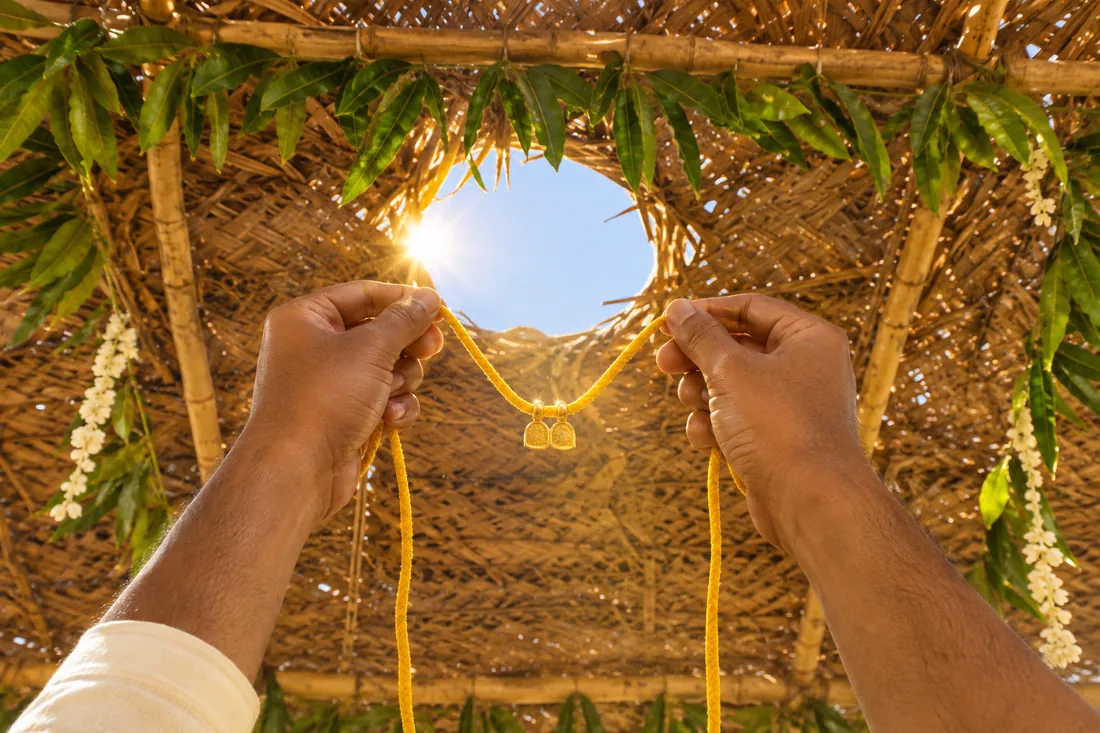
Two hands lifting a gold tali on a turmeric-yellow thread toward a round opening in a woven palm-frond pandal roof hung with mango leaves, the sky and the sun showing through

Garlanded on the dais

When the bridegroom returns from his procession round the village, the two of them sit side by side on planks on the dais, their maternal uncle garlands them with wreaths of flowers, and the bride's maternal uncle gives her a ring.

Touched by everyone first

Before it is tied, the tali goes round the whole gathering, to be touched and blessed by every person there — so that by the time it reaches the bride, it carries all of them.

Shown to the sky before it is tied

The bridegroom takes up the tali and holds it up through an opening in the roof of the pandal, to the sky or to the sun. Only when everyone present has given their leave does he tie it round the bride's neck.

  • The tali held up through the pandal roof
  • Tied only with the leave of everyone present

Three times round, with linked hands

Towards the close of the day a tray of fruit, flowers and betel passes between the two of them three times, and then they walk three times round the pandal with their hands linked. Several of these are familiar at many Tamil weddings; they are written here because these households kept them too.

The morning after, a share for everyone

The next morning the bride's relatives buy good curds, plantains, sugar and pepper and mix them together. Everyone gathers again at the pandal, and a share goes to the elder of the gathering, to the newly married couple and to every person present.

Also from that one account; practice and emphasis differ from one district and one family to another.

The goddesses of the village

The mother of each village, and her sisters

Every village keeps its own mother goddess, and the way these households speak of her is worth writing down.

Each village, its own mother

Each village holds that its own mother is not the same as the mother of the next village along — and yet all of them are sisters. It is a way of keeping a goddess entirely your own while knowing she has family everywhere.

The names a household keeps

Among the goddesses named for these households are Ellamma, Mungilamma, Padaiyattal, Pidariyamma, Gangammal and Mariyattal. They are honoured widely across the Tamil country by many households, and they are named here as goddesses these families keep, not as goddesses they hold alone.

  • Ellamma · Mungilamma · Padaiyattal
  • Pidariyamma · Gangammal · Mariyattal

Devotion is honoured here on its own terms. Nothing on this site ranks one form of it above another.

How a family is known

The deity a household keeps, and the place it comes from

When two Adi Dravidar families begin to talk, these are often among the first things they ask about.

The deity first, then the place

Two families often begin with the deity a household keeps and the place it comes from. You write the deity in your own words, and your native district sits beside it on the profile.

A place for a gotra, if your family keeps one

If your family also keeps a gotra, there is a place for it beside the deity, and leaving it empty closes nothing.

The native district

The native district is on every profile and can be searched, so a family that wants to look close to home can do so — and a family settled far away is never asked to choose between where it lives and where it comes from.

Practice differs from one district and one family to another — this is heritage held with pride, not a single rule book.

Questions families ask

Common questions from Adi Dravidar families

How is our family's lineage recorded?

By the deity your household keeps, written in your own words, with your native district beside it. If your family also keeps a gotra, there is a place for that too — and leaving it empty closes nothing.

Our family has lived in Bengaluru, or abroad, for three generations.

Then you are in the right place. Native place, the place you live now and the language spoken at home are separate parts of the profile, and none of them changes which community you belong to.

Will we only see Adi Dravidar profiles here?

Yes. Registering through this page places your profile in the Adi Dravidar community, and every profile you see, match with, or contact belongs to it. If your family belongs to another Tamil community that is sometimes called by this name, please tell us through the request option in the app — it is the kind of request that decides what we open next.

Older outside names for the community — are they used here?

No. Names that outsiders once used for the community appear nowhere on this site. Adi Dravidar is the name on every profile and in every search, and a family that also keeps an older name of its own is just as much at home here.

Will our phone number be visible to everyone?

It is not shown openly on your profile. A member who wants to take an introduction forward can see your contact through the app's Reveal Contact feature and reach you directly, and Government-ID-verified badges help you know who you are speaking with.

Next step

Register or login when your family is ready to continue

Create your account and step into the Adi Dravidar space on Sri Guru Raghavendra Matrimony, where the deity your household keeps and the district your family comes from are part of every profile from the first day — and your family sets the pace.