Sri Guru Raghavendra Matrimony™ emblem
SRI GURU RAGHAVENDRA MATRIMONY™

The potter community, across every region of India

Kumbara Matrimony

Across India the community's many names share one root — Kumbhakara, the maker of the pot. Begin a Kumbara alliance among families who already share your craft heritage, your festivals, and your way of life, with your regional sub-community honoured from the first profile.

Kannada KumbaraTelugu Kummari / SajjanaMarathi & Gujarati Kumbhar / PrajapatiTamil Kusavan / Velar

Begin when you are ready

Register now, or read about the community's heritage first

Creating an account takes a few minutes. If your family prefers to understand the space first, the sections below walk through the regional sub-communities, the heritage of the craft, Sant Gora Kumbhar, and the community's service to society.

Registrations from this page stay within the Kumbara section — every profile your family sees and contacts belongs to the community.
Shared craft heritage across India

A heritage your family carries every day

Across India the community's many names share one root — Kumbhakara, the maker of the kumbha, the earthen pot. Kannada Kumbara, Telugu Kummari, Marathi and Gujarati Kumbhar, Hindi-belt Kumhar, Tamil Kusavan and Velar, Bengali Kumbhakar: all belong to one community of potters, whose craft is among the oldest livelihoods of the subcontinent.

Many households now build their lives in farming, business, teaching, and the professions, while keeping the values their elders carried — honesty, humility, simplicity, and hard work. The potter's wheel still turns at festivals, the purna kalasha, the full pot crowned with mango leaves and a coconut, still blesses weddings and housewarmings, and families remember with pride that their craft brought auspiciousness to every celebration.

When it is time to find a life partner, families want someone who understands this heritage from within. Kumbara matrimony gathers brides and grooms from across these regions in one community space, so your search begins among people who already share your roots, your festivals, and your way of life.

What families often ask first

What families often value first

  • Profiles state regional sub-community, native place, and family background up front, so your family knows the essentials before the first conversation.
  • Filter by sub-community and native place — from Kannada Kumbara to Bengali Kumbhakar — to narrow the search to families who match your region and traditions.
  • Registrations from this page stay within the Kumbara section, so every profile your family considers belongs to the community.

What your family will find inside

Everything your family checks, before the first phone call

These are the details Kumbara households settle first — and they are visible before any contact is exchanged.

Government ID verified members stand out

Members who complete Government ID verification carry a clear mark, giving your family added reassurance at a glance.

Filter by sub-community and native place

Narrow the search by regional sub-community, native place, and family origin — whether your family says Kumbara, Kummari, Kumbhar, Prajapati, Kusavan, or Kumbhakar.

Education, work, and family background together

Degrees, professions, and family character read clearly on every profile, in the same order elders weigh an alliance.

Lineage recorded your way

Record your family's Gotra, Bali, or Kula as free text, matching how lineage is named in your region.

Contact details stay private

Phone numbers and email are not shown openly on profiles. A member uses the Reveal Contact feature to see another member's details and reach out directly when they are ready to take an introduction forward.

Interest is never lost

Shortlists and expressed interest stay saved, so your family can return to a promising profile after the household has talked it over.

Built around how Kumbara alliances actually happen

Whether your family's search stays within one region or reaches across India and beyond, the details that matter are always in view.

Why families feel at ease

Why Kumbara families feel at home

The details that decide an alliance sit together in one place, presented the way your family would present them.

A community-scoped beginning

Your search stays within the Kumbara community pool, so every introduction starts from shared craft heritage.

Every region under one roof

Regional names — Kummari, Kumbhar, Kumhar, Prajapati, Kusavan, Velar, Kumbhakar — are all at home here, each with its own sub-community option.

Comfortable for parents and members alike

Whether the search is led by a parent, a sibling, or the member themselves, the profile reads clearly for all of them.

Move at your family's pace, with tradition honoured up front and you reach out when your family is ready.

One community, many names

From Kannada Kumbara to Bengali Kumbhakar

The potter community lives in nearly every part of India, and each region carries its own name and its own micro-heritage. Knowing where your family belongs helps you search with clarity.

South India

In the south the community is found across Karnataka, Andhra, Telangana, Tamil Nadu, and the Tulu coast, where the older Sanskrit term Kulala, potter, underlies several regional names.

  • Kannada Kumbara
  • Telugu Kummari / Sajjana, tracing descent to the legendary King Salivahana
  • Tulu / Coastal Kulala / Moolya, a coastal heritage with the matrilineal Aliya Santana tradition
  • Tamil Kusavan / Velar, renowned for sacred terracotta

West and Central India

Across Maharashtra, Gujarat, Goa, Konkan, Rajasthan, and the central states, many families honourably call themselves Prajapati.

  • Marathi Kumbhar
  • Konkani Kumbhar
  • Gujarati Prajapati
  • Rajasthani Kumhar / Prajapat
  • Central India Kumhar

North and East India

Through the Hindi belt and into the east, the community is known as Kumhar and Kumbhakar, with a living artisan legacy in Bengal's heritage clay quarters.

  • Hindi-belt Kumhar (UP / Bihar)
  • Jharkhand Kumhar
  • Punjab / Haryana Kumhar
  • Odia Kumbhar
  • Bengali Kumbhakar, the Pal families of Kumortuli and Bankura

If your family's name or region is not listed separately, Other Kumbara keeps you within the same community space.

A heritage of making

Makers of form from clay

Because the potter shapes form from formless clay, families across regions see their craft as a small echo of the creator's own work — a proud, faith-affirming heritage.

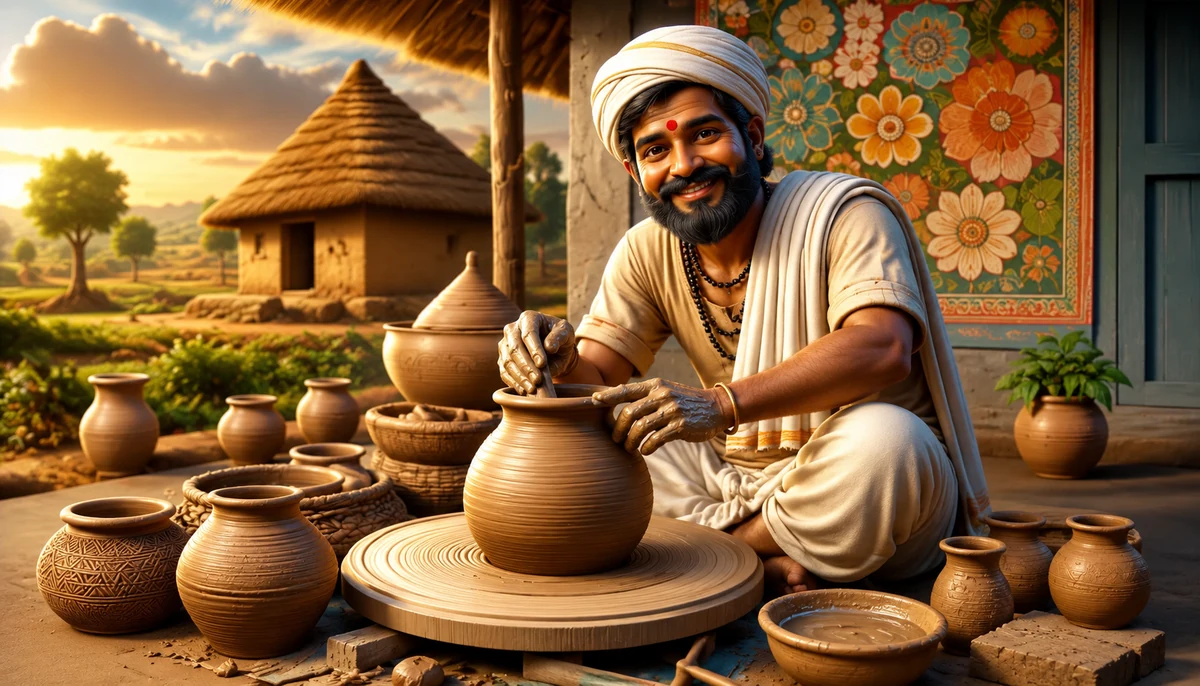
A village potter shaping clay on the wheel — the craft at the heart of the Kumbara community

Descendants of Prajapati

Many northern and western families honour the name Prajapati, after the creator. A beloved tradition tells of a potter, absorbed in his craft, who alone could offer the full sugarcane plant, and was blessed with the title lord of creation.

The line of Kulalan

In the southern Kulala and Velar tradition, families trace descent from Kulalan, said to be a son of Brahma, granted the potter's craft and the gift of shaping new vessels each day.

The pot at every celebration

The purna kalasha blesses weddings and housewarmings, brides carry rice-filled pots of prosperity into a new home, and the earthen diya lights every Deepavali. The potter has long been a quiet giver of auspiciousness.

Honest, humble, hardworking

Across regions families describe themselves in the same warm terms — honesty, humility, simplicity, and hard work — captured in the saying sab mitti hai, in the end, all is clay.

Remembered with reverence

Sant Gora Kumbhar — the saint-potter of the Varkari tradition

The community's most beloved spiritual figure is Sant Gora Kumbhar, lovingly Goroba Kaka — a potter-saint of the Varkari sect of the Bhakti movement in Maharashtra, traditionally dated to around 1267–1317 CE. A potter of Ter, in present-day Dharashiv district, and a devotee of Vithoba of Pandharpur, he was a companion of Sant Namdev and, tradition holds, of the formative generation of Varkari saints in the age of Dnyaneshwar. He composed Marathi abhangs, devotional verses, and taught that humility and devotion matter more than birth — the devotee, he said, is clay to be shaped by the divine.

Devotion through the craft

Gora Kumbhar saw his everyday work at the wheel as worship. His paduka, sacred sandals, are still carried in the annual Pandharpur Wari pilgrimage, and his life has been honoured in films across many languages, including the Kannada classic Bhakta Kumbara.

The unbaked pot — a legend the tradition treasures

Tradition relates that when the great saints gathered at his home, Gora was asked — as the potter who knows his pots — to tell which of them were spiritually ripe. Tapping each head gently with his potter's rod, he pronounced Sant Namdev the one pot still unbaked, a moment tradition credits with spurring Namdev's deeper spiritual quest. Gora's samadhi at Ter remains a living pilgrimage site, honoured each year with a fair of bhajan and kirtan.

Vishwakarma and the potter's wheel

Like other artisan families, potters revere Vishwakarma, the divine craftsman. Many observe Vishwakarma Puja and Ayudha Puja, when the wheel, the chaak, and the tools are honoured as instruments of a god-given craft.

This tribute is shared with reverence and gratitude alone. No endorsement, affiliation, or sponsorship by any saint, deity, temple, tradition, or institution is implied. These names are part of the community's shared heritage.

Service to society

The hands that light India's festivals

From the diya at the door to the idol at the heart of a festival, the Kumbara have shaped the objects of India's celebrations and rites for centuries — a quiet, everyday service the whole country shares in.

Makers of the sacred image

Bengal's Kumbhakar families of Kumortuli sculpt the clay idols of Durga and her children for the great pujas — a tradition tied to a Durga Puja now inscribed on UNESCO's list of the intangible cultural heritage of humanity. In Tamil Nadu, the Velar and Kusavan potters craft the towering terracotta horses offered to the village guardian Ayyanar.

Honoured master potters

The nation has recognised the community's artists with the Padma Shri — among them Mohan Lal Kumhar of Molela in Rajasthan, V. K. Munusamy of Tamil Nadu, and Binod Maharana of Odisha, who carried their terracotta traditions to national and international acclaim.

The lamp-lighters of every festival

The diyas of Deepavali, the matka that keeps water cool through summer, the kalasha at every wedding — the everyday work of the Kumbara furnishes the festivals and rites of millions of homes, season after season.

These artists and traditions are recalled with gratitude and pride, as shared community heritage. No ranking of any community is intended.

Questions families ask

Common questions from Kumbara families

We are Kummari, Prajapati, Kumbhar, or Kumbhakar — is this the right place for us?

Yes. Kumbara matrimony is one pan-India space for the whole potter community. Kummari, Prajapati, Kumbhakar, Kumhar, Kumbhar, Kusavan, and Velar are all regional names of the same community, and each has its own sub-community option when you register.

Can we search only within our own regional sub-community?

Yes. You can filter by sub-community, native place, and family origin — from Kannada Kumbara to Bengali Kumbhakar — so your matches stay close to your region and traditions.

How is our family's lineage recorded?

Lineage is a free-text field, so you can enter your Gotra, Bali, or Kula exactly as it is named in your region.

Will our phone number be visible to everyone?

It is not shown openly on your profile. A member who wants to take an introduction forward can see your contact through the app's Reveal Contact feature and reach you directly, and Government-ID-verified badges help you know who you are speaking with.

Next step

Register or login when your family is ready to continue

Create your account and step into the Kumbara section of Sri Guru Raghavendra Matrimony, where your regional sub-community, lineage, and family background are part of every profile — and your family sets the pace.