Sri Guru Raghavendra Matrimony™ emblem
SRI GURU RAGHAVENDRA MATRIMONY™

Jhulelal, the river, and the family name

Sindhi Matrimony

Sindh takes its name from the Sindhu, the river the world calls the Indus, and many Sindhi families keep the river close wherever they live — in Jhulelal, seated on its waters, and in Cheti Chand, the new year kept at the first moon of Chet. The Sindhi families this page is for live in Ulhasnagar, Mumbai and Pune, in Gandhidham, Adipur, Ahmedabad and Vadodara, and in towns across India and beyond — and this page begins with the river, then the name a family carries, the nukh, and the part of Sindh a family's people knew as home.

Sindhi

Begin when you are ready

Register now, or read about Sindhi heritage first

Creating an account takes a few minutes. If your family prefers to understand the space first, the sections below walk through the river and the name, Jhulelal, Cheti Chand and the Bahrana Sahib, how a Sindhi family is known, misri and the hathialo, and the college and the towns the community built.

Registrations from this page stay within the Sindhi community — every profile your family sees and contacts belongs to it.

The river, the new moon, the name

A heritage your family carries every day

The river gave Sindh its name, and the same word, carried west through Persian and Greek, gave India its name too.

Sindhi families have made their homes across India — Ulhasnagar and Mumbai, Pune, Gandhidham and Adipur, Ahmedabad and Vadodara, Jaipur, Ajmer, Bhopal and Indore — and built colleges in Mumbai and two towns in Kutch of their own.

So an alliance here begins with what a Sindhi household names first — where in Sindh its people came from, and the nukh if it keeps one — with the dignity your family expects.

What families often ask first

What families often value first

  • Sindhi families meet here as one community — Amil, Bhaiband, Sahiti, or any other name your family uses.
  • The place in Sindh your elders came from, and your nukh if your family keeps one, sit on your profile, each in your own words.
  • Search by native place across Thane, Mumbai City and Mumbai Suburban, Pune, Kutch, Ahmedabad, Vadodara, Jaipur, Ajmer, Bhopal, Indore and beyond.

What your family will find inside

Where in Sindh your family comes from, and the nukh if you keep one

These are the details Sindhi households settle first — and they are visible before any contact is exchanged.

Government ID verified members stand out

Members who complete Government ID verification carry a clear mark, giving your family added reassurance at a glance.

Your nukh, in your own words

A Sindhi profile carries the nukh if your family keeps one, written the way your family writes it. Your full family name is shared once contact is revealed.

Filter by native place and family origin

Narrow the search by native place — Thane, Mumbai City, Mumbai Suburban, Pune, Kutch, Ahmedabad, Vadodara, Jaipur, Ajmer, Bhopal, Indore, Lucknow and many more.

Education, work, and family background together

Degrees, professions, and family character read clearly on every profile, in the same order elders weigh an alliance.

Contact details are not shown openly

Phone numbers and email are not shown openly on profiles. A member uses the Reveal Contact feature to see another member's details and reach out directly when they are ready to take an introduction forward.

Interest is never lost

Shortlists and the profiles your family has already opened stay saved, so you can return to a promising profile after the household has talked it over.

Built around how Sindhi alliances actually happen

Whether your family hopes for a household from its own part of Sindh or looks more widely, in Ulhasnagar or Gandhidham, in Pune or far beyond, the nukh and where a family's elders came from are there to read on every profile that names them.

Why families feel at ease

Why Sindhi families feel at home

The details that decide an alliance sit together in one place, presented the way your family would present them.

Whatever name your family uses

Amil, Bhaiband and Sahiti families, and Sindhi households of any other name, meet here as one community. Your family can write the name it uses on its profile, and read how every other family describes itself.

Where in Sindh your people lived

Many Sindhi families still know each other as Shikarpuri or Hyderabadi, or by another town their people knew in Sindh. There is room for it on your profile, whether your family now lives in Ulhasnagar or far beyond it.

Comfortable for parents and members alike

Whether the search is led by a parent, a sibling, or the member themselves, the profile reads clearly for all of them.

Move at your family's pace, with tradition honoured up front and you reach out when your family is ready.

The river and the name

Named for the Sindhu

Before Jhulelal, before the family name, there is the river, and the river is where a Sindhi family's story begins.

Sindh, the Sindhu and India

Sindhu is the river's old Sanskrit name; the world knows it as the Indus. Sindh is named for it, and the same word, passing west through Persian and Greek and on into Latin, became the name India.

Homes across India

Sindhi families live across the country — in Ulhasnagar in Thane district, in Gandhidham and Adipur in Kutch, in Mumbai and Pune, Ahmedabad and Vadodara, Jaipur and Ajmer, Bhopal, Indore and Lucknow — towns where a Sindhi family can still hear its own language in the market.

Native place on the profile is always a district in India, so for most Sindhi families it is the one they now call home; the town in Sindh your elders came from is written beside it.

The god of the river

Jhulelal

For many Sindhi families today, the river has a face, and it is Jhulelal's.

A devotional painting of Jhulelal seated on a lotus over a silver river fish at dawn, his hand raised in blessing, as Sindhi families picture the god of the river

As families know him

Jhulelal is pictured as a white-bearded figure seated cross-legged on a lotus spread over the back of a palla fish, crowned, with a peacock feather at the crown's top. By tradition he was born at Nasarpur in Sindh, on the new-year day of Chet, and families also call him Uderolal, Amarlal and Darya Lal.

One name, more than one meaning

The name Jhulelal is explained in more than one way — a cradle that rocked by itself, a lullaby the women sang to the child, the rise and swell of the river's own waves. The accounts differ, and each family tells the one it grew up with.

Water and light

The river is honoured in two forms, water and light. A lamp is kept burning, and akho, an offering of rice and grain, is given to the water — at a river or a canal, at a well, or even before a jar of water at home.

The devotion a home keeps

Each Sindhi home keeps its own devotion — for many families that includes reverence for Guru Nanak's teachings — and nothing on this site assumes one for you.

Devotion is honoured here on its own terms. Nothing on this site ranks one form of it above another.

Days kept by the water

Cheti Chand, the Bahrana Sahib and Chaliho

At the new year and through the flood season, the river comes into the household's calendar.

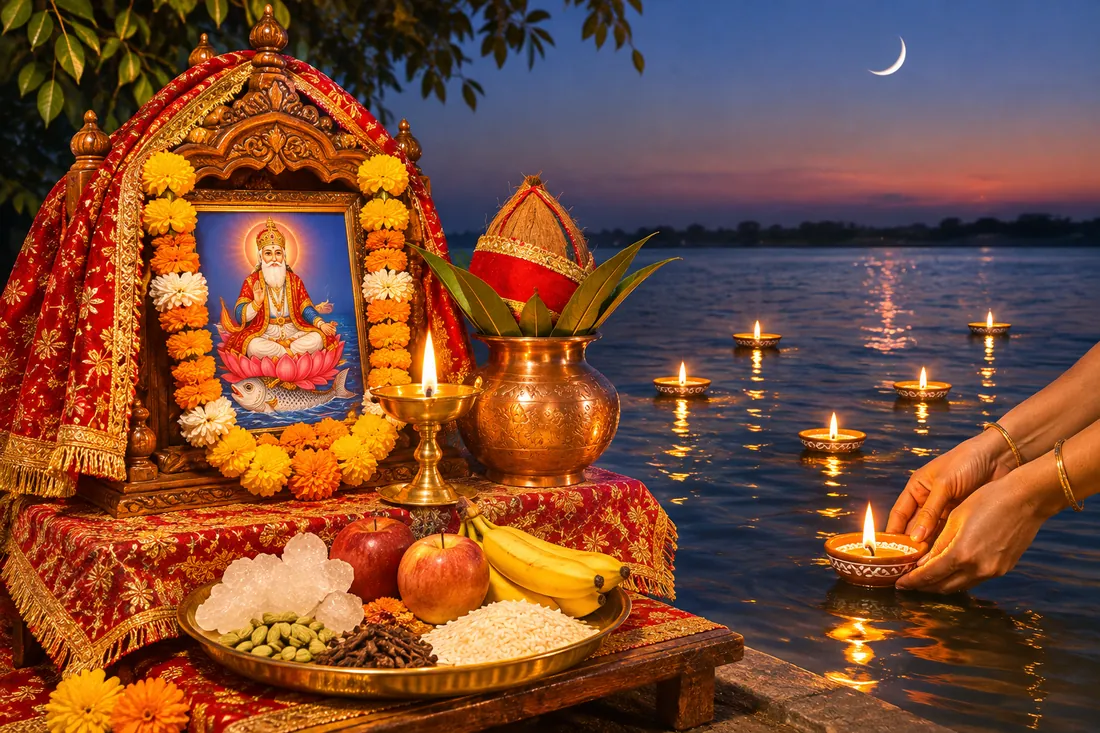
The Bahrana Sahib at the river's edge on Cheti Chand — a lamp, misri, cardamom, fruit and a coconut-crowned kalash, and small lamps set afloat on the water at evening

Cheti Chand

Cheti Chand is the Sindhi new year and Jhulelal's birthday, kept together at the first moon of Chet, the month of Chaitra.

The Bahrana Sahib

At Cheti Chand, and on other days kept for the river god, his image is set in a small temple of its own with a lamp burning inside, and carried in procession with music, songs and dance to the river or the sea, where it is given to the water as evening comes.

Chaliho

Chaliho is the festival of the forty days of the flood, kept in the monsoon. An account of Sindhi customs written in 1959 begins it at the full moon of Akhar, and temples and families today keep their own dates. Offerings of grain are made at the water, and on the last day an earthen pot holding forty kinds of food, crowned with a coconut and hung with cloves, cardamoms and mango leaves, is carried to the water and given to it.

Each family keeps these days in its own way, at a river, by the sea, or at home.

The name, the nukh, the place

The family name, the nukh and the place in Sindh

Ask a Sindhi family who they are and the answer usually begins with the family name.

A name that remembers

Many Sindhi family names end in -ani, added to an ancestor's name or to the place the family once lived — so the name itself remembers where the family began.

The nukh

Beside the family name, a household may also keep a nukh, the line Sindhi families have traditionally married away from. If your family keeps one, it sits on the profile in your own words.

The place in Sindh

Many families still know themselves by the town or village in Sindh their elders came from — Hyderabad, Shikarpur, Larkana, Sukkur, Sehwan, Thatta — or by a region such as the Sahiti country. If your family also names itself Amil, Bhaiband or Sahiti, or keeps a gotra, there is a place for that too, and you may leave any of it blank.

Practice differs from one town and one family to another — this is heritage held with pride, not a single rule book.

The wedding

Misri first, then the hathialo

The same 1959 account sets the wedding down step by step. These are some of its steps, in the order it gives them.

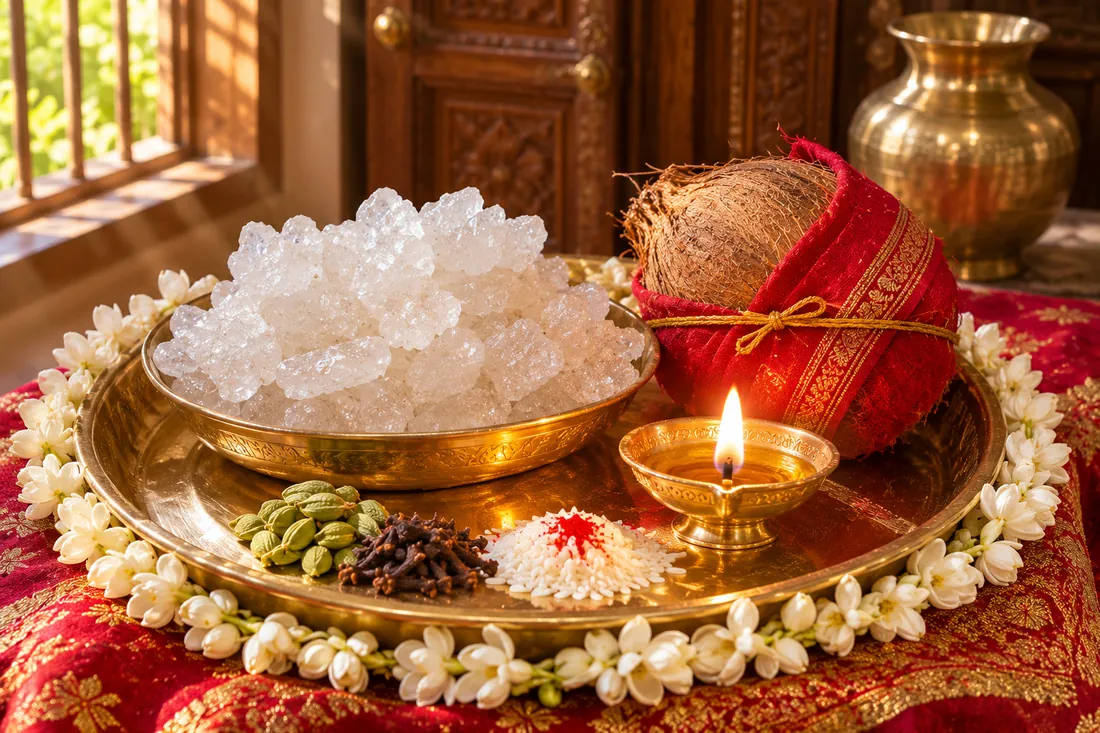
A brass tray of misri, a coconut wrapped in red cloth and a lit lamp — the sugar candy that seals a Sindhi betrothal

Misri

A tray of misri, sugar candy, goes from one family to the other, and once it has been accepted and the sugar candy eaten, the betrothal is complete.

The ladas, sung at night

From the new moon of the wedding month, the women of the neighbourhood gather at night to sing the ladas, the marriage songs, to the beat of a large brass plate or a drum, and every visitor goes home with sugar.

The millstone and the oil

A few days before the wedding, the women gather round the house millstone in the evening, and each of them, the bride or groom too, puts in a handful of wheat and grinds it, singing. Later the bride or groom dips all ten fingers in a pot of oil and touches them to the head three times, and every relative drops a coin into the pot and anoints the head in turn.

Hathialo and phera

The couple's hands are joined, the corners of their garments are tied together, and they walk four times round the fire. The joining of hands, the hathialo, and the rounds of the fire, the phera, are the heart of the marriage. When the bride first comes to her new home, a lamp in an earthen cover is held over her head at the threshold.

The day after

On the day after the wedding, the groom's mother feeds both of them seven mouthfuls of rice, sugar and milk mixed together.

Families keep the wedding in their own ways today — this is heritage held with pride, not a single rule book.

Places to study, places to live

A college in Bandra, two towns in Kutch

Some of the most lasting things Sindhi families made in India were places to study and places to live.

A college in Bandra, 1949

In June 1949 the R. D. National College opened in Bandra, begun by the principal of a college in Hyderabad, in Sindh, with gifts from Sindhi families. The board behind both colleges, the Hyderabad (Sind) National Collegiate Board, went on to K. C. College at Churchgate, H. R. College, colleges of law and engineering, and colleges in Ulhasnagar.

Two towns in Kutch

In 1948 Sindhi families formed a company of their own, the Sindhu Resettlement Corporation, and on land the Maharao of Kutch gave, they planned and built two towns, Gandhidham and Adipur.

The dates and names here are the institutions' own.

Questions families ask

Common questions from Sindhi families

Will we only see Sindhi profiles here?

Yes. Registering through this page places your profile in the Sindhi community — Amil, Bhaiband and Sahiti families, and Sindhi households of any other name — and every profile you see, match with, or contact belongs to it.

How is our family's lineage recorded?

Many Sindhi family names carry an ancestor's name, so the name itself remembers whose family you are; your family name is shared in full once contact is revealed. On the profile you can write your nukh, the line Sindhi families have traditionally married away from, and the place in Sindh your elders came from. If your family also names itself Amil, Bhaiband or Sahiti, or keeps a gotra, there is a place for that too. Each is written in your own words, and you may leave any of it blank.

We are Amil (or Bhaiband, or Sahiti). Is this our page?

Yes. Amil, Bhaiband and Sahiti families, and Sindhi households of any other name, are one community here. If your family uses one of these names, write it on your profile in your own words, and it will be there for every family that reads it.

We are Lohana. Is this our page?

If your family is Sindhi, yes — many Sindhi households carry the Lohana name, and you can write it on your profile. Lohana is also a name many Gujarati and Kutchi families carry, and Gujarati- and Kutchi-speaking Lohana families have a page of their own here.

Will our phone number be visible to everyone?

It is not shown openly on your profile. A member who wants to take an introduction forward can see your contact through the app's Reveal Contact feature and reach you directly, and Government-ID-verified badges help you know who you are speaking with.

Next step

Register or login when your family is ready to continue

Create your account and step into the Sindhi space on Sri Guru Raghavendra Matrimony, where your family's place in Sindh, and your nukh if you keep one, can sit on your profile from the first day — and your family sets the pace.