Sri Guru Raghavendra Matrimony™ emblem
SRI GURU RAGHAVENDRA MATRIMONY™

The people of the salt earth, and of the tanks

Uppara / Sagara Matrimony

This is a community with several names and one story. Uppara and Uppaliga both mean the people who made salt from the earth; Melusakkare is their own gentler word for it; Kerebandiyavaru remembers the tanks they were trusted to keep; and Sagara is the emperor whose descendants they hold themselves to be. Families that answer to any of these belong here, and the page begins where a household begins — with the bedagu, the family deity and the town it is from.

Uppara (Uppar, Uppera)SagaraUppaliga (Uppaliyan)Melusakkare (Melusakkareyavaru)

Begin when you are ready

Register now, or read about the Uppara and Sagara heritage first

Creating an account takes a few minutes. If your family prefers to understand the space first, the sections below walk through the names the community answers to, the descent from Sagara, the uppinamole and the feast-day puja, Channakeshava, and how a family records its bedagu.

Registrations from this page stay within the Uppara and Sagara community — every profile your family sees and contacts belongs to it.
Many names, one community

A heritage your family carries every day

The Uppara and Sagara households are spread across Karnataka — Mysuru, Chitradurga, Tumakuru, Kolar, Hassan, Shivamogga, Davanagere, Ballari and Bengaluru — and east into Telangana and Andhra Pradesh, where the same families are more often called Sagara. In the older Kolar and Bengaluru households Telugu is spoken at home; across most of the rest of Karnataka it is Kannada, and both are the community's own.

What the old records keep returning to is a mound of earth. Salt was drawn from saline soil on round mounds with a lime-plastered cup at the crown, channels running down to a reservoir and shallow pans to take the sun. The same families were entrusted with the repair of village tanks, which is what Kerebandiyavaru means, and they generally held inam land for it — the work of keeping a village in salt and in water.

So an alliance here begins with what a household names first: its bedagu, the family deity it keeps, the language spoken at home and the town it calls its own — with the dignity your family expects.

What families often ask first

What families often value first

  • Your bedagu — the line your family marries away from — is written the way your family says it, and never guessed from a surname.
  • The family deity your household keeps, and the language spoken at home, sit on every profile.
  • Search by native place across Mysuru, Chitradurga, Tumakuru, Kolar, Hassan, Shivamogga, Davanagere, Ballari, Nalgonda, Nizamabad, Anantapur, Kurnool and beyond.

What your family will find inside

Everything your family checks, before the first phone call

These are the details Uppara and Sagara households settle first — and they are visible before any contact is exchanged.

Government ID verified members stand out

Members who complete Government ID verification carry a clear mark, giving your family added reassurance at a glance.

Every name the community answers to, in one place

Uppara, Sagara, Uppaliga, Melusakkare, Sunnagara, Kerebandiyavaru — a family searching for the name it grew up with finds its way here, whichever of them that is.

Filter by native place and family origin

Narrow the search by native place — Mysuru, Chitradurga, Tumakuru, Kolar, Hassan, Shivamogga, Davanagere, Ballari, Nalgonda, Nizamabad, Anantapur, Kurnool and many more.

Education, work, and family background together

Degrees, professions, and family character read clearly on every profile, in the same order elders weigh an alliance.

Contact details are not shown openly

Phone numbers and email are not shown openly on profiles. A member uses the Reveal Contact feature to see another member's details and reach out directly when they are ready to take an introduction forward.

Interest is never lost

Shortlists and the profiles your family has already opened stay saved, so you can return to a promising profile after the household has talked it over.

Built around how Uppara and Sagara alliances actually happen

Whether your family looks within its own circle of towns and its own language, or further afield among households whose customs sit well with yours, the details that decide it — the bedagu, the family deity, the language and the native town — are always in view.

Why families feel at ease

Why Uppara and Sagara families feel at home

The details that decide an alliance sit together in one place, presented the way your family would present them.

One community, and every name it goes by

A household in Mysuru may say Uppaliga, one in Chitradurga Melusakkare, one in Nalgonda Sagara. They are not being sorted into different groups here. The name your family uses is on your profile, and so is the town and the language, so a household that wants to look within a familiar circle can see at a glance where a family is from.

Your language is on the profile, not assumed

Kannada in most of Karnataka, Telugu in the older Kolar and Bengaluru households and across Telangana and Andhra. Neither is treated as the default, and a family that would rather match within its own can simply see which is which.

Comfortable for parents and members alike

Whether the search is led by a parent, a sibling, or the member themselves, the profile reads clearly for all of them.

Move at your family's pace, with tradition honoured up front and you reach out when your family is ready.

The names and what each one remembers

Uppara, Sagara, Melusakkare, Kerebandiyavaru

Few communities carry as many names as this one, and each of them remembers a different thing about the same people. They are worth knowing, because a family searching for the name it grew up with should not have to guess.

The names that mean salt

Uppara and Uppaliga both come from uppu, salt, and both simply mean the people who made it. Melusakkare is the community's own word for the same thing — it means the finer sugar, and it was used the way a household uses a kinder word for its own work. Melusakkareyavaru, the people of the melusakkare, is what they have long called themselves.

  • Uppara, Uppar, Uppera — Kannada
  • Uppaliga, Uppaliyan, Uppaligar — Mysuru and southward
  • Melusakkare, Melusakkareyavaru — the community's own name for itself
  • Sunnagara, Sunna Uppara — the households that burned lime
  • Namada Uppara, Kallukutiga Uppara — older trade names still carried

Sagara, the name of the descent

In formal correspondence the community has long addressed its own as Sagaravamsa — those of the line of Sagara. East of the Karnataka border the name has simply become the everyday one, which is why a family in Nalgonda or Nizamabad will say Sagara where a family in Chitradurga says Uppara. The tradition behind the name is in the next section.

Kerebandiyavaru, the tank-keepers

Kere is a tank and bandi is a cart. The name was given because these households were entrusted with the repair of the village tanks, and generally held inam land in return for it. In a dry country that is not a small thing to have been trusted with, and it is the reason the name is still spoken with some pride.

Families of the Lingayat observance

Some households of this community keep the Lingayat observance and are known as Lingayat Uppara. That name will bring a family to this page, and the Veerashaiva Lingayat community has a page of its own here as well. Which of the two your family registers under is your household's own decision, and both are open to you.

Names that belong to other families

A few names are spoken in the same breath as this one but belong to families with their own name and their own story — Lonari, Beldar and the Gavandi families among them, and Vaddar and Bhovi households, who are a community of their own. We would not gather them in here without asking them first. If your family answers to one of those, please do let us know through the request option in the app; it is the kind of request that decides what we open next.

Practice and emphasis differ from one town, one language and one family network to another — this is heritage held with pride, not a single rule book.

The descent the community keeps

Sagara, and the river that came down

Two accounts of this community's beginning are recorded, and neither cancels the other. Both are held as tradition, and both are about salt.

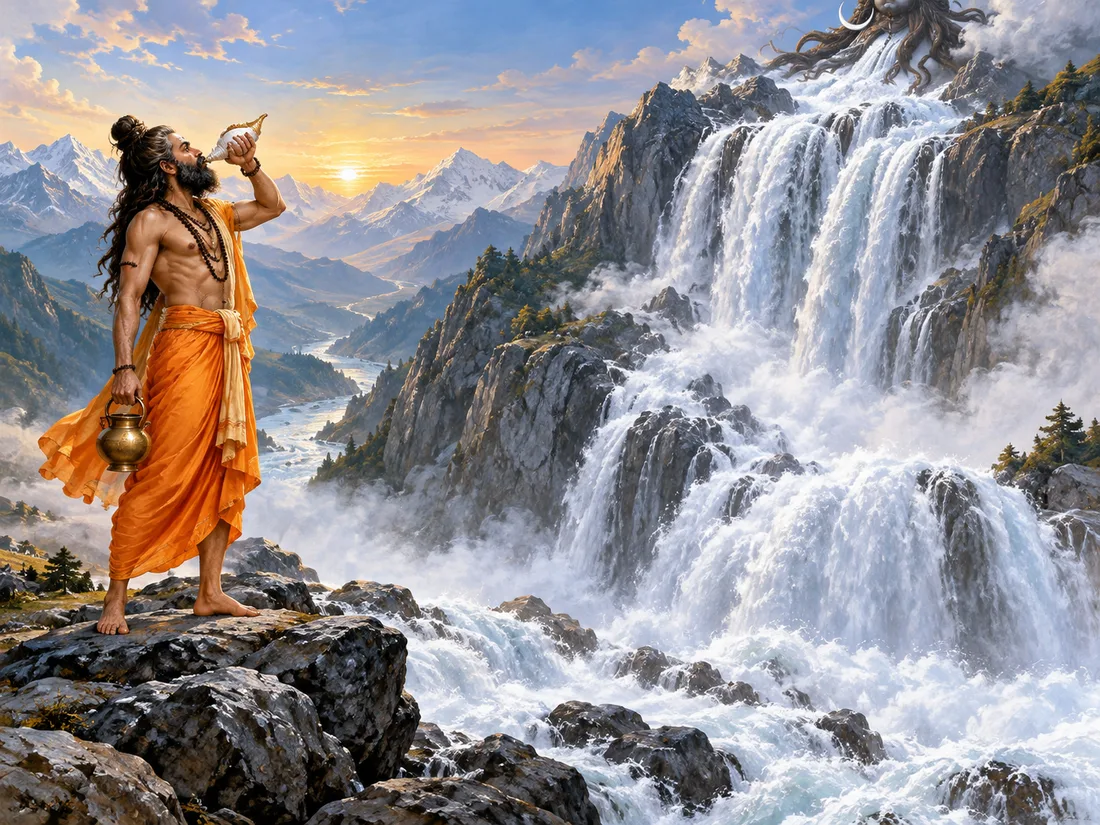
Bhagiratha sounding the conch at the moment the Ganga reaches the earth from Shiva's matted hair, the tradition Uppara and Sagara households keep as the story of their own descent

The sons of Emperor Sagara

By tradition these households descend from the sons of Emperor Sagara, who dug down into the earth searching for their father's sacrificial horse and were undone by a rishi's curse for the wrong they did him. The ashes lay until Bhagiratha, born long after into the same line, brought the Ganga down from Shiva's hair so that the water might reach them and give them rest. Both halves are held as tradition — the sons who dug, and the river that came for them.

  • Sagaravamsa, the line of Sagara, in the community's formal address
  • Bhagiratha, of the same line, who brought the river down
  • The Ganga, worshipped by name at the river before a wedding

The drop of sweat

The other account is gentler. Parvati found that food had no taste in it, and said so; and from a drop of Shiva's own sweat a man was made and given the work of drawing salt out of the earth, so that what was cooked would taste of something. His children were told to keep that work. It is a small story for a large thing — that a household's trade began because a table was flat without it.

The road south

The community's own tradition is that these families lived first in the country around Kasi, and came south by way of Ratnagiri and Dharmavaram before settling through the old Mysore country. They are remembered as having carried their god with them.

Both accounts are the community's own tradition, set down here as tradition — held with reverence, and never as a claim over anyone.

The work, and the mound it was done on

The uppinamole, and why it is worshipped

The mound the salt was drawn on is what the old accounts describe most carefully, and it is among the things these households are recorded as worshipping. That a working place was also kept as a place of prayer is worth saying plainly.

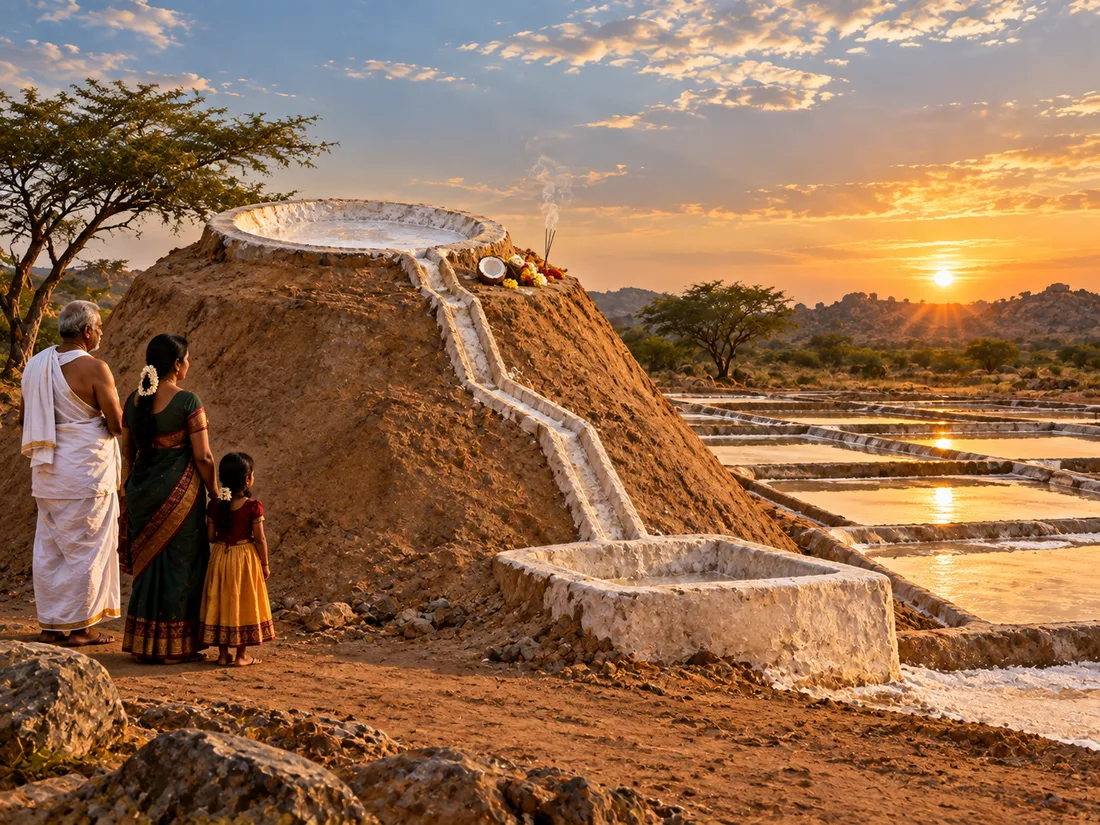
Three generations of an Uppara family standing before an uppinamole on a feast day, with incense burning and a coconut and flowers set at the lime-plastered cup on its crown

How the salt was made

Round mounds of earth stood with a cup cut into the crown, about five feet across and two deep, its sides and bottom plastered with lime. In the dry season saline earth was gathered wherever it was found and carried to the mounds on buffaloes, laid in on a bed of straw, and watered. The brine ran down open channels to a plastered reservoir, and from there into shallow pans about three feet square, where the sun finished the work.

  • Uppinamole — the saline heap, the mound itself
  • The cup at the crown, plastered with lime
  • Open channels to a reservoir lower down
  • Shallow pans, and the sun

The mound is a place of worship

The mounds they made their salt on are the objects of their worship: on the important feast days families go out to them, burn incense, break a coconut and offer puja there. A working place, kept as a shrine — the same earth twice over.

  • Incense burned at the mound
  • A coconut broken, and puja offered
  • Kept on the important feast days

When the salt work ended

The making of earth-salt was prohibited outright in British India in 1880, and it fell away here too until almost nothing of it was left. The households turned to what was near: farming, brick and stone and building work, contracting in the larger towns, and in Shimoga some took to kitchen gardening. The mounds stayed where they were, and the feast-day walk out to them stayed too.

Heritage is remembered here for its own sake. No trade, past or present, places any family above or below another on this site.

Faith in the house

Channakeshava, and the deity a family keeps

Most Uppara and Sagara households stand in the Vaishnava tradition, and many also keep Shiva; a good number name Shiva as the deity of the house. Both sit comfortably in the same community and always have.

Channakeshava

He is the community's own god, carried south with the families by their own account and given temples where they settled. A household that names him on its profile is saying something a family on the other side will recognise at once.

The places families go

Tirupati, Kadiri and Nanjangud are the pilgrimages these households have kept longest — two of them Vaishnava, one of them Shiva's, which is the community's faith in miniature.

  • Tirupati
  • Kadiri
  • Nanjangud

The year as it is kept

Ugadi at the turn of the year, Gauri and Ganesha together, Dasara and Deepavali. On Shivaratri the fast is kept until the evening. Alongside these the village goddesses are honoured as they are across this country — Durgamma, Yellamma, Maramma, Sunkalamma — and which of them a house keeps usually depends on where that house is from.

Naming the deity of the house

There is a place on the profile for your family deity, written the way your family says the name. It is there because it is often the first thing two households discover they have in common, and it is never required.

Every tradition named here is honoured on its own terms. Nothing on this site ranks one form of devotion above another.

How a marriage is guarded

The bedagu, and the line a family marries away from

The rule is the one this community has always kept: a household marries away from its own line. What that line is called, and what the names sound like, is worth knowing before you fill anything in.

Bedagu, also called kula

The exogamous lines of this community are called bedagus, or kulas, and they are reckoned through the father. Two families of the same bedagu do not marry. There is no list to pick from here, because no printed list ever held every household's name — you write yours the way your family says it, and that is the whole of it.

The names are of living things

A bedagu is usually named for a plant, an animal or some other object, which that line does not cut, eat or put to use. The old registers hold names like Mallige for jasmine, Arasina for turmeric, Belli for silver, Ane for the elephant, Kottumbari for coriander, Kenda for a burning cinder, Chilume for a spring of water. If your family's name is one of these, it is a very old thing to be carrying.

  • Mallige — jasmine
  • Arasina — turmeric
  • Belli — silver
  • Ane — elephant
  • Kottumbari — coriander
  • Kenda — a burning cinder
  • Chilume — a spring of water

If your family keeps a gothram instead

Telugu-speaking Sagara households often reckon a rishi gothram and keep an intiperu, the house name, beside it. That is not a different community and it is not a mistake — write the gothram and the house name the way your family says them, in the same place. Most households name a bedagu; if yours names a gothram, there is room for it.

Your language and your own circle of towns

Many families look first within a familiar circle of towns, and among households that speak what they speak at home. Both the language and the native place are on every profile for that reason, and how wide to look stays your family's decision.

Nothing here is assumed from a surname, and nothing is assumed from silence. You may leave any of these blank.

The wedding, day by day

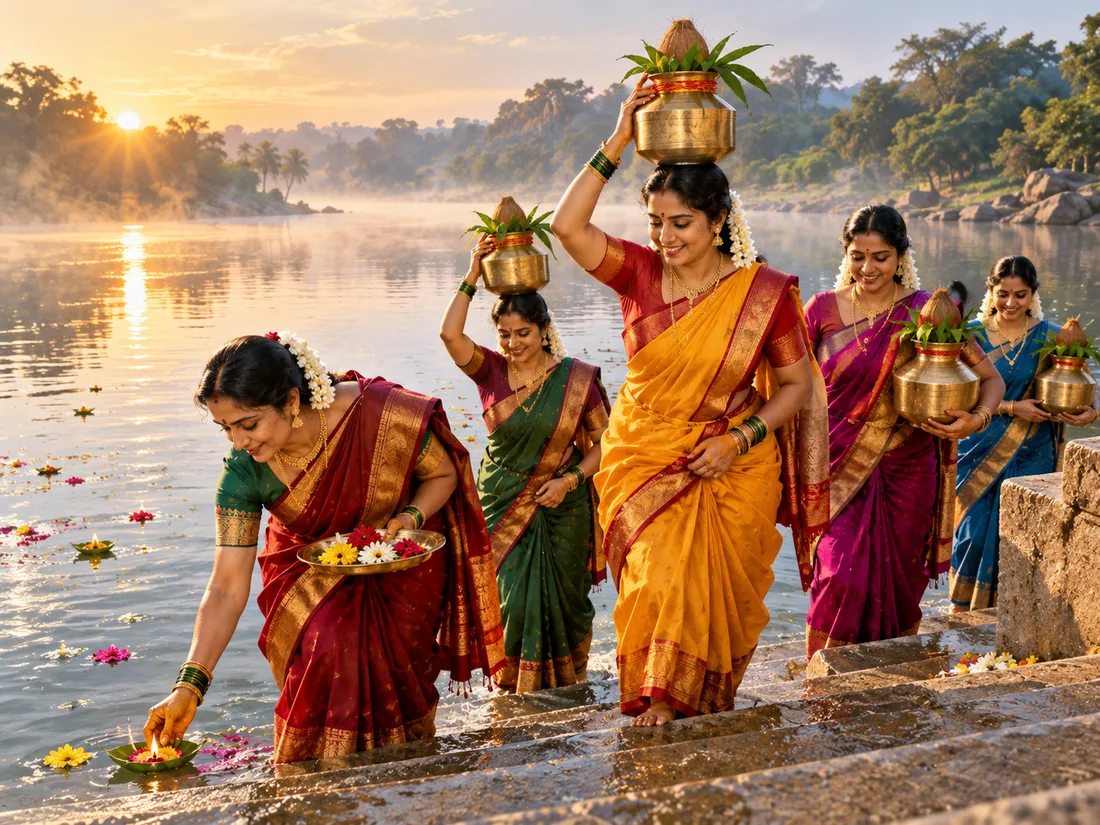
Sastrada Niru, the water fetched from the river

An Uppara wedding is set down day by day in the old accounts, and water fetched from the river runs right through it.

Married women of an Uppara household carrying brass pots of Sastrada Niru up the river steps at dawn after worshipping Ganga, the ceremonial water used for the wedding day's cooking

The water, and who fetches it

On the day the marriage pandal goes up, a party of married women walks out to the river. They worship Ganga there, and carry back water called Sastrada Niru — the water of the rite — and that day's food is cooked with it. The women who go are not volunteers: when the day is fixed, the people who will fetch the water are named, along with everyone else who has a part. A family that has come down from Sagara sends its women to the Ganga on the morning of a wedding. Nobody had to explain that twice.

  • Sastrada Niru — the water of the rite
  • Ganga worshipped at the river before it is drawn
  • Named in advance, along with the rest of the wedding parts
  • Fetched again on the nagavali day, by the couple themselves

The days of it

The first day is Madavaniga Sastra, when the turmeric is put on. The second is Chappara, when the pandal is raised on its twelve pillars with the milk-post at the centre and the ariveni pots brought into the house. Then comes the dhare, which these households keep in the evening. On the nagavali day the couple go down to the river themselves, worship Ganga and bring back two pots of water for the day's cooking.

Around the milk-post

Their garments knotted together, the couple go three times round the milk-post, the bridegroom leading the bride by the hand. They look up for the star Arundhati, as households across this country do, and then go in to the ariveni pots and bow to them. The uncle on the mother's side lifts the bhashingas from their foreheads, and the family sits down to eat.

Customs vary from one town and one household to another, and none of this is a test anyone has to pass. It is set down so that two families reading it recognise each other.

Questions families ask

Common questions from Uppara / Sagara families

Will we only see Uppara and Sagara profiles here?

Yes. Registering through this page places your profile in the Uppara and Sagara community, and every profile you see, match with, or contact belongs to it. Your native town, the language spoken at home and your family's own bedagu are on the profile, so a household that wants to look within a familiar circle can see at a glance where a family is from.

We say Melusakkare (or Uppaliga, or Kerebandiyavaru, or Sagara). Is this our page?

It is. These are names for one community, not names for different ones — Uppara and Uppaliga mean the people who made salt, Melusakkare is the community's own gentler word for the same work, Kerebandiyavaru remembers the village tanks these families kept, and Sagara is the emperor the line is traced to. You will find one community to choose when you register, and the name your family uses is written on your profile so that families who know it recognise it.

Our family speaks Telugu and keeps a gothram, not a bedagu. Where do we belong?

Here, and nothing needs changing. Telugu-speaking Sagara households commonly reckon a rishi gothram and keep an intiperu, the house name, beside it, while Kannada-speaking households more often name a bedagu. Write whichever your family keeps, in your own words, in the same place — and the language spoken at home is on the profile too, so a family that would rather match within its own can see it.

How is our family's lineage recorded?

By the bedagu, which is the line your family marries away from and is reckoned through the father. You write it in your own words, the way your family says it, because no printed list ever held every household's name. A family that keeps a rishi gothram instead writes that, with the house name beside it. Nothing is worked out from a surname, and you may leave it blank.

Will our phone number be visible to everyone?

It is not shown openly on your profile. A member who wants to take an introduction forward can see your contact through the app's Reveal Contact feature and reach you directly, and Government-ID-verified badges help you know who you are speaking with.

Next step

Register or login when your family is ready to continue

Create your account and step into the Uppara and Sagara space on Sri Guru Raghavendra Matrimony, where your bedagu, your family deity and your native town are part of every profile from the first day — and your family sets the pace.