Sri Guru Raghavendra Matrimony™ emblem
SRI GURU RAGHAVENDRA MATRIMONY™

The dotara, the aigna and the home loom

Rajbanshi Matrimony

A traditional Rajbanshi homestead stands around an open courtyard, the aigna, with areca and fruit trees to the north and bamboo to the west. This page is for Rajbanshi families of North Bengal, wherever they live today.

Rajbanshi

Begin when you are ready

Register now, or read about Rajbanshi heritage first

Creating an account takes a few minutes. If your family would like to know the space first, the sections below tell of the aigna and the patani, the thakur at the gate and Madan Kam, Bhawaiya on the dotara, and the gotra line.

Registrations from this page stay within the Rajbanshi community — every profile your family sees and contacts belongs to it.
North Bengal

A heritage your family carries every day

Cooch Behar, Jalpaiguri and Alipurduar, the plains around Siliguri, Uttar and Dakshin Dinajpur, and Malda: North Bengal is home.

At home the family speaks Rajbanshi, and many speak Bengali as well.

Shiva and Krishna are honoured in Rajbanshi homes.

What families often ask first

What families often value first

  • A line for the gotra, filled in by your family and spelled its own way.
  • Search by native district — Cooch Behar, Jalpaiguri, Alipurduar, Darjeeling, Uttar Dinajpur, Dakshin Dinajpur, Malda, or anywhere beyond.
  • Rajbanshi families only, whether your own family lives in Cooch Behar or has settled well beyond North Bengal.

What your family will find inside

Where the other family is from

Whether the other family is from Dinhata or from Malda, the profile shows their district at a glance, so the elders know where to begin.

Government ID verified members stand out

Members who complete Government ID verification carry a clear mark, giving your family added reassurance at a glance.

Narrow the search by native district

Start with Cooch Behar or Jalpaiguri, add Alipurduar and the two Dinajpurs, or open the search to Rajbanshi families settled across India.

Lineage recorded your way

Your family's own spelling of the gotra is the one other families see.

Education, work, and family background together

Degrees, professions, and family character read clearly on every profile, in the same order elders weigh an alliance.

Contact details are not shown openly

Phone numbers and email are not shown openly on profiles. A member uses the Reveal Contact feature to see another member's details and reach out directly when they are ready to take an introduction forward.

Interest is never lost

Shortlists and the profiles your family has already opened stay saved, so you can return to a promising profile after the household has talked it over.

Built around how Rajbanshi alliances are made

Before the first visit, the profile already says where a family comes from, and the gotra too if the family names one.

Why families feel at ease

Why Rajbanshi families feel at home

The first things your family would tell another about itself are on the profile, said the way you say them at home.

North Bengal first

Look among families from your own corner of North Bengal before you widen the search, from the Dooars to the Dinajpurs.

One name, however it is spelled

Rajbanshi, Rajbongshi or Rajbonshi: however a family writes the name, every spelling leads here.

Comfortable for parents and members alike

Whether the search is led by a parent, a sibling, or the member themselves, the profile reads clearly for all of them.

Move at your family's pace, with tradition honoured up front and you reach out when your family is ready.

Where the homestead stands

Around the aigna, from Cooch Behar to Malda

Rajbanshi homes are spread across North Bengal, and the family speaks a language of its own, Rajbanshi.

From Cooch Behar to Malda

Cooch Behar, Jalpaiguri and Alipurduar; the plains around Siliguri in Darjeeling district; Uttar and Dakshin Dinajpur; and Malda.

The Rajbanshi tongue

A growing number of poems, stories and songs are being written in Rajbanshi.

The aigna

In a traditional homestead the houses are set in a rectangle around the aigna, the open courtyard, and the east and the south are left open so that sun and breeze come in.

Patani, agran and fota

These are woven on the home loom, and the patani turns up in songs sung today.

Dheki shak and napa shak

Two dishes of greens from the home kitchen: dheki shak, made from young fern shoots, and napa shak, both cooked with barely any oil.

Not every home keeps all of these; nothing here is a rule.

At the gate and in spring

Bishohori at the gate, Madan Kam in spring

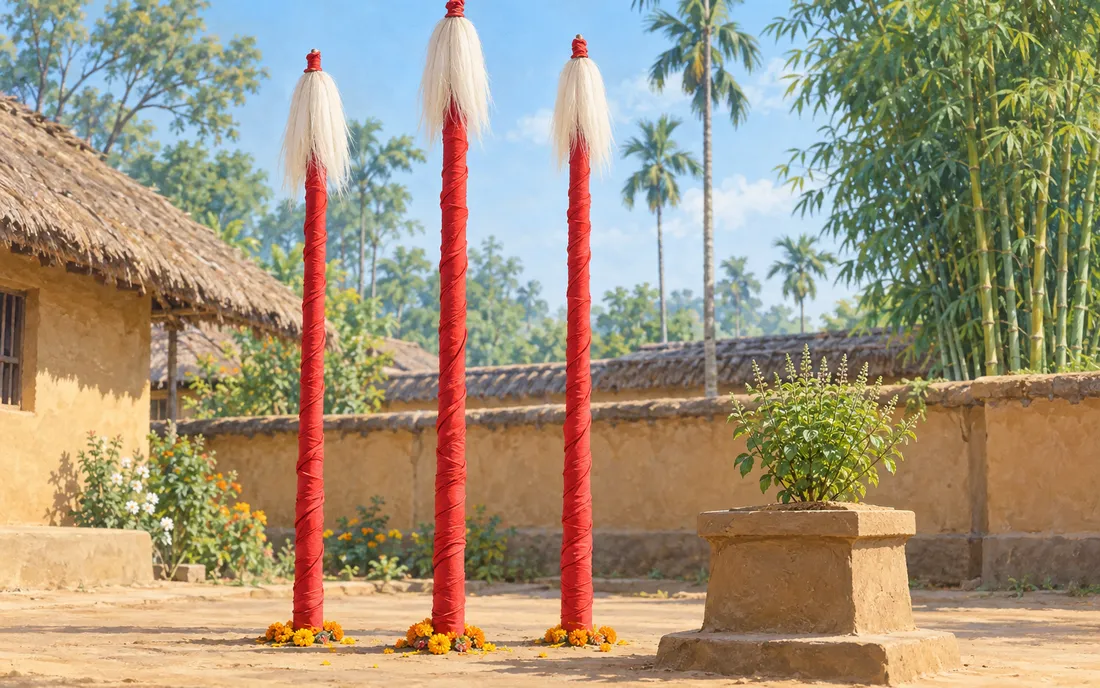
Many Rajbanshi homesteads keep a thakur of their own at the entrance, and in spring, in the villages that keep Madan Kam, bamboo is dressed in cloth and worshipped.

An illustration of the spring worship of Madan Kam: three bamboo poles wrapped in red cloth, each crowned with a white yak-tail whisk, standing in a mud-plastered village courtyard beside a tulsi plant on its clay platform, with marigolds at their feet

The thakur at the entrance

At the entrance of a homestead the thakur is usually Manasa, whom the songs call Bishohori, or Kali.

The bamboo of Madan Kam

Around Madan Chaturdashi, in Chaitra or Baishakh, bamboo poles are wrapped in coloured cloth, a yak-tail whisk is tied at the top, and the bamboo is worshipped as Madan Kam.

Two days of bamboo play

Where the puja is kept, it brings two days of bamboo play and a bamboo fair.

Shiva and Krishna

Devotion to Shiva and the Vaishnava way of Krishna both run deep.

No two homesteads worship in quite the same way.

Songs of North Bengal

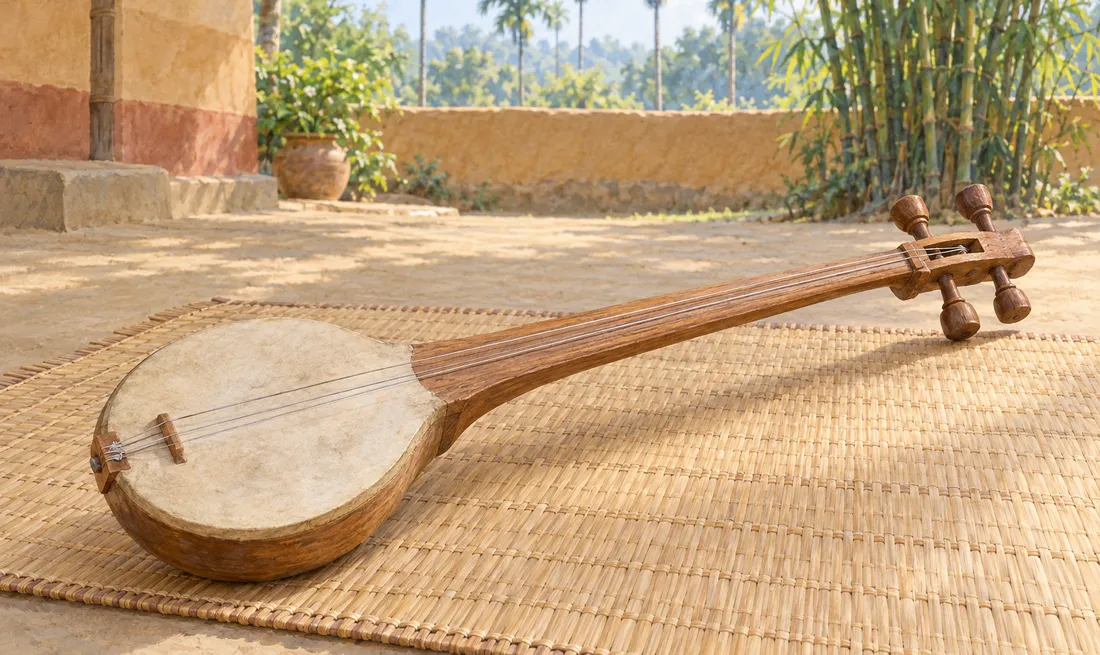
Bhawaiya, sung to the dotara

Bhawaiya is North Bengal's song of longing, and Rajbanshi homes count it among their own.

An illustration of a dotara, a long-necked folk lute with four strings and a round skin-covered body, lying on a woven bamboo mat in a village courtyard with areca palms and bamboo behind

Songs of separation

Bhawaiya dwells on biraha, the ache of being apart, and draws its notes out long to carry the feeling.

The dotara and its company

The dotara is joined by the sarindra and the bena, the khol and the dhol, the kansi and the khartal, and the sanai and the mukha bansi.

Chatka and the Bishohori pala

Chatka, Chorchunni, Palatia, Lahankari and the Bishohori pala are sung as well.

Dotorar Dang

Since 1417 by the Bengali calendar, a magazine in the Rajbanshi tongue, Dotorar Dang, has come out of Cooch Behar.

Bhawaiya belongs to all of North Bengal, and it is told here as part of what Rajbanshi homes hold dear.

One line, the gotra

The gotra on a Rajbanshi profile

The profile has a single place for the gotra, labelled simply Gotra.

In the elders' spelling

Where a family names its gotra, it goes here, spelled the way the elders say it.

Never read off a surname

The gotra is only ever what your family writes; a surname is never taken to be the gotra.

A blank line is fine

If your family does not write a gotra, nothing appears there.

Whatever the family writes there is shown just as it is, and that is all.

Questions families ask

Common questions from Rajbanshi families

Will we only see Rajbanshi profiles here?

Yes. Registering through this page places your profile in the Rajbanshi community, and every profile you see, match with, or contact belongs to it.

How is our family's lineage recorded?

In one line, the gotra, in your family's own spelling. The line may stay empty, and no surname is ever turned into a gotra.

Our family writes the name as Rajbongshi. Is this page for us?

Yes. Rajbanshi, Rajbongshi, Rajbonshi or রাজবংশী: however your family writes the name, this page is yours, and your native district tells other families where your home is.

Will our phone number be visible to everyone?

It is not shown openly on your profile. A member who wants to take an introduction forward can see your contact through the app's Reveal Contact feature and reach you directly, and Government-ID-verified badges help you know who you are speaking with.

Next step

Register or login when your family is ready to continue

Create your account and step into the Rajbanshi space on Sri Guru Raghavendra Matrimony, where the gotra and your native district are part of every profile from the first day — for Rajbanshi families of North Bengal and wherever they have settled, and your family sets the pace.