Sri Guru Raghavendra Matrimony™ emblem
SRI GURU RAGHAVENDRA MATRIMONY™

The people who kept the lamps burning

Ganiga Matrimony

Ganiga in Kannada, Gandla and Telikula in Telugu — one community, and in every one of those languages the word means the oil-mill, or the oil it pressed. These are the households whose work put light in other people's lamps, and whose own name for themselves is the community of the lamp. An alliance here begins where a Ganiga family begins: the gotra, the line the household goes by, the deity it keeps, and the town it belongs to.

Gandla / Telikula / Deva GanigaLingayat Ganiga / SajjanaOther Ganiga community

Begin when you are ready

Register now, or read about the Ganiga heritage first

Creating an account takes a few minutes. If your family prefers to understand the space first, the sections below walk through the mill and the name it gave, the names of light, the districts and the two languages, the gotra and the lines that keep a sept, and the handful of salt at the wedding.

Registrations from this page stay within the Ganiga community — every profile your family sees and contacts belongs to it.
One community, and the word is the work

A heritage your family carries every day

Bengaluru, where Ganigarapete is one of the trade streets of the old pete and carries this community's name; Mysuru and Nanjangud; the Kolar, Chikkaballapura and Tumakuru belt, where Telugu is the language of the house; and east into Telangana and along the Andhra coast, where the same families are Gandla and Telikula.

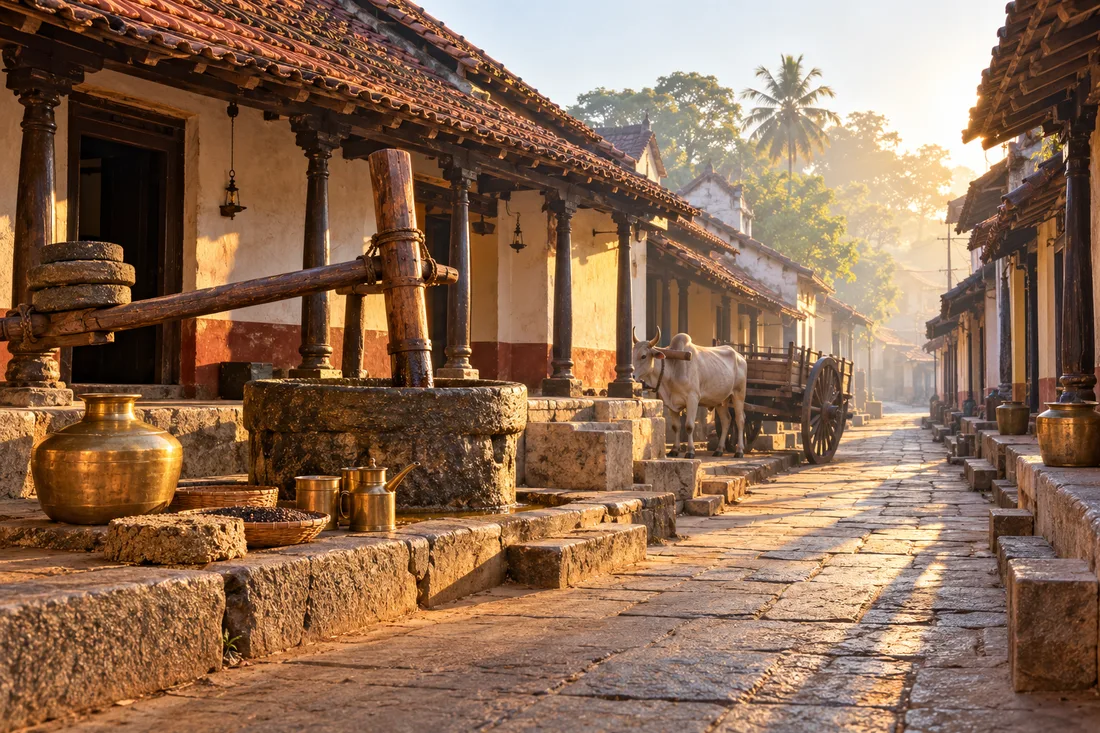
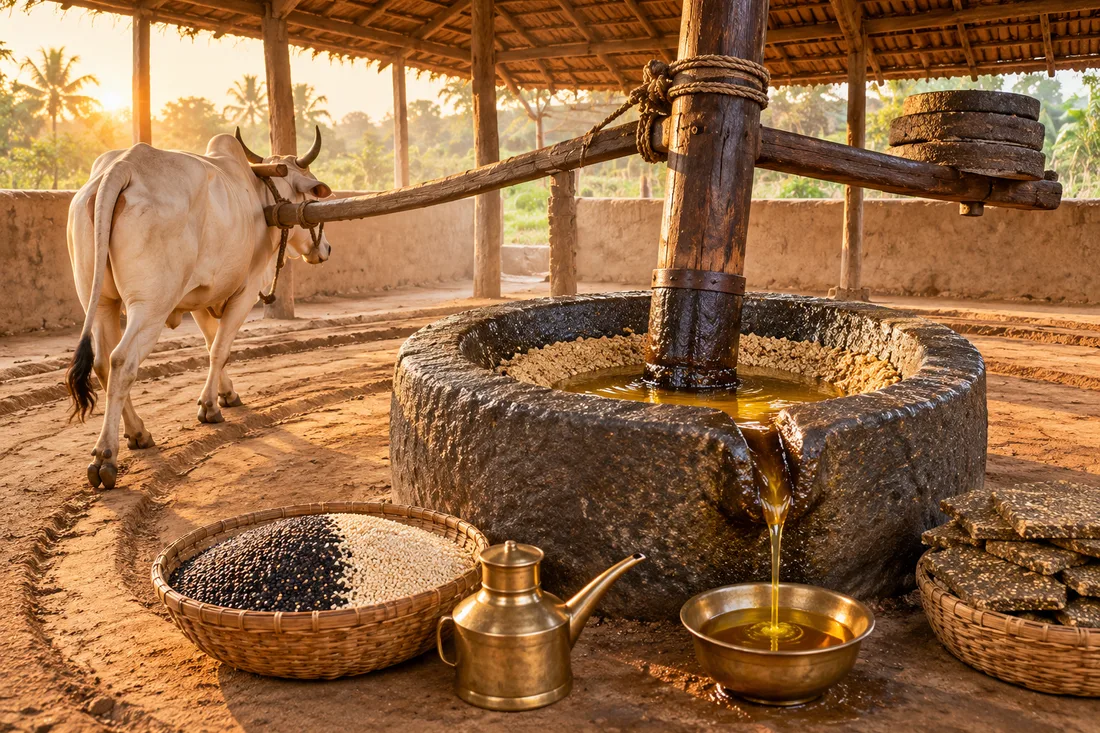
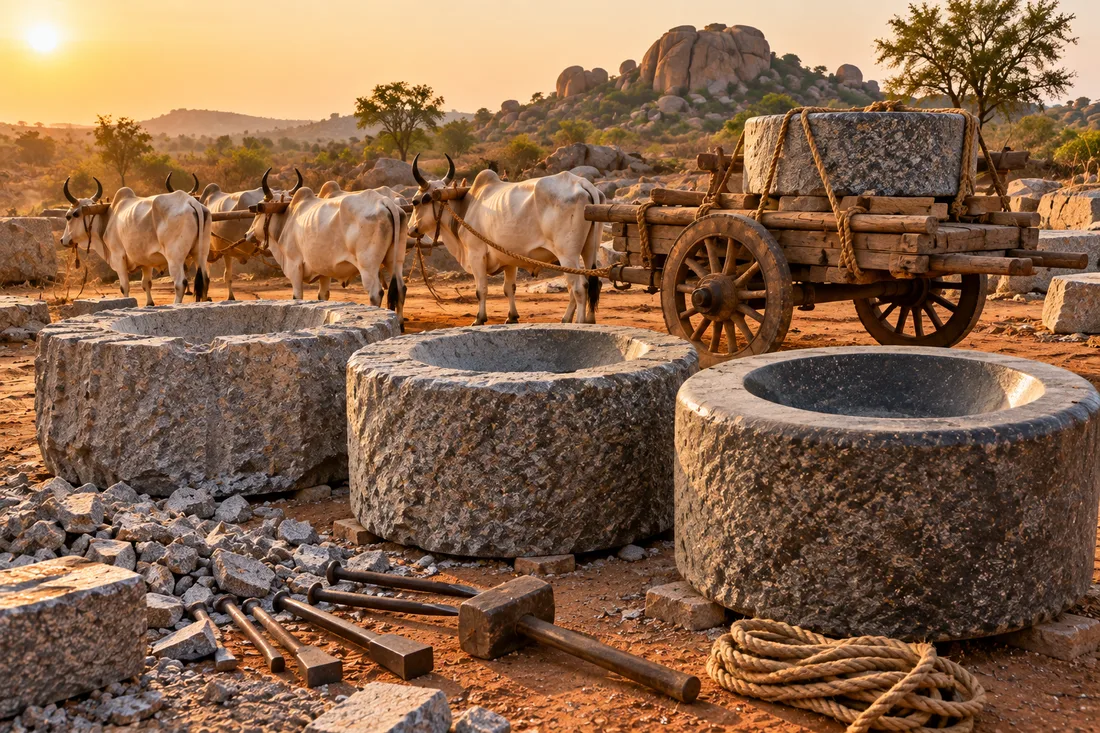
The mill was a mortar cut from granite or hollowed from the heart of a tamarind tree and sunk into the ground, a pestle six or seven feet long shod with iron, a pole lashed near the top with flat stones piled on its end to press harder when the seed needed it, and a bullock walking its circle. In Bengaluru it stood in front of the house or in the compound, where anyone passing could see the day's work.

So an alliance here begins with what a Ganiga household names first: the gotra, the line the family goes by, the deity of the house and the town it belongs to — with the dignity your family expects.

What families often ask first

What families often value first

  • Your gotra is written in your own words, and the families of Nanjangud who keep none have a place on the profile too.
  • The name your family's line goes by — the sept some households keep beside the gotra — and your kula devaru sit on every profile.
  • Search by native place across Bengaluru, Mysuru, Mandya, Kolar, Chikkaballapura, Tumakuru, Hyderabad, and the Telugu districts where your family is known as Gandla or Telikula.

What your family will find inside

Everything your family checks, before the first phone call

These are the details Ganiga households settle first — and they are visible before any contact is exchanged.

Government ID verified members stand out

Members who complete Government ID verification carry a clear mark, giving your family added reassurance at a glance.

Your gotra, written the way your family writes it

There is no roll of these gotras anywhere in print — some four hundred are said to be remembered out of a much larger number once counted. So you write yours in your own words rather than hunting for it in a list, and a household that keeps none is not left with nowhere to stand.

Filter by native place and family origin

Narrow the search by native place — Bengaluru, Mysuru, Mandya, Kolar, Chikkaballapura, Tumakuru, Hyderabad and many more.

Education, work, and family background together

Degrees, professions, and family character read clearly on every profile, in the same order elders weigh an alliance.

Contact details are not shown openly

Phone numbers and email are not shown openly on profiles. A member uses the Reveal Contact feature to see another member's details and reach out directly when they are ready to take an introduction forward.

Interest is never lost

Shortlists and the profiles your family has already opened stay saved, so you can return to a promising profile after the household has talked it over.

Built around how Ganiga alliances actually happen

Whether your family looks among the Kannada households of the old Mysore country or among the Telugu-speaking families of Kolar and the districts east of it, the things that decide it — the gotra, the line the household goes by, the deity it keeps and the native town — are always in view.

Why families feel at ease

Why Ganiga families feel at home

The details that decide an alliance sit together in one place, presented the way your family would present them.

Kannada and Telugu households, both at home here

A family that says Ganiga and a family that says Gandla or Telikula are the same community speaking two languages, and the profile carries the name your household actually uses — along with the language spoken at home, which matters to many families and is asked for plainly.

A place for the line that has no gotra

Some households keep a sept named for a plant or a creature the family does not cut or harm, and the families of Nanjangud keep neither. Every one of those answers has somewhere to go, and none of them reads as a gap.

Comfortable for parents and members alike

Whether the search is led by a parent, a sibling, or the member themselves, the profile reads clearly for all of them.

Move at your family's pace, with tradition honoured up front and you reach out when your family is ready.

The mill, and the name it gave

The gāna, and the households that worked it

This community is named for an object, and it is worth seeing the object before anything else is said.

A bullock-driven gāna, the traditional oil mill — a granite mortar sunk into the floor of an open shed, its tamarind-wood pestle lashed to a weighted pole, with sesame seed and pressed oil-cake beside it

What a gāna was

A mortar cut from a block of granite, or hollowed out of the heart of a tamarind tree, sunk five or six feet into the ground. A pestle six or seven feet long, shod with iron at its foot. A pole lashed near the top, with flat stones piled on the outer end when the seed needed pressing harder. And a bullock, walking its circle from before the light.

  • Sesame, groundnut, coconut and castor
  • The cake left behind, fed to the cattle
  • The mill worshipped on the important days
Granite mortars for bullock oil mills in different stages of cutting in a stone-cutters' yard on the dry Bengaluru plain, with a bullock cart loaded and waiting

Cut at Bettahalasur, and carted home

The stone mortars were cut about fifteen miles out of Bengaluru, at Bettahalasur, and came home on carts drawn by four or five pairs of bullocks. A household did not buy one often, and the one it had outlasted the man who bought it.

The mark entered against the name

In the old Mysore record of the marks each community carried at a marriage, the mark set down against this name is the oil-press itself. Eleven other communities have their own marks in that same list, several of them with a home on this site. What belongs to these households is that the mill is both the work and the name.

Practice and emphasis differ from one town, one branch and one family network to another — this is heritage held with pride, not a single rule book.

The names of light

Jyothipana, and the oil that kept the lamps burning

Two of this community's own names for itself have nothing to do with the mill and everything to do with what the mill was for.

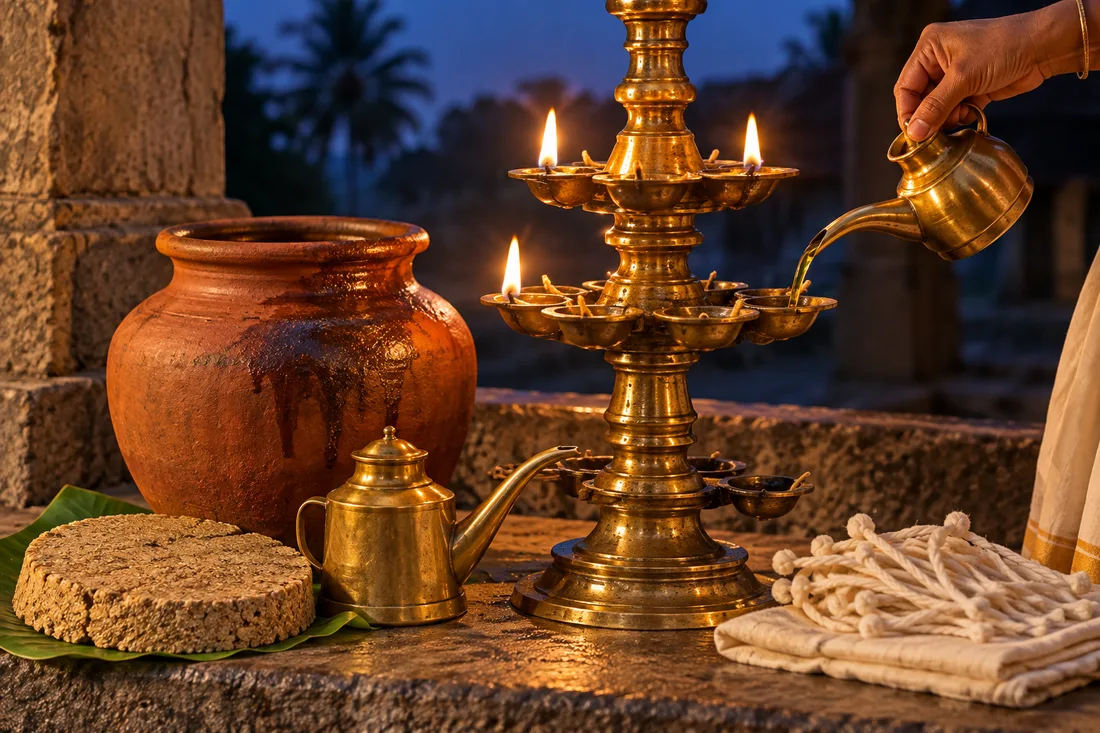
Sesame oil being poured from a brass measure into the unlit cups of a tall many-wicked lampstand at dusk, beside a terracotta oil jar and a cake of freshly pressed oil-cake

The community of the lamp

Jyothipana, the community of the lamp. Jyothinagara, the people of the city of light. By tradition Iswara, needing the darkness taken out of the world at night and the perpetual light kept, made a man and gave him the oil-mill — and the oil that kept the lamps burning in the temples came from these houses.

  • Jyothipana · Jyothiphana
  • Jyothinagara · Jothinagara

The lampstand is honoured too

On the important days it is not only the mill that is worshipped in a Ganiga house. The lampstand itself is honoured — the object the whole trade existed to feed.

A name the oil-pressers of the South share

These are the names these households have always used of themselves, and they are written here for that reason. Oil-pressing families elsewhere in the South carry lamp-names of their own in their own languages, and nothing here is said to set one apart from another.

Devotion is honoured here on its own terms. Nothing on this site ranks one form of it above another.

Where the families are

Ganigarapete, and the districts the households belong to

Ganiga families are spread across two languages and a good deal of country, and they answer to more than one name. It is worth setting down which households this page is for.

A lane of the old Bengaluru pete at first light, with tiled-roof houses on stone plinths and a working bullock oil mill standing in the open compound in front of one of them

A street of their own in Bengaluru

Ganigarapete is one of the trade streets of the old Bengaluru pete and carries this community's name. The mills stood in front of the houses or in their compounds, so the street was the workshop as much as the home. Several of the neighbouring petes belong to communities that have their own homes on this site.

The districts, and the two languages

Bengaluru, Mysuru and Nanjangud; the Kolar, Chikkaballapura and Tumakuru belt, along with Anekal and Hoskote, where many households speak Telugu at home; and eastward into Telangana and along the Andhra coast. Hyderabad and Bengaluru hold a great many families now, and the work of the last two generations has carried them a good deal further.

The names in Telugu

Gandla, Telikula and Devathilakula are the names these same families carry in Telugu, and along the northern coast Telikula is the one used in preference to any other. Deva Ganiga and Onteddu Ganiga are carried by households whose own sangha in the Bengaluru and Kolar districts runs a marriage committee to this day. Whichever of these your family says, it leads here.

  • Gandla · Gandla Telikula · Telikula
  • Devathilakula
  • Deva Ganiga · Onteddu Ganiga · Ontiyeddu

Families of the Lingayat observance

Some Ganiga households keep the Lingayat observance and are known as Lingayat Ganiga, or as Sajjana. Those names will bring a family to this page, and the Veerashaiva Lingayat community has a home of its own here as well. Which of the two your household registers under is entirely your family's decision, and both are open to you.

If your family carries one of these names and does not find itself described here, please do tell us through the request option in the app — it is the kind of message that decides what we open next.

How a marriage is guarded

The gotra, and the lines that keep a sept instead

A Ganiga family marries away from its own line. What that line is called depends on which branch of the community a household belongs to, and this page keeps the difference plain.

The gotra, written in your own words

These gotras are eponymous, and the old accounts count them in the hundreds — some four hundred still remembered out of a far larger number once claimed. Many of them end in the same way, in -nollu or -ulu, which is the first thing an elder listens for. There is no roll of them in print anywhere, so you write yours the way your family says it rather than hunting for it in a list.

  • Bālanollu · Badranollu · Vēdanollu · Vīranollu · Viththanollu
  • Kannendra · Komarendra · Brahmendra · Nagendra
  • And a place for one that is not listed, or not known

The lines that keep a sept

Several branches keep, instead of a gotra, a line named for a plant or a creature the household does not cut, eat or harm. The Vēdanollu line keeps the parijāta, the night-flowering jasmine, and will not cut it. The Kannendra and Komarendra lines each hold back from a herb. If your family keeps a line like this, there is a place for it on the profile beside the gotra.

The families of Nanjangud

The Ganiga households of Nanjangud keep none of these gotras, and that is simply how it has always been with them. There is a place on the profile for that too, and it closes nothing and is not a gap anybody will read into.

The kula devaru is a name, not a rule

The deity a household keeps — Munisvara, Yellamma, the deity of the village — is how a family is known and is honoured on the profile as its own. It is not what an alliance is decided by. The gotra, or the line the family goes by, is.

Every line named here stands on its own terms. Nothing on this site places one household above another.

The house, and the wedding

Faith, and a handful of salt

Both Siva and Vishnu are kept in these houses, and the deities of the village with them. One small thing at a Ganiga wedding is worth setting down on its own.

Salt held in the hand

When the kankana, the protective thread, is being tied at the wrist, the couple hold a little common salt in the hand. Two separate accounts written down a hundred years ago and a thousand miles apart in temperament — one from the Telugu households, one from the Mysore country — record the same small act, in almost the same words. It is the detail of a Ganiga wedding that has travelled furthest without changing.

What the houses keep

Siva and Vishnu are both at home in these households, and the deities of the village stand beside them. On the important days the mill is worshipped, and the lampstand of the house with it.

Walking at the close of the procession

In the larger towns these households are remembered for their place at the close of the great Vaishnava processions — a torch, a cloth umbrella, a bell-metal gong. It comes to us from one account, written down in 1891, which records it as what these families themselves said of their place. It is set down here as a thing remembered, which is what it is.

Devotion is honoured here on its own terms. Nothing on this site ranks one form of it above another.

Questions families ask

Common questions from Ganiga families

We are Gandla, or Telikula. Is this our page?

Yes. Ganiga, Gandla and Telikula are the same community's name in different languages, and Devathilakula, Deva Ganiga and Onteddu Ganiga belong here as well. Along the northern coast Telikula is the name used in preference to any other, and a family that has only ever said Telikula is in exactly the right place.

Our family keeps the Lingayat observance and we are called Sajjana, or Lingayat Ganiga. Which page is ours?

Either, and it is your household's decision. Those names will bring you to this page, and the Veerashaiva Lingayat community has a home of its own on this site. Both are open to you, and registering under one takes nothing away from the other.

We do not know our gotra. Can we still register?

Yes, and you are in good company. There is no published roll of these gotras anywhere, some households keep a line named for a plant or a creature instead, and the Ganiga families of Nanjangud have never kept a gotra at all. There is a place on the profile for each of those answers, and none of them is a bar to registering.

Our family's title is Shetty. Does that decide our community?

No. A title like Shetty is carried by households of several unrelated communities across Karnataka, and on its own it does not say which one a family belongs to. What decides it is the name your household answers to and the line it keeps, and those are what the profile asks for.

Will our phone number be visible to everyone?

It is not shown openly on your profile. A member who wants to take an introduction forward can see your contact through the app's Reveal Contact feature and reach you directly, and Government-ID-verified badges help you know who you are speaking with.

Next step

Register or login when your family is ready to continue

Create your account and step into the Ganiga space on Sri Guru Raghavendra Matrimony, where your gotra, the name your family's line goes by and your household deity are part of every profile from the first day — and your family sets the pace.