Sri Guru Raghavendra Matrimony™ emblem
SRI GURU RAGHAVENDRA MATRIMONY™

A garland in the name, a garden offered to Vitthal

Mali Matrimony

Mali takes its name from mala, a garland, and the Mali families this page is for have long been the people of the watered field — the well, the channel and the garden worked through every season. Their own saint, Savata of Aran, sang that onion, radish and greens were all his Vitthal. This page begins there: with the kul a family belongs to, the deity the household keeps, and the garden where the garland is grown.

Mali

Begin when you are ready

Register now, or read about the Mali heritage first

Creating an account takes a few minutes. If your family prefers to understand the space first, the sections below walk through the garland in the name, Sant Savata of Aran, the kul and the devak, the families this page is for, the household's faith and the wedding's songs, and a school for girls opened in 1848.

Registrations from this page stay within the Mali community — every profile your family sees and contacts belongs to it.

The garland, the garden and the kul

A heritage your family carries every day

The name Mali comes from mala, a garland — the gardener who grows the flowers and strings them.

Across Pune, Satara, Ahilyanagar, Nashik and Solapur, in Khandesh and in Vidarbha, Mali families have long farmed land watered from wells and canals — fruit, vegetables, flowers and sugarcane.

So an alliance here begins with what a Mali household settles first — the kul, the devak, the deity the house keeps, and the native place — with the dignity your family expects.

What families often ask first

What families often value first

  • Your kul, devak, gotra and kuldaivat sit together on the profile, each in your own words.
  • Search by native place across Pune, Satara, Ahilyanagar, Nashik, Solapur, Jalgaon, Amravati, Akola, Nagpur and many more.
  • Registrations from this page stay within the Mali community, so every profile your family considers belongs to it.

What your family will find inside

The kul, the devak and the deity of the house, there to read

These are the details Mali households settle first — and they are visible before any contact is exchanged.

Government ID verified members stand out

Members who complete Government ID verification carry a clear mark, giving your family added reassurance at a glance.

In the words your elders use

The kul your family belongs to, the devak it keeps and the deity of the house sit on the profile, written the way your elders say them.

Filter by native place and family origin

Narrow the search by native place — Pune, Satara, Ahilyanagar, Nashik, Solapur, Jalgaon, Amravati, Akola, Nagpur and many more.

Education, work, and family background together

Degrees, professions, and family character read clearly on every profile, in the same order elders weigh an alliance.

Contact details are not shown openly

Phone numbers and email are not shown openly on profiles. A member uses the Reveal Contact feature to see another member's details and reach out directly when they are ready to take an introduction forward.

Interest is never lost

Shortlists and the profiles your family has already opened stay saved, so you can return to a promising profile after the household has talked it over.

Built around how Mali alliances actually happen

Whether your family looks within its own district or across Maharashtra and beyond, a profile that names its kul and devak shows them from the very first look.

Why families feel at ease

Why Mali families feel at home

The details that decide an alliance sit together in one place, presented the way your family would present them.

The kul is settled first

Before an alliance goes further, two Mali households settle the kul. It is on the profile, written the way your family says it.

Your own group, if it matters to you

Some households have long married within their own Mali group; others look wider. If yours keeps a group, write it on the profile.

Comfortable for parents and members alike

Whether the search is led by a parent, a sibling, or the member themselves, the profile reads clearly for all of them.

Move at your family's pace, with tradition honoured up front and you reach out when your family is ready.

The name

A garland in the name

The community's name is a gardener's word, and the old accounts find the whole household in the garden.

A Mali garden at first light — a stone well with a wooden pulley and rope, water running down an earthen channel to beds of yellow and white shevanti and jasmine, with rows of onion, radish and coriander, and a pair of wooden Varkari clappers with a tulsi-bead string resting on the well's rim

The garland-maker

Mala is a garland in Sanskrit, and in Marathi a garland is a mal too — a name made of flowers strung on a thread. The old district accounts describe the whole household at work — the women beside the men, in the field and in selling the flowers, fruit and vegetables.

Watered land, all the year round

A Mali garden was never only a field. It was a well, a channel cut to carry its water to every bed, and the care that kept both running from one harvest to the next.

A heritage held with pride; no ranking of any community is intended.

The saint of the garden

Savata of Aran

The Mali families' own saint is Savata of Aran, near Modnimb in Solapur district — a gardener and a Varkari of the thirteenth century, whom Sant Namdev praised in a verse kept with Savata's own abhangs: 'Blessed is Aran, a mine of jewels, where the treasure, Savata, was born.'

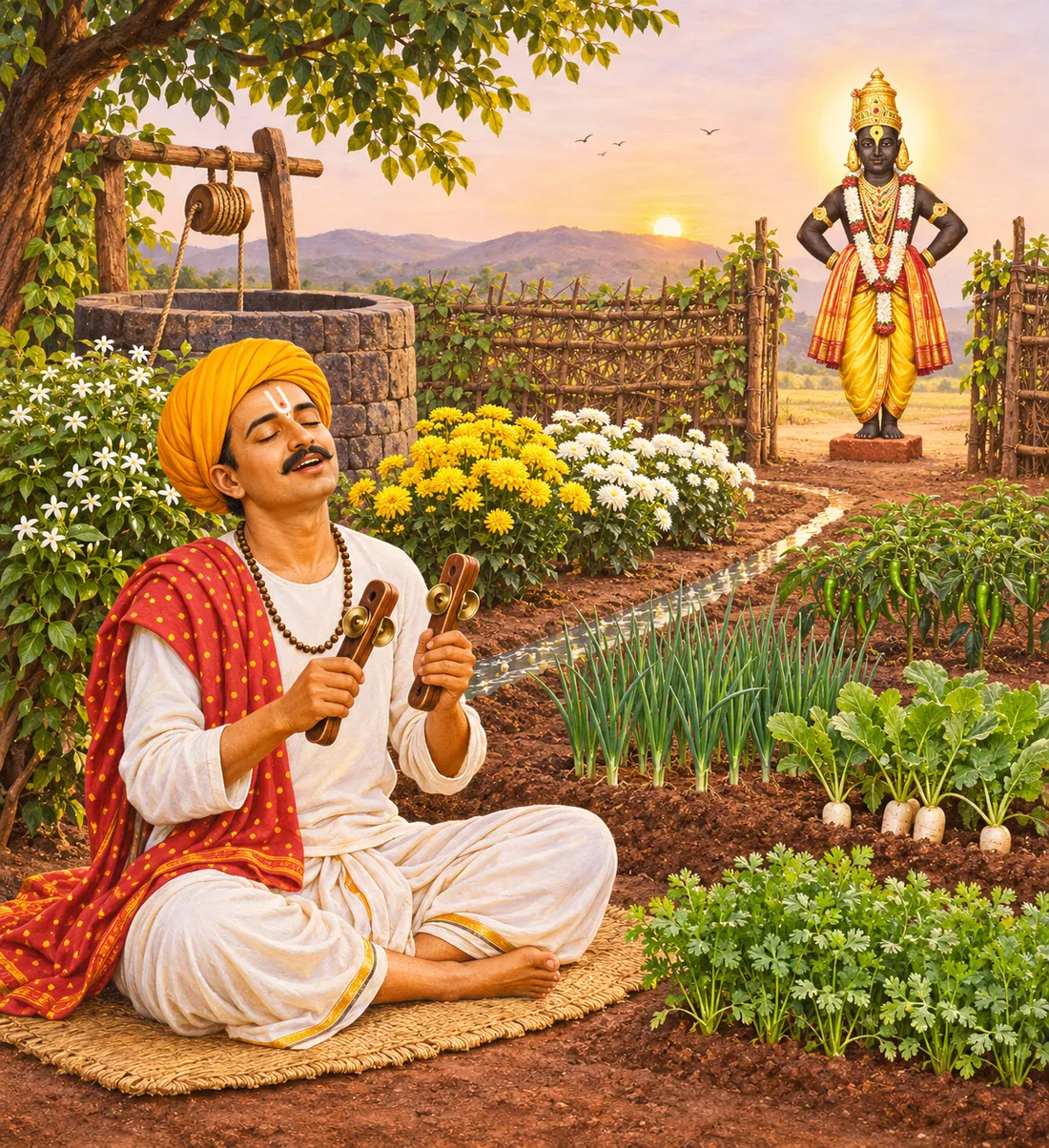
Sant Savata of Aran seated in his vegetable garden at sunrise, eyes closed in song with wooden clappers in his hands, while Vitthal, standing on a brick with his hands on his hips, appears at the garden's edge

The gardeners' people, in Savata's words

In one of his own abhangs Savata sang: 'We are of the gardeners' people; we plant the watered field. In our hands the water-bag and its rope; the water runs to the flowering plants. Peace has bloomed as the shevanti; love has flowered as jai and jui. Savata made his garden — and saw Vitthal with his own eyes.'

Onion, radish and greens

In another of his abhangs: 'Onion, radish and greens — all of it is my Mother Vitthal. Garlic, chilli and coriander — all of it has become my Hari. The water-bag, its rope, the well and the cord — Pandhari fills them all.'

The Lord in the garden

In Mahipati's Bhaktavijaya, the eighteenth-century book of the saints' lives, Vitthal is walking with Namdev and Dnyandev when he sees the village of Aran and longs to meet Savata. Saying he is thirsty, he leaves the two outside and goes into the garden, and finds Savata with his eyes closed, singing the Name, unaware of himself. Vitthal lays a hand on his head; Savata wakes, falls at his feet and weeps for joy: 'Blessed is this day — with my own eyes I have seen my mother and my father.' Elsewhere in the same book, when Vitthal comes home tired, Rukmini laughs and asks whether he has been weeding Savata's garden.

His own abhangs are set down here with reverence, beside what Namdev sang and Mahipati wrote of him; devotional matters rest with each family.

The line a family keeps

The kul a family belongs to

A Mali alliance is made outside the family's own kul.

The kul

The kul is the line a household traces to one forefather, most often carried in its surname, and sometimes gathering several surnames that remember the same ancestor. Each family writes its kul as its elders name it.

The devak, and the deity of the house

Many households also keep a devak for their weddings, and some avoid a match within the same devak as well. The kul, the devak, the gotra where a family keeps one, and the deity the house keeps are each written on the profile in your own words, and you may leave any of them blank.

Each family reckons its own line; nothing here places one household above another.

Who this page is for

The families this page is for

They are the Marathi-speaking Mali families of Maharashtra — from Pune, Satara, Ahilyanagar, Nashik and Solapur to Jalgaon and the districts of Vidarbha — and Mali households who have settled in the cities and beyond.

Phul Mali, Savta Mali, or simply Mali

Many say Phul Mali or Savta Mali; others name another Mali group, or simply Mali. Each is welcome here, and a household can write its own group on the profile in its own words.

Far from the home district

A Marathi Mali household that has made its home in Mumbai, Bengaluru, Hyderabad or far beyond still names the district its people come from, and is as much at home here as a family that never left Satara or Amravati.

No ranking among these names is intended.

Faith and the wedding

The household's faith, and the wedding's songs

Vitthal of Pandharpur and the family deity of each house, then the songs recorded for a new couple's first homecoming.

The Varkari way, and the deity of the house

Many Mali households walk the Varkari way, with Vitthal of Pandharpur at its heart. Many name Saptashrungi Devi of Vani, near Nashik, or Khandoba as the family deity, and every household keeps its own.

Songs of the soil

An account of the communities of Maharashtra records that when a Mali bride and groom first come home to the groom's house, the two of them are bathed, and songs are sung of the soil, of flowers and of fruit trees, asking nature's blessing on the new couple.

Each household keeps its own deity and its own wedding customs; they are named here with affection.

Remembered with gratitude

A school for girls, 1848

Two people born into Mali families are remembered across Maharashtra, and with them the school for girls they opened in Pune.

Jyotirao and Savitribai Phule

Jyotirao Phule and Savitribai Phule were both born into Mali families — she in 1831, at Naigaon in Satara district. In Pune in 1848 they opened a school for girls, and Savitribai, who taught there, is remembered as one of the first women teachers in India. The family name itself is said to come from flowers: Jyotirao's forebears were so skilled at growing and arranging them that they took the name Phule.

Recalled with gratitude as part of the community's heritage. No ranking of any community is intended.

Questions families ask

Common questions from Mali families

Will we only see Mali profiles here?

Yes. Registering through this page places your profile in the Mali community — Phul Mali, Savta Mali and the other Marathi Mali families of Maharashtra and beyond — and every profile you see, match with, or contact belongs to it.

How is our family's lineage recorded?

As your family's own — your kul first, then your devak, and your gotra and family deity where you keep them — each written in your own words. An alliance is traditionally made outside your own kul, and some households also avoid the same devak. Because one kul can gather several surnames, a kul is never worked out from a surname; each family writes its own.

We call ourselves Phul Mali, or by the name of another Mali group — is this our page?

Yes. This page welcomes Mali families of every group. You can write your family's group on the profile in your own words, so a family for whom it matters can see it before any conversation begins.

Our family is Mali, but we speak Kannada, Gujarati or Hindi at home. Is this our page?

It is written for the Marathi Mali families of Maharashtra and every household that has gone out from them, whatever language is spoken at home today. Families elsewhere carry the Mali name for communities of their own, with their own languages and customs; if yours is one of them, please tell us through the request option in the app — it is the kind of request that decides what we open next.

Will our phone number be visible to everyone?

It is not shown openly on your profile. A member who wants to take an introduction forward can see your contact through the app's Reveal Contact feature and reach you directly, and Government-ID-verified badges help you know who you are speaking with.

Next step

Register or login when your family is ready to continue

Create your account and step into the Mali space on Sri Guru Raghavendra Matrimony, where your kul, your devak and the deity your house keeps have their place on the profile from the first day — and your family sets the pace.