Sri Guru Raghavendra Matrimony™ emblem
SRI GURU RAGHAVENDRA MATRIMONY™

The old trading towns of Rajasthan and Gujarat

Bania / Vania Matrimony

Bania is not one community but a name shared by many — Agarwal, Maheshwari, Khandelwal, Modh, Kapol and more, each with its own origin day, its own kuldevi and its own circle of marriage. So this page asks first which community your family belongs to, and then the things that follow from it: the gotra or the khaanp, the kuldevi, and the town your family is from.

Agarwal (Agrawal)MaheshwariKhandelwalModh Vaniya

Begin when you are ready

Register now, or read about the Bania heritage first

Creating an account takes a few minutes. If your family prefers to understand the space first, the sections below walk through the communities the name covers, Maharaja Agrasen and Agroha, Mahesh Navami, the gods of the house, and how a family records its gotra or khaanp.

Registrations from this page stay within the Bania community — every profile your family sees and contacts belongs to it.
Many communities, one shared name

A heritage your family carries every day

The Bania communities belong to the old trading towns of Rajasthan and Gujarat — Agroha and Khandela, Jaipur and Bikaner, Shekhawati with its painted houses, Porbandar and Patan and Khambhat — and to the cities their households later settled in, from Delhi and Agra to Indore, Kolkata, Mumbai and south into Hyderabad and Bengaluru.

What the old records notice about these households is the kitchen and the gate: a strict vegetarian table, water and shade kept for travellers, the wells and rest-houses and temples the towns still use. A Bania family is known first for what it will not do — harm a living thing — and then for what it keeps open to others.

So an alliance here begins with what a household names first: the community it belongs to, the gotra or the khaanp it marries away from, the kuldevi it keeps, and the town it calls its own — with the dignity your family expects.

What families often ask first

What families often value first

  • Your own community is named first — Agarwal, Maheshwari, Khandelwal, Modh, Kapol and the rest each stand on their own, never merged into one another.
  • The gotra or khaanp your family marries away from, and the kuldevi it keeps, sit on every profile.
  • Search by native place across Jaipur, Bikaner, Jodhpur, Sikar, Ahmedabad, Rajkot, Surat, Delhi, Agra, Indore and beyond.

What your family will find inside

Everything your family checks, before the first phone call

These are the details Bania households settle first — and they are visible before any contact is exchanged.

Government ID verified members stand out

Members who complete Government ID verification carry a clear mark, giving your family added reassurance at a glance.

Your community, named on its own

An Agarwal profile says Agarwal; a Maheshwari profile says Maheshwari; a Modh or Kapol Vaniya profile says so. These are separate communities that share an older name, and the profile names the one your family answers to rather than the name they have in common.

Filter by native place and family origin

Narrow the search by native place — Jaipur, Bikaner, Jodhpur, Sikar, Churu, Ahmedabad, Rajkot, Surat, Delhi, Agra, Indore and many more.

Education, work, and family background together

Degrees, professions, and family character read clearly on every profile, in the same order elders weigh an alliance.

Contact details are not shown openly

Phone numbers and email are not shown openly on profiles. A member uses the Reveal Contact feature to see another member's details and reach out directly when they are ready to take an introduction forward.

Interest is never lost

Shortlists and the profiles your family has already opened stay saved, so you can return to a promising profile after the household has talked it over.

Built around how Bania alliances actually happen

Whether your family looks within its own community and its own circle of towns, or further afield among families whose customs sit well with yours, the details that decide it — the community, the gotra or khaanp, the kuldevi and the native town — are always in view.

Why families feel at ease

Why Bania families feel at home

The details that decide an alliance sit together in one place, presented the way your family would present them.

No community folded into another

Agarwal, Maheshwari, Khandelwal, Modh, Kapol and the rest each keep their own name here. Families who look only within their own community can do exactly that, and families open to another whose customs sit well with theirs can see them too. The choice stays with your household, not with us.

A vegetarian home, taken as read

For most Bania households the kitchen is not a preference to be explained at the first meeting. It is simply how the house has always been, and it reads that way on the profile.

Comfortable for parents and members alike

Whether the search is led by a parent, a sibling, or the member themselves, the profile reads clearly for all of them.

Move at your family's pace, with tradition honoured up front and you reach out when your family is ready.

The name and the communities under it

Which community your family belongs to

This is the first thing this page asks, because it is the first thing a family asks. Bania is a name several communities share; it is not the name of a single one.

Communities that share the name

Each of these has its own origin day, its own kuldevi and its own circle of marriage. They are named together here so that a family searching for the older word finds its way in — and then chooses its own community from the list.

  • Agarwal (Agrawal, Aggarwal, Agarwala) — of Agroha and the north
  • Maheshwari — of Rajasthan, with its own origin day and its own flag
  • Khandelwal — of Khandela in Sikar
  • Modh, Kapol, Khadayata, Lad, Disawal, Sorathia — the Gujarati Vaniya communities
  • Nema, Gahoi, Agrahari, Kasaundhan, Kesarwani, Asati — of the eastern towns

Families of Jain tradition

Oswal, Porwal and Shrimal households are named alongside the rest in everyday speech, but most of them follow the Jain tradition — their own teachers, their own temples, their own calendar. It would not be right to gather them under a Hindu community page, so they are not listed above. This page is for the Hindu Bania communities.

Practice and emphasis differ from one community, one town and one family network to another — this is heritage held with pride, not a single rule book.

The city of the open door

Maharaja Agrasen, and the brick and the coin

The Agarwal community traces itself to a king remembered for two decisions, and both of them are about other people rather than about himself.

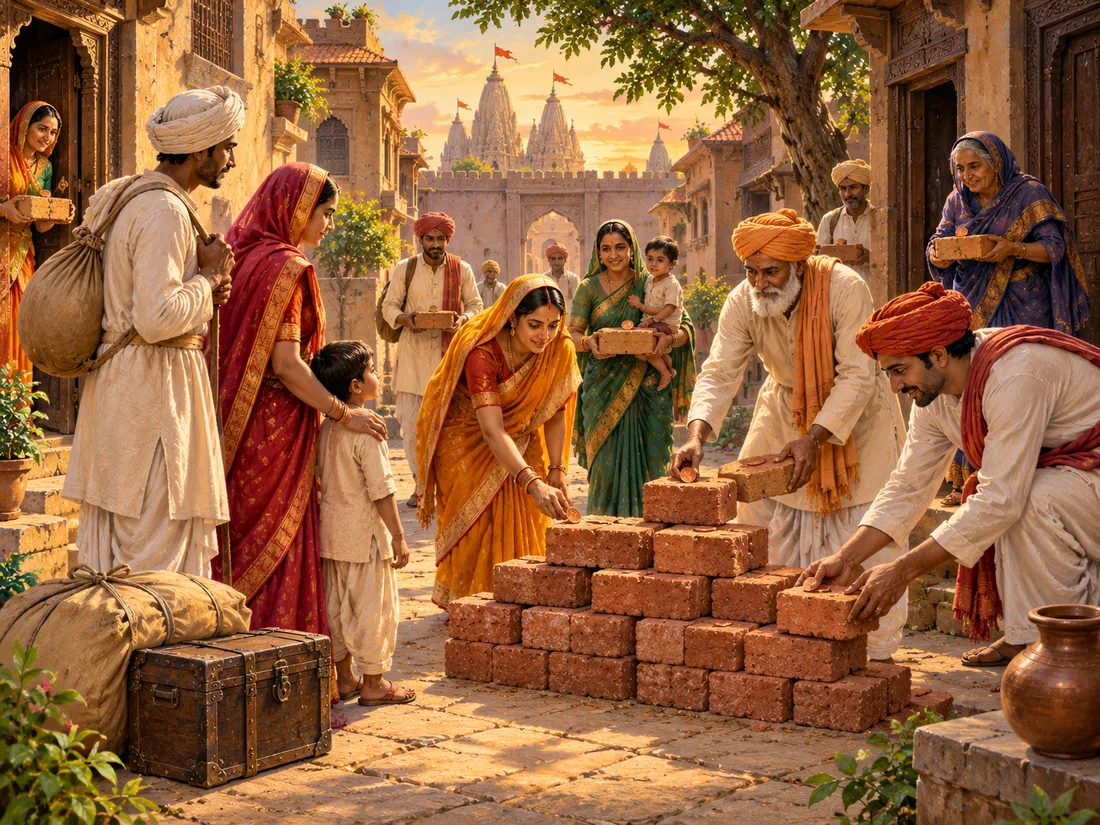
Neighbours stepping into a lane at Agroha, each carrying one brick and one small copper coin to a newly arrived family, the custom Agarwal households tell about themselves

The sacrifice he stopped

By tradition Maharaja Agrasen founded the city of Agroha and, seeing the animals brought for the fire, would not have the rite completed. What his people took from him afterwards was a way of living rather than a rank: a table without meat, and a city whose gate stood open. The account of his life as the community now keeps it was set down by the poet Bharatendu Harishchandra in 1871, and it is held as tradition.

  • Agroha, in what is now Hisar district
  • Seventeen and a half lineages by tradition, listed as eighteen today
  • Agrasen Jayanti, kept at the opening of Sharad Navaratri

A brick and a coin

The custom the community tells about itself is this: when a household came to Agroha — or, in the older telling, when a merchant's work failed — every family in the town brought a brick and a coin, so that no one began again with nothing. The two versions differ on the occasion and on the amount, and both are old. What neither version disagrees about is the point of it, which is that beginning again was treated as everybody's business.

Agroha Dham

The temple complex at Agroha was raised between 1976 and 1984, with a shrine to Mahalakshmi at its centre, Saraswati to the west and a wing given to Maharaja Agrasen himself. Families gather there at Sharad Purnima each year.

The origin account is the community's own tradition, held with reverence and set down here as tradition — not as history, and never as a claim over anyone.

The day the community counts from

Mahesh Navami, and the seventy-two khaanps

The Maheshwari community keeps its own origin day, and names not just the day but the morning it considers itself to have begun.

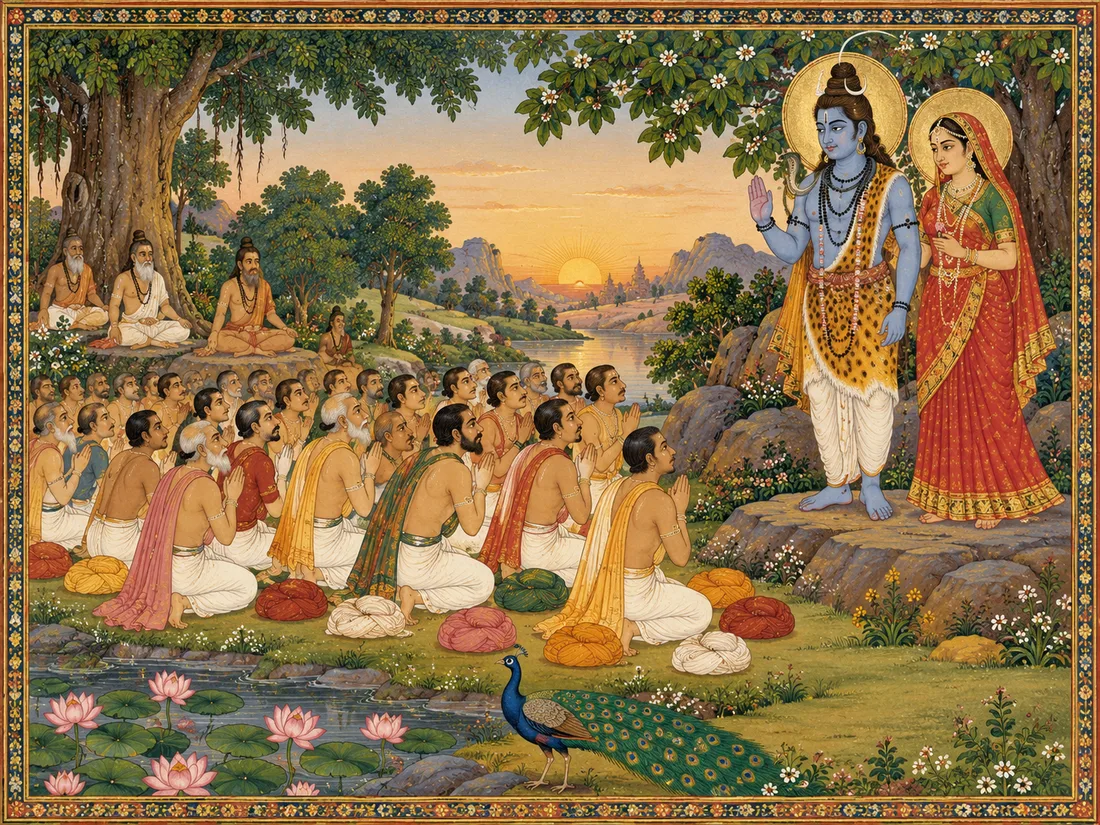
Shiva and Parvati restoring the seventy-two at first light, their turbans set down before them, the morning the Maheshwari community counts itself from

Shiva's word at the ashram

By tradition a company of seventy-two men disturbed the rite of ascetics in the forest and were turned to stone, and Shiva — Mahesh, from whom the community takes its name — restored them, asking them to set down the weapon and take up the work of trade. From those seventy-two come the khaanps, the clans a Maheshwari family still names. The account is recorded in the community's own literature and is held as tradition.

  • Mahesh Navami, on the bright ninth of Jyeshtha
  • The Divydhwaj, the community's own flag
  • Seventy-two khaanps by tradition; eighty-two in the published register today

A goddess for every khaanp

The register the community publishes for itself sets each khaanp beside its own kuldevi, and beside the rishi gotra that household also keeps. That is why a Maheshwari family, asked about its lineage, will usually answer with the khaanp first and the gotra second.

Which day a household keeps, and how, varies from town to town and family to family.

The gods of the house

Ganesh at the head of the first page

Ask which deity a Bania household turns to first and the answer is older and plainer than the one people expect.

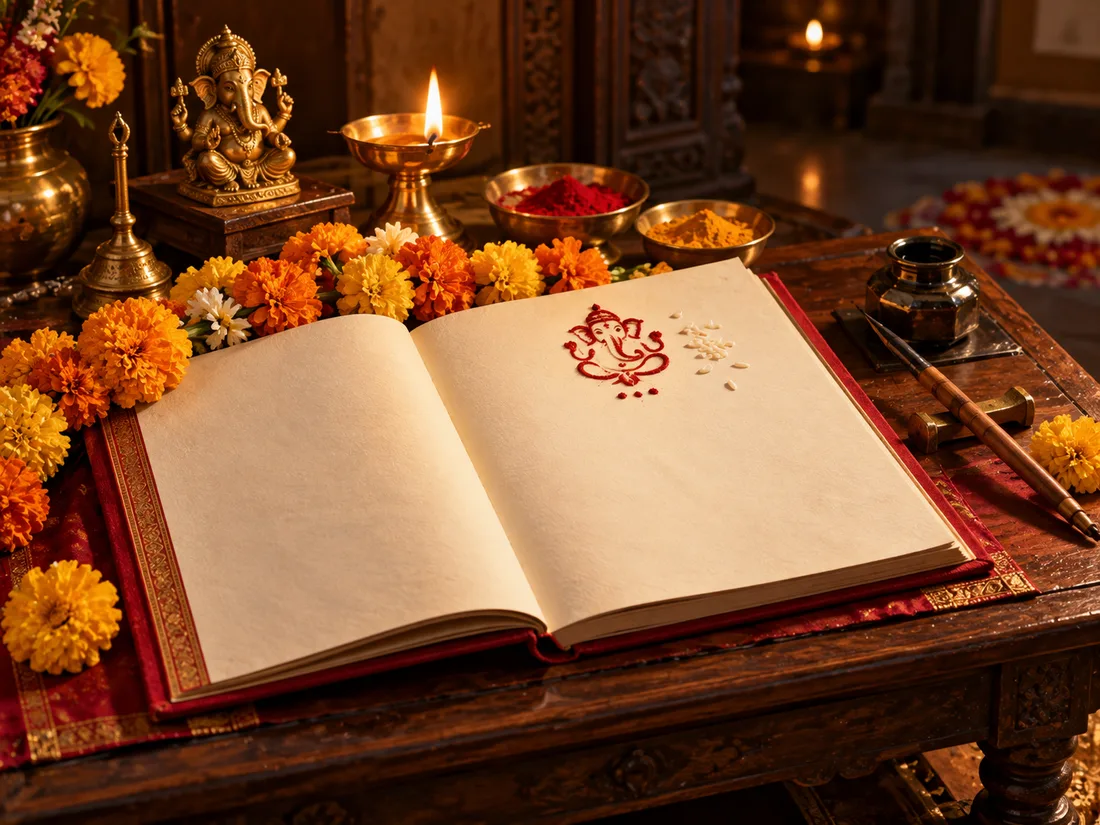
A new account book opened at Diwali, Ganesh drawn on its first blank page in red kumkum beside grains of rice, a lit brass lamp and marigolds

Ganesh, before anything is begun

The ethnographers who wrote these communities down in the early 1900s are unambiguous about it: the principal deity of the Bania households is Ganesh. At Diwali the year's work is closed and a fresh book opened, and the first thing that goes on the first page is his image — the beginning of things asked to bless a beginning. In Gujarat the same day is kept as Chopda Pujan, and the new year's first working day as Labh Pancham, customs the Gujarati trading households share among themselves.

A Modh Vaniya household in Porbandar

Among the best known of these households was a Modh Vaniya family of Porbandar, and what Mohandas Gandhi carried out of it was his mother's side of the house: Putlibai came of a Pranami Vaishnava family, a Krishna-bhakti tradition, and the vegetarian table and the refusal to harm a living creature that he is remembered for were the ordinary furniture of that home before they were anything else. It is a fair picture of what these households have generally held to be the point.

  • Porbandar, in Gujarat
  • A Pranami Vaishnava household on his mother's side
  • The vegetarian table, and ahimsa, learned at home

Devotion varies from household to household. Naming a family deity or a sampradaya here is a way of being known, never a test anyone has to pass.

The path of grace

Sri Vallabhacharya, and the seva of Shrinathji

Many Hindu Bania households of Gujarat and Rajasthan keep this tradition, and for those that do it shapes the day rather than only the calendar.

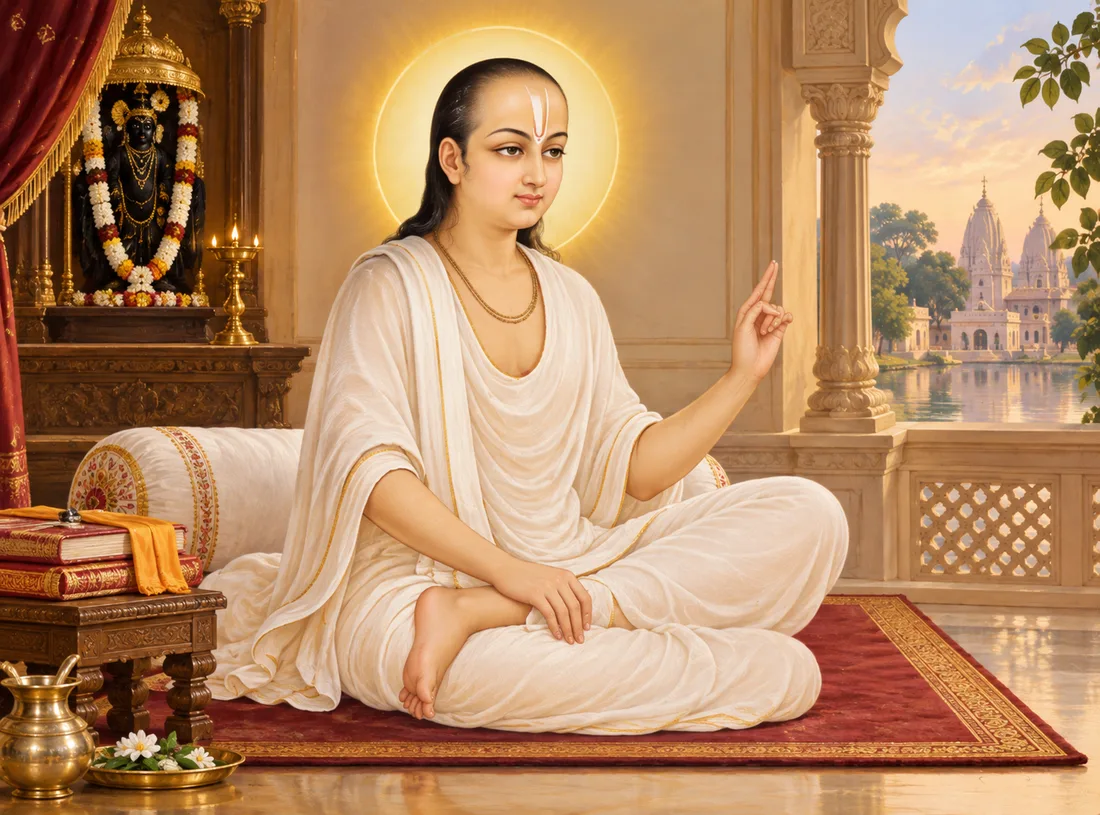
Sri Vallabhacharya seated in a pillared pavilion with his hand raised in teaching, his manuscripts beside him and a shrine of Krishna behind

Sri Vallabhacharya

Sri Vallabhacharya (1479–1530) taught the Bhagavata across the length of the country and set out the philosophy his followers call Shuddhadvaita. The places where he stopped and expounded it are remembered as the eighty-four Baithaks, and they are still visited. What he left was not a discipline of withdrawal but a way of loving attention, which is why the tradition he began is called the Pushtimarg — the path of nourishing, or of grace.

  • Shuddhadvaita, the philosophy he set out
  • The eighty-four Baithaks, the seats of his teaching
  • Pushtimarg, the path of grace
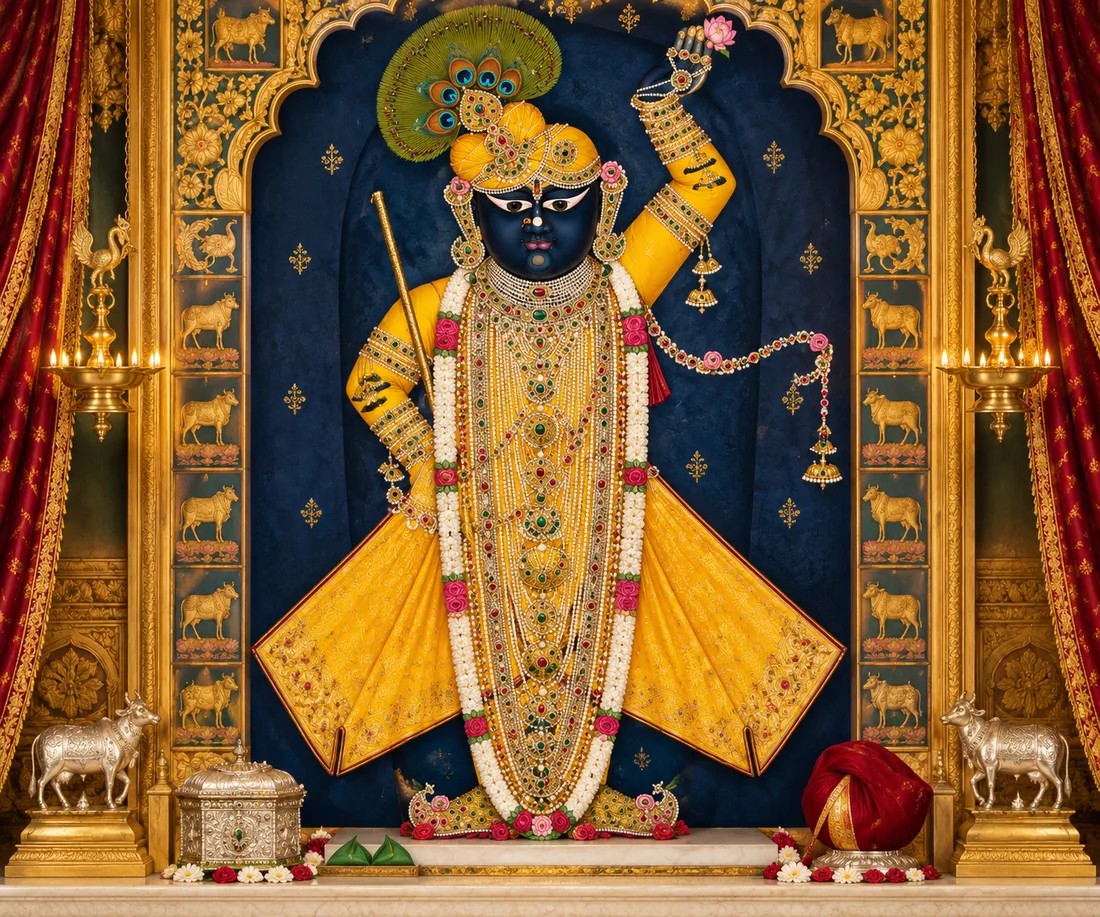
The svarupa of Shrinathji, left arm raised in the gesture of lifting Govardhan, before a pichhwai hanging worked with cows

Shrinathji, and the house at Nathdwara

The form the tradition turns to is Shrinathji — Krishna as a boy, the left arm raised, as he is remembered lifting Govardhan. The older ground of the tradition is Braj, around Mathura, Vrindavan and Govardhan itself; the svarupa later came to a village in the Mewar hills that grew around it and is now Nathdwara, in Rajasthan. The cloth hangings behind him, the pichhwai, are changed with the season, and the cows worked into them are not decoration — they belong to the hill and the story both.

  • Braj — Mathura, Vrindavan and Govardhan
  • Nathdwara, in the Mewar hills of Rajasthan
  • The pichhwai, changed with the season
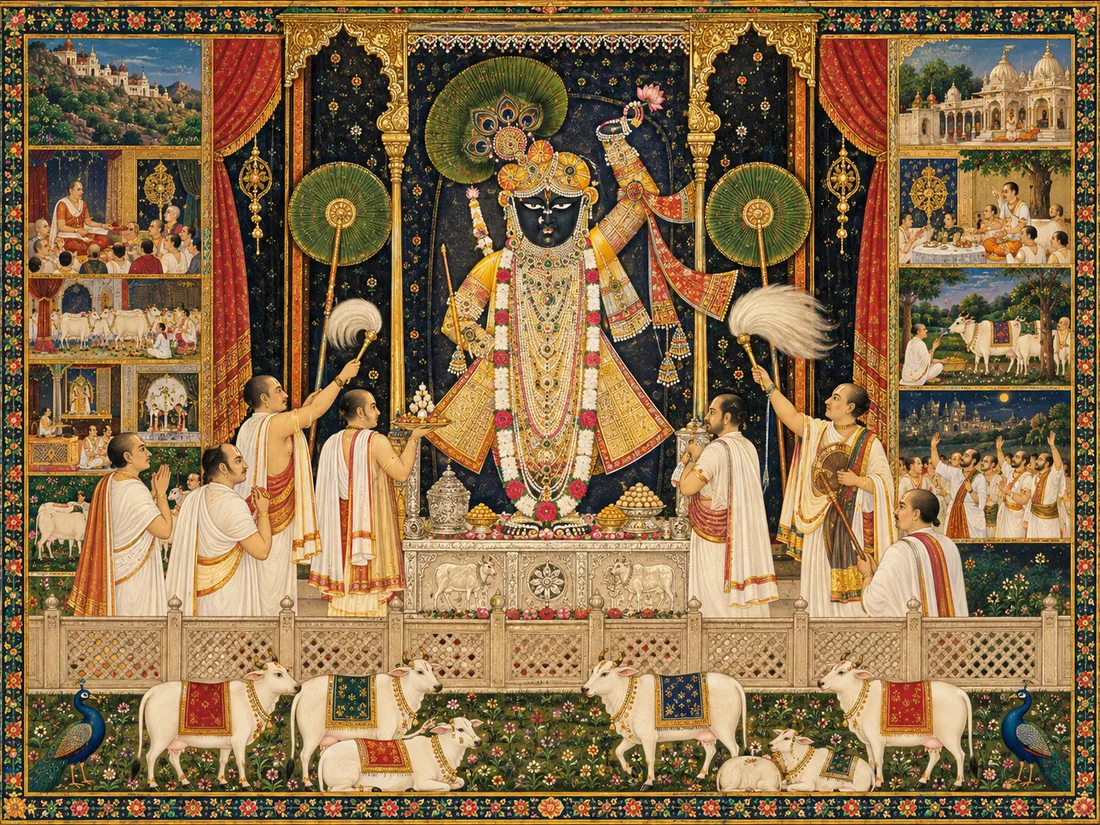
The seva of Shrinathji — sevaks fanning with chamaras and offering bhog before the shrine, with cows and calves in the meadow in front

Seva, and the eight darshans

What a household does here is called seva, and it is closer to looking after someone than to worship at a distance: the deity is woken, dressed, fed, taken out of the heat, sung to and put to rest, and the day opens to the family eight times as it goes — Mangala, Shringar, Gwal, Rajbhog, Utthapan, Bhog, Sandhya and Shayan. Vallabhacharya’s son Vitthalnath is remembered for setting that daily order. It is a tradition of attention rather than austerity, and it is kept as much in the home as in the temple.

  • Mangala, Shringar, Gwal, Rajbhog
  • Utthapan, Bhog, Sandhya, Shayan
  • Kept in the house as well as the temple

This is a sampradaya, not a community. Families of several communities follow it, and a Bania family may follow it or may not — naming it on a profile is a way of being known, never a test anyone has to pass.

How a marriage is guarded

Gotra, khaanp and the town you come from

The rule is the same everywhere — a family marries away from its own line — but the word for that line is different in each of these communities, and getting it right is most of what this page is for.

Agarwal — the gotra, and there is a list

Agarwal families reckon by gotra, and this is the one community here whose list is settled: eighteen, standardised by the community's own assembly and used on its registration forms to this day. So it can be offered as a list to choose from, with a place for a household whose gotra is not on it and a place for a family that does not know it. No family is turned away for either.

  • Dharan · Madhukool · Tayal · Naagal · Kuchal · Goyal
  • Garg · Goyan · Mittal · Jindal · Singhal · Bansal
  • Airen · Kansal · Bhandal · Tingal · Mangal · Bindal

Maheshwari — the khaanp, then the gotra

A Maheshwari family marries away from its khaanp, and keeps a rishi gotra beside it. Both are written here in your own words, the way your family says them, because the published registers differ and no single list would hold every household.

Khandelwal, and the Gujarati Vaniya communities

Khandelwal families reckon by gotra, each gotra with its own kuldevi, and the two are usually spoken together. In the Gujarati Vaniya communities the gotra was never the working rule — what has always decided an alliance there is the community, the surname and the town a family belongs to. So all three sit on the profile, written the way your family writes them.

Your own circle of towns

Many families look first within a familiar circle of towns, and would rather be shown where a household is from than be asked to explain it. Your native place is on every profile for that reason, and your family decides how wide to look.

Nothing here is assumed from a surname, and nothing is assumed from silence. You may leave any of these blank.

Questions families ask

Common questions from Bania / Vania families

Will we only see Bania profiles here?

Yes. Registering through this page places your profile in the Bania community, and every profile you see, match with, or contact belongs to it. Your own community — Agarwal, Maheshwari, Khandelwal, Modh, Kapol or another — is named on your profile, so a family that wants to look only within its own can see at a glance which is which.

We are Agarwal (or Maheshwari, or Khandelwal). Is this our page, or should we wait for our own?

This is your page. Bania is the older name these communities share, and it is how many families search — but it is not a single community, and this page does not treat it as one. Your own community is a choice you make when you register and it is named on every profile, so your family can keep its search within it.

Our family is Oswal (or Porwal, or Shrimal). Where do we belong?

Most Oswal, Porwal and Shrimal households follow the Jain tradition, with their own teachers, temples and calendar, and it would not be right to place them under a Hindu community page. So they are not part of this one. If your household follows the Jain tradition, please do let us know through the request option in the app — it is the kind of request that decides what we open next. And if yours is one of the Oswal, Porwal or Shrimal families that has always kept the Hindu tradition, you are welcome here — choose Bania when you register and name your own community on your profile.

How is our family's lineage recorded?

By whichever line your community marries away from. An Agarwal family chooses its gotra from the eighteen the community itself settled on, with a place for one that is not listed and a place for not knowing. A Maheshwari family writes its khaanp and, beside it, its gotra. A Khandelwal family writes its gotra and its kuldevi together. A Gujarati Vaniya family writes its community, its surname and its town, which is what has always decided an alliance there. All of it is written the way your family writes it, and you may leave any of it blank.

Will our phone number be visible to everyone?

It is not shown openly on your profile. A member who wants to take an introduction forward can see your contact through the app's Reveal Contact feature and reach you directly, and Government-ID-verified badges help you know who you are speaking with.

Next step

Register or login when your family is ready to continue

Create your account and step into the Bania section of Sri Guru Raghavendra Matrimony, where your own community, your gotra or khaanp, your kuldevi and your native town are part of every profile — for Agarwal, Maheshwari, Khandelwal and Gujarati Vaniya families, and your family sets the pace.