Sri Guru Raghavendra Matrimony™ emblem
SRI GURU RAGHAVENDRA MATRIMONY™

The house name a family writes before its own

Mala Matrimony

Mala families are Telugu-speaking households of Andhra Pradesh and Telangana, with long-settled families in Tamil Nadu and through the old Bellary and Rayalaseema belt. A household here writes its intiperu — its house name — before its own name, and that is the first thing two families check. So this page begins there, and then with the deity the house keeps and the district it belongs to.

MalaMala DasariMala SanyasiMala Hannai

Begin when you are ready

Register now, or read about the Mala heritage first

Creating an account takes a few minutes. If your family prefers to understand the space first, the sections below walk through Gontiyalamma and the six months she stays, the loom in the corner of the room, the two betels and the feast the children bless, and the house name a family marries away from.

Registrations from this page stay within the Mala community — every profile your family sees and contacts belongs to it.
The house name, and the loom in the corner

A heritage your family carries every day

These are households of the Telugu country — through the Godavari and Krishna districts, Guntur and Prakasam, Kadapa and Kurnool and Anantapur, and across Telangana — with families long settled in Tamil Nadu and through the old Bellary belt, and a great many now in Hyderabad, Bengaluru and Chennai.

The old record draws a line down the middle of the community's work: in the eastern districts weaving was the staple, and in the west families held land and farmed it. Both are equally this community's, and a family from either side will find itself here.

So an alliance here begins with what a Mala household names first: the intiperu, the deity of the house and the town the family belongs to — with the dignity your family expects.

What families often ask first

What families often value first

  • Your intiperu — the house name your family writes before its own — is recorded in your own words, exactly as your household says it.
  • Your kula devata sits on every profile, whichever of the deities your house keeps.
  • Search by native place across the Godavari and Krishna districts, Guntur, Prakasam, Kadapa, Kurnool, Anantapur, Hyderabad, Warangal, Bengaluru, Chennai and beyond.

What your family will find inside

Everything your family checks, before the first phone call

These are the details Mala households settle first — and they are visible before any contact is exchanged.

Government ID verified members stand out

Members who complete Government ID verification carry a clear mark, giving your family added reassurance at a glance.

The intiperu, written as your family writes it

The house name a family puts before its own is the line it marries away from, and it is what an elder asks for first. You write yours in your own words — there is no list you have to fit into.

Filter by native place and family origin

Narrow the search by native place — the Godavari and Krishna districts, Guntur, Prakasam, Kadapa, Kurnool, Anantapur, Hyderabad, Warangal and many more.

Education, work, and family background together

Degrees, professions, and family character read clearly on every profile, in the same order elders weigh an alliance.

Contact details are not shown openly

Phone numbers and email are not shown openly on profiles. A member uses the Reveal Contact feature to see another member's details and reach out directly when they are ready to take an introduction forward.

Interest is never lost

Shortlists and the profiles your family has already opened stay saved, so you can return to a promising profile after the household has talked it over.

Built around how Mala alliances actually happen

Whether your family looks within its own circle of districts or further afield among households whose ways sit well with yours, the things that decide it — the intiperu, the deity of the house and the native town — are always in view.

Why families feel at ease

Why Mala families feel at home

The details that decide an alliance sit together in one place, presented the way your family would present them.

Your house name, exactly as you write it

Nothing is chosen for you from a list. A household writes its intiperu the way it has always written it, and it is read on the profile the way your family means it.

Every district, and every kind of household

A weaving family of the eastern districts and a farming family of the west are equally at home here, and so is a household in Hyderabad or Chennai whose grandparents left the village. The native place is on the profile; nothing else is assumed from it.

Comfortable for parents and members alike

Whether the search is led by a parent, a sibling, or the member themselves, the profile reads clearly for all of them.

Move at your family's pace, with tradition honoured up front and you reach out when your family is ready.

The goddess who comes home

Gontiyalamma, and the six months she stays

Of everything written down about these households, one observance stands apart — and on a page about marriage, it is the one worth beginning with.

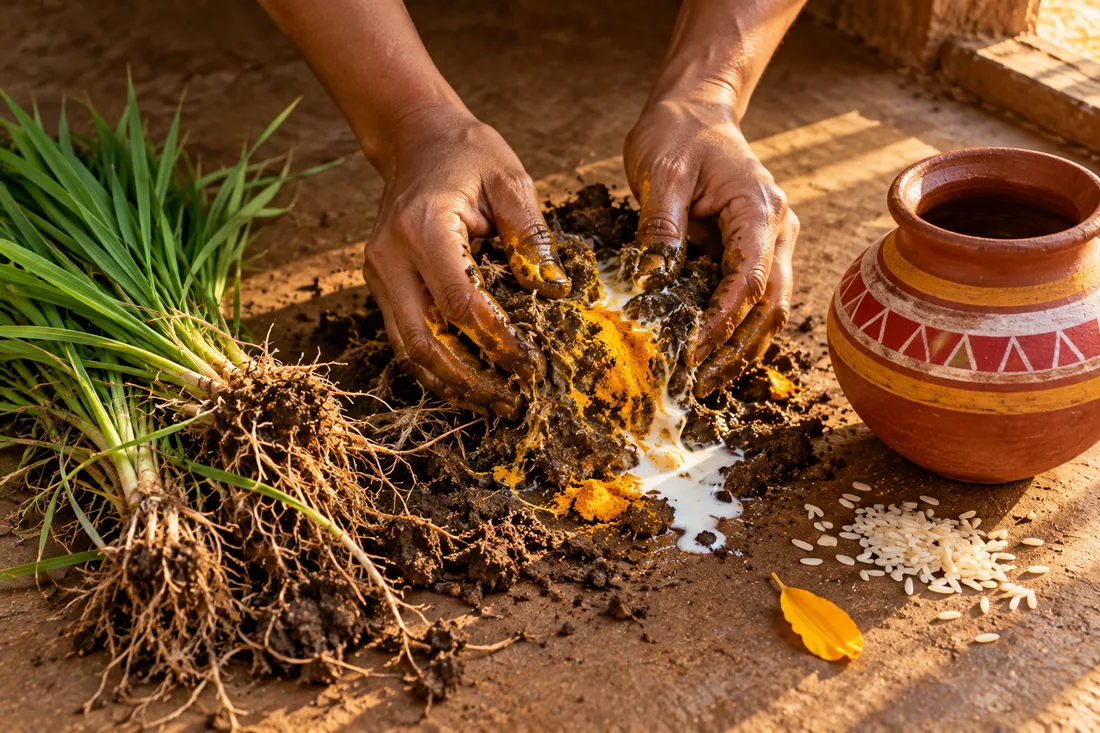
Hands mixing turmeric and milk into the dark earth still clinging to the roots of a freshly pulled handful of green paddy, on a swept earth floor, with a painted earthenware pot beside them

Made from the earth off the paddy roots

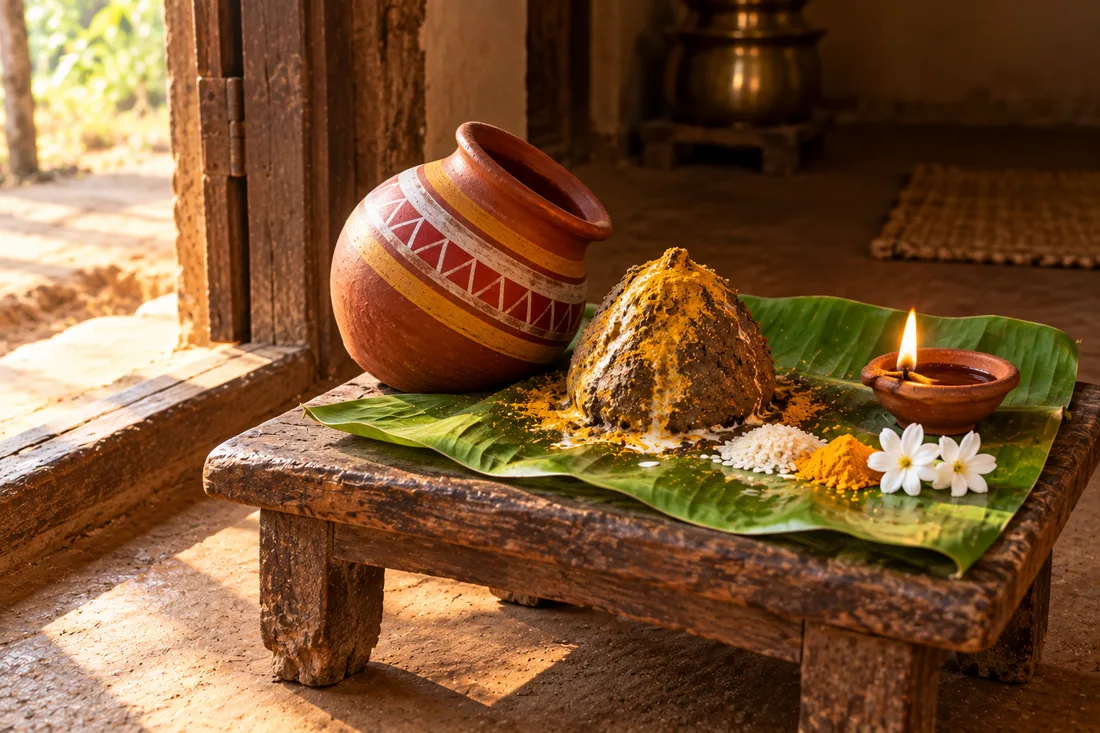
Among the Godavari households, a handful of growing paddy is pulled up at Dasara. Eight days later the earth still clinging to its roots is worked together with turmeric and milk, and from that the image of the goddess is made. She is kept under the painted pot, and the record identifies her with the mother of the five Pandava brothers.

The painted pot lifted aside on a low wooden stool, and beneath it on a plantain leaf a small hand-moulded mound of earth streaked with turmeric and milk, a clay lamp burning beside it with rice, turmeric and jasmine

Worshipped every Sunday, house by house

For the next six months she is worshipped every Sunday, by all the villagers in turn — so that over the half-year she has been in every house in the place, one Sunday at a time.

Sent back with her gifts

On Sivaratri night she is carried round the village, the families walking with her bearing pots of rice and food, and she is set into the river or the tank. The meaning the record gives is this: she is the daughter of the community, she has lived with them six months, and they are now sending her back to her husband with her gifts.

A cloth and a cow, and where they go

A common vow is to send a cloth and a cow with her on the last day. Those gifts are afterwards given to a married daughter of the house — so the vow made to the goddess lands, in the end, in a real daughter's hands. On a page about marriage there is not much that says more than that.

This is recorded of the Godavari households. Practice and emphasis differ from one district, one branch and one family network to another.

The work

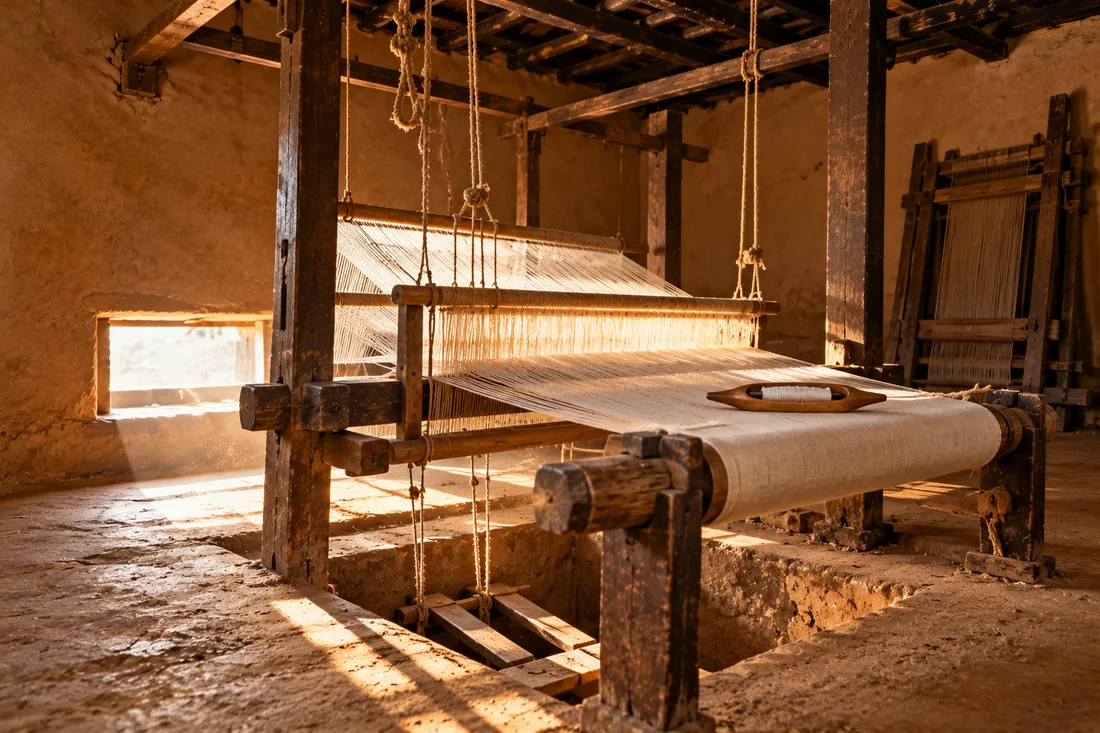
The loom in the corner of the room

In the eastern districts weaving was the staple, and the way the loom sat in the house is described closely enough that you can picture the room.

A wooden pit loom in the corner of a mud-walled village room at first light, its frame slung from the rafters by ropes over a pit cut in the floor for the treadles, the warp lit from below by a window at floor level

Slung from the rafters, over a hole in the floor

The loom stood in one corner, hung from the roof beams by ropes, with a pit cut in the mud floor to take the treadles and a small window set level with the floor so the light came up through the warp. When the work was done the whole thing folded up and went into the corner.

  • Eight months at the loom, four at the reaping
  • The women spun; the men wove
  • The cotton was the district's own

The shuttle rubbed smooth on the nose

One small habit of the trade was written down here and, so far as the whole of that seven-volume record goes, nowhere else: the weaver rubbing the shuttle against his nose to smooth it before he sends it through. It is the kind of thing only someone who watched closely would have thought to note.

The loom is honoured

These households are recorded as honouring the loom itself. Weavers of other communities in the South are recorded doing the same in the same work, each in their own way, and it is set down here as something these families kept rather than something they kept alone.

Jammalamadugu

The 1909 record places Mala weavers around Jammalamadugu in Kadapa, and Jammalamadugu is a handloom town to this day. Who works its looms now is a different question and this page does not claim an answer to it.

Practice and emphasis differ from one district, one branch and one family network to another — this is heritage held with pride, not a single rule book.

When a marriage is made

The little betel, the big betel, and a feast the children bless

The stages of a Mala marriage are named, and two of them are named in a way that appears nowhere else in the old record.

The betel comes twice

First the Chinna Tambulam, the little betel, at the girl's house — and that one does not bind anybody. Then the Pedda Tambulam, the big betel, which does. Two families can take the first step and still step back from it, and everybody present knows which of the two evenings they are at.

  • Chinna Tambulam — the little betel
  • Pedda Tambulam — the big betel

Bhumalu, and the three children

A feast over two days for the couple and blood relations only — six to ten people, and all of them married couples, three pairs or five. Three children tie the wrist-thread on each couple and daub them with sandal and red rice. Not a grain may be dropped. It is one of the few rites anywhere in that record where the blessing is given by children.

The consent is asked out loud, three times

Before the marriage the priest asks whether the elders, the Mala people generally, and the village as a whole are in favour of it — and he asks three times. Before the token is tied the groom must ask leave of priest and people, three times again. At the betrothal the maternal uncle asks the parents first and then the whole gathering.

And the blessing runs both ways

The priest dips a twig of the jivi tree in milk and hands it to the husband, who crosses his hands above his wife's head and lets the drops fall on her. Then she takes it and does exactly the same over him. Whatever else has changed in a hundred years, that is a fine thing to have written down.

Yellow and white, a branch at the door, and betel to every house

The wedding clothes are yellow and white, and on no account indigo. An oleander branch is planted by the door with the wrist-thread tied to it, and somebody waters it every day until the ceremonies are done. Betel goes to every house in the village, with even the unborn counted in. And after the ceremonies at the groom's house the whole party goes to the bride's for the Marala Pendli — the second wedding.

Several of the rites named here are kept by other households across the Telugu country too, and are written as things these families keep rather than things they hold alone.

The deities of the house

Two traditions, and the names a household keeps

Mala families are recorded in both the Vaishnava and the Saiva observance, and what a household keeps is very much its own.

Both observances, in the same community

Households are recorded in both traditions, and ceremonies are said to vary with the district and the observance. One small difference was thought worth writing down: after the Bhumalu feast, Vaishnava households give out what is left, and Saiva households keep it within the house.

The names that are honoured

Among the deities named for these households are Gurappa, Subbarayadu, Gunnathadu, Sunkalamma, Poleramma, Gangamma and Gontiyalamma. Several of them are honoured widely across the Telugu country by many households, and they are named here as deities these families keep, not as deities they hold alone.

  • Gurappa · Subbarayadu · Gunnathadu
  • Sunkalamma · Poleramma · Gangamma
  • Gontiyalamma

What the hymns honour

The hymns sung in these households honour Chennudu — Chennakesava — and Pedda Muni.

The intiperu, and the rule behind it

The house name is not only how a family is known: it is the line the family marries away from, and two households of the same intiperu do not make an alliance. No roll of these house names exists anywhere, and the profile does not pretend one does — you write yours as your family says it. Descent runs in the father's line.

Devotion is honoured here on its own terms. Nothing on this site ranks one form of it above another.

Questions families ask

Common questions from Mala families

How is our family's lineage recorded?

By the intiperu, the house name your family writes before its own. It is the line you marry away from, and two households of the same intiperu do not make an alliance. You write yours in your own words — no roll of these house names exists, so nothing is chosen for you. Your kula devata sits beside it on the profile.

Our family has been in Tamil Nadu, or in the Bellary side, for generations.

Then you are in the right place. These households have been settled outside the Telugu districts for a very long time, and native place and the state your family lives in are separate fields on the profile. Neither changes which community you belong to.

Will we only see Mala profiles here?

Yes. Registering through this page places your profile in the Mala community, and every profile you see, match with, or contact belongs to it. Your intiperu, your family deity and your native district are on the profile, so a household that wants to look within a familiar circle can see at a glance who a family is.

Older outside names for the community — are they used here?

No. Only the names families use of themselves are used on this site, and those are the names you will see on every profile and in every search.

Will our phone number be visible to everyone?

It is not shown openly on your profile. A member who wants to take an introduction forward can see your contact through the app's Reveal Contact feature and reach you directly, and Government-ID-verified badges help you know who you are speaking with.

Next step

Register or login when your family is ready to continue

Create your account and step into the Mala space on Sri Guru Raghavendra Matrimony, where your intiperu and the deity your household keeps are part of every profile from the first day — and your family sets the pace.