Sri Guru Raghavendra Matrimony™ emblem
SRI GURU RAGHAVENDRA MATRIMONY™

Kalam, dawat and the twelve names

Kayastha Matrimony

Chitraguptavanshi Kayastha families trace themselves to Lord Chitragupta, keeper of the record of every deed, and on Yama Dwitiya, just after Diwali, they set the kalam and the dawat — the pen and the inkpot — before him. This page is for the families of the twelve names, Srivastava, Saxena, Nigam, Mathur and the rest, from Bhopal, Jabalpur, Sagar and Rewa to Lucknow, Patna and Delhi.

SrivastavaSaxenaNigamMathur Kayastha

Begin when you are ready

Register now, or read about Kayastha heritage first

Creating an account takes a few minutes. If your family prefers to understand the space first, the sections below walk through the kalam and the dawat of Yama Dwitiya, Chitragupta and his shrines in Madhya Pradesh, the twelve names, the kul that comes first, and the khaskalams of Rewa.

Registrations from this page stay within the Kayastha community — every profile your family sees and contacts belongs to it.
Chitragupta's own families

A heritage your family carries every day

Writing is the heritage these families carry — the kalam and the dawat set before Chitragupta each Yama Dwitiya, and twelve family names that come down, by tradition, from his twelve sons.

Families are found across Madhya Pradesh — Bhopal, Jabalpur, Sagar, Damoh, Narsinghpur, Seoni, Chhindwara, Rewa and Ujjain — through Uttar Pradesh, Bihar and Delhi, and in Hyderabad, where Kayastha households have made their home for close to three hundred years.

A Kayastha family usually asks three things before anything else: which of the twelve, which kul, and which district. All three sit on the profile, and the kul is written the way the family says it.

What families often ask first

What families often value first

  • Your family's group among the twelve sits on the profile, with your kul beside it in the words your elders use.
  • Search by native district — Bhopal, Jabalpur, Sagar, Rewa, Lucknow, Prayagraj, Patna and beyond.
  • Registrations stay within the Kayastha community, and within it your family can look across all twelve names or only within its own.

What your family will find inside

Which of the twelve, which kul, which district — on the profile

These are the questions a Kayastha household settles first, and the answers are there before any contact is exchanged.

Government ID verified members stand out

Members who complete Government ID verification carry a clear mark, giving your family added reassurance at a glance.

Narrow the search by group and native district

Look across all twelve names, choose only your own, or pick several — and narrow by native district: Bhopal, Jabalpur, Sagar, Rewa, Lucknow, Patna and many more.

Lineage recorded your way

The kul, the gotra and the kul devta are each written as your elders say them — there is no list you have to fit into.

Education, work, and family background together

Degrees, professions, and family character read clearly on every profile, in the same order elders weigh an alliance.

Contact details are not shown openly

Phone numbers and email are not shown openly on profiles. A member uses the Reveal Contact feature to see another member's details and reach out directly when they are ready to take an introduction forward.

Interest is never lost

Shortlists and the profiles your family has already opened stay saved, so you can return to a promising profile after the household has talked it over.

Built around how Kayastha alliances are made

Whether your family looks close to home in Bhopal or Jabalpur, or among Kayastha households in Lucknow, Delhi and Hyderabad, the things that decide an alliance — the group, the kul, the district and the family itself — stay in view.

Why families feel at ease

Why Kayastha families feel at home

The details that decide an alliance sit together in one place, presented the way your family would present them.

Known by your own name

Srivastava, Saxena, Nigam, Chitransh or simply Kayastha — the names families type most often all lead here.

Madhya Pradesh first, and the whole heartland

A family in Bhopal or Sagar and a family in Lucknow, Patna or Delhi find each other here, each with its native district on the profile.

Comfortable for parents and members alike

Whether the search is led by a parent, a sibling, or the member themselves, the profile reads clearly for all of them.

Move at your family's pace, with tradition honoured up front and you reach out when your family is ready.

Yama Dwitiya

Kalam and dawat

On the second day of the bright half of Kartik — the same day as Bhai Dooj — a Kayastha household sets its pen and its inkpot before Chitragupta.

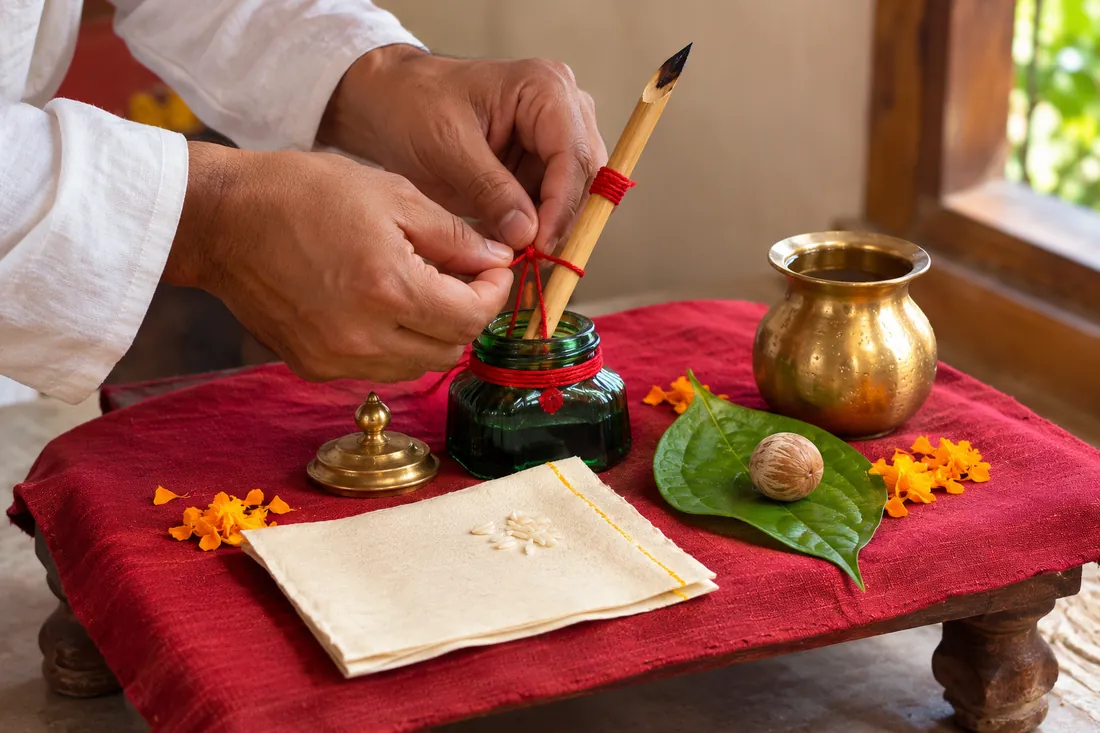
Hands tying red thread around a reed pen standing in its green glass inkpot for the Kalam-Dawat puja of Yama Dwitiya, beside a folded sheet of paper with rice, a betel leaf and a brass lota

What the family sets out

The kalam, the pen, and the dawat, the inkpot, are placed before Chitragupta's image, the pen tied with a red thread. With a fresh pen the family writes the names of the deities, Chitragupta's among them, and often line after line of Ram's name. In some homes the year's accounts are set before him too.

Twice in the year, by the old record

An account of the Central Provinces written in 1916 notes Kayastha families honouring the pen and the ink twice a year. An older account names two days in the year for Chitragupta's worship: this one after Diwali, and a second just after Holi, in Chaitra.

In Bhopal

In Bhopal the kalam-dawat puja is kept each year at the city's Chitragupta temples — in Chitragupta Nagar at Kotra, in Professor Colony and at 1100 Quarters.

Each family keeps the day in its own way — this is heritage held with pride, not a single rule book.

Faith

Chitragupta, keeper of every deed

Kayastha homes honour Chitragupta as their divine ancestor, beside the Shaiva, Shakta or Vaishnava devotion each family follows.

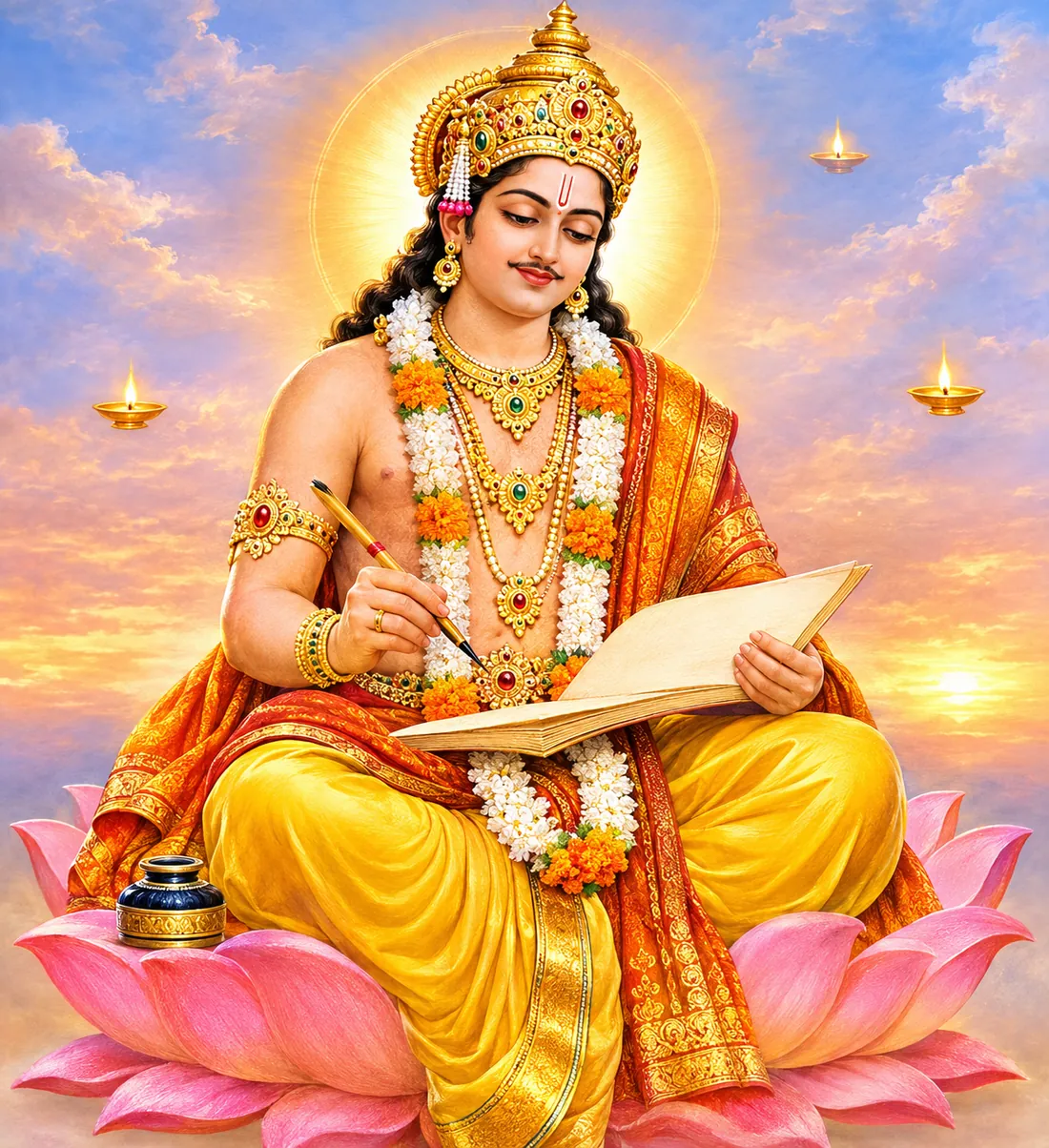
A devotional painting of Lord Chitragupta seated on a pink lotus, writing with a pen in an open book, an inkpot beside him and small lamps floating in the dawn sky

Bearing an inkpot and a pen

By tradition, as the Padma Purana tells it, Chitragupta came forth from Brahma himself, bearing an inkpot and a pen, to keep the record of every deed. The families of the twelve names trace their own line to him — which is why they are called Chitraguptavanshi, and why many say Chitransh.

His shrines in Madhya Pradesh

At Ankpat in Ujjain stands the Chitragupta Dham, in the city where, tradition says, he sat in austerity. In Chhindwara the district's Kayastha families laid the foundation of a Chitragupta temple in 1901, and Bhopal keeps several of its own.

  • Ankpat, Ujjain
  • Chhindwara, from 1901
  • Bhopal

At the wedding too

The same 1916 account of the Central Provinces notes Kayastha families worshipping Chitragupta at their weddings, as they did at Holi and Diwali.

Mentioned here with reverence alone; devotional matters rest with each family and its elders.

The community

The twelve names

By tradition Chitragupta had twelve sons, and the twelve family names of the community come down from them.

Twelve sons, twelve names

Most families know their own, and here each is named on its own: Srivastava, Saxena, Nigam, Mathur, Bhatnagar, Asthana, Kulshreshtha, Gaur, Ambashtha, Karn, Suryadhwaj and Valmik. A family that is not sure of its group is just as welcome.

  • Srivastava · Saxena · Nigam
  • Mathur · Bhatnagar · Asthana
  • Kulshreshtha · Gaur · Ambashtha
  • Karn · Suryadhwaj · Valmik

Names from old towns

Several of the names point to old towns of the north — Srivastava to Shravasti, Saxena to Sankisa, Mathur to Mathura, Bhatnagar to Bhatner and Gaur to the old city of Gaur. That is how the old accounts read them; families keep their own stories too.

Within your own group, or across the twelve

Families once married within their own group, and many still prefer to. Over the last century more and more families have married across the twelve. Both are open here: your family can look only within its own group, or across all twelve.

Whichever of the twelve is yours, the welcome is the same.

How a family is known

The kul comes first

Where a family keeps its kul, it is the line that household marries away from — so the kul comes first among the family's lines on the profile.

The kul, and the mother's side

The kul — in many families called the al — is a family line, often named for the town or village the family came from, or for an old title, and it passes from father to child. Where the kul is kept, two households of the same kul do not make an alliance, and many families keep the mother's side in mind as well. The kul goes on the profile in the family's own words.

The gotra has its place too

Old records note that many Kayastha families share one gotra, Kashyap, which is why the kul is the one weighed. The gotra still sits on the profile, for every family that keeps it in mind.

A name shared far and wide

Sinha, Verma, Prasad and Lal are carried by many Kayastha families and by many families of other communities too, and so are some of the twelve, being the names of old towns. A surname is a family's name and nothing more; each family says for itself where it belongs.

The family deity

There is a place for the kul devta, if your household keeps one. It differs from one family to the next, so it is written as your elders name it, or left blank.

Practice differs from one region and one family to another — in some homes only the father's kul is weighed — so each family records its own.

Madhya Pradesh

The khaskalam of Rewa

In the old Rewa state the papers of the court were drawn up, and its accounts kept, by the khaskalams — its writers and accountants.

Written in the state's own record

The Rewa state gazetteer of 1907 records that the khaskalams belonged to the Kayastha community, and that their way of keeping the state's accounts was spoken of most favourably.

From the capital to the village

The same gazetteer found the old abstracts of the state's receipts and expenses remarkably full and clear, item by item, from the accounts of each village up to the summary for the whole state.

A piece of Madhya Pradesh's own record, set down here as heritage held with pride.

Questions families ask

Common questions from Kayastha families

Will we only see Kayastha profiles here?

Yes. Registering through this page places your profile in the Kayastha community, and every profile you see, match with, or contact belongs to it.

How is our family's lineage recorded?

Your kul is written in your own words, the way your family has always said it. The gotra and the kul devta have their place too, and nothing is assumed from a surname.

We are Srivastava — or Saxena, Nigam, Mathur — do we choose our own group?

Yes. Each of the twelve is named on its own, and a family that is not sure of its group can choose Other Kayastha. Some families look only within their own group and others across all twelve; both are open to you.

Our family is Kayastha from Odisha, Bengal or Maharashtra — is this our place?

This page is for the families of the twelve names — Srivastava, Saxena, Nigam, Mathur and the rest. Odia Karan families, many of whom also say Odia Kayastha, have their own page here, and so do Bengali Kayastha families and Chandraseniya Kayastha Prabhu (CKP) families. Kayastha families of other traditions keep their own customs, and the request option in the app is how you tell us which community to welcome next.

Will our phone number be visible to everyone?

It is not shown openly on your profile. A member who wants to take an introduction forward can see your contact through the app's Reveal Contact feature and reach you directly, and Government-ID-verified badges help you know who you are speaking with.

Next step

Register or login when your family is ready to continue

Create your account and step into the Kayastha space on Sri Guru Raghavendra Matrimony, where your family's group among the twelve, your kul and your native district are part of every profile from the first day — for Chitraguptavanshi families of Madhya Pradesh, Uttar Pradesh, Bihar and Delhi, wherever they live today, and your family sets the pace.