Sri Guru Raghavendra Matrimony™ emblem
SRI GURU RAGHAVENDRA MATRIMONY™

The Odia families of the palm leaf and the pen

Karan Matrimony

In Odia, karana is the word for a writer, and Karan families wrote many of Odisha's records on palm leaf, often in Karani, a quick running hand. The Karan families this page is for are Odia households, found chiefly in Cuttack, Puri, Balasore and the other coastal districts and in Ganjam to the south — and this page begins with the word their name means, then the gotra and the native district that sit on every profile.

Karan

Begin when you are ready

Register now, or read about Karan heritage first

Creating an account takes a few minutes. If your family prefers to understand the space first, the sections below walk through karana, the writer, and the Karani hand, the chronicle kept at Puri from Sunia to Sunia, the gotra and the names families carry, and the farewell songs.

Registrations from this page stay within the Karan community — every profile your family sees and contacts belongs to it.
The palm leaf and the pen

A heritage your family carries every day

Writing was the craft, the palm leaf and the iron lekhani its tools — and the craft's name, karana, is the one these families carry.

Families are found across the coastal districts of Odisha — Cuttack, Puri, Khordha, Jagatsinghpur, Kendrapara, Jajpur, Bhadrak and Balasore — and southward in Ganjam and Gajapati, and today in Bhubaneswar, Bengaluru, Hyderabad and well beyond.

Here the gotra, in your family's own words, and the native district are set down on the profile before the first conversation — so a Karan household weighs an alliance with what it asks first, and with the dignity your family expects.

What families often ask first

What families often value first

  • Your gotra and your family sit on the profile in your own words, exactly as your elders name them.
  • Search by native district — Cuttack, Puri, Khordha, Balasore, Kendrapara, Ganjam and beyond.
  • Registrations stay within the Karan community, whether your family calls itself Karan, Karana or Odia Kayastha.

What your family will find inside

The gotra and the native district, read before anyone calls

These are the details Karan households settle first — and they are visible before any contact is exchanged.

Government ID verified members stand out

Members who complete Government ID verification carry a clear mark, giving your family added reassurance at a glance.

Lineage recorded your way

Your gotra is written exactly as your elders name it, and a family deity too if your household keeps one — there is no list you have to fit into.

Filter by native place and family origin

Narrow the search by native place — Cuttack, Puri, Khordha, Jagatsinghpur, Kendrapara, Jajpur, Bhadrak, Balasore, Ganjam, Gajapati and many more.

Education, work, and family background together

Degrees, professions, and family character read clearly on every profile, in the same order elders weigh an alliance.

Contact details are not shown openly

Phone numbers and email are not shown openly on profiles. A member uses the Reveal Contact feature to see another member's details and reach out directly when they are ready to take an introduction forward.

Interest is never lost

Shortlists and the profiles your family has already opened stay saved, so you can return to a promising profile after the household has talked it over.

Built around how Karan alliances are made

Whether your family looks close to home in Cuttack or Puri or among Odia households in Bengaluru and Hyderabad, the things that decide an alliance — the gotra, the native district and the family itself — are always in view.

Why families feel at ease

Why Karan families feel at home

The details that decide an alliance sit together in one place, presented the way your family would present them.

Known by either name

Many Karan families also call themselves Odia Kayastha, and some write Karana. Whichever your family uses, this is the page for you.

The native district always in view

A family still in Cuttack and a family three generations in Bengaluru both name the district they come from, and that is on the profile for every family to see.

Comfortable for parents and members alike

Whether the search is led by a parent, a sibling, or the member themselves, the profile reads clearly for all of them.

Move at your family's pace, with tradition honoured up front and you reach out when your family is ready.

The name

Karana — the writer, in Odia

Before the gotra or the district, there is the name itself — an Odia word with a craft inside it.

The word itself

Among the meanings the old Odia dictionary gives for karana, two sit side by side: a professional writer, and an expert one. It is a name that describes a craft, and the craft was writing.

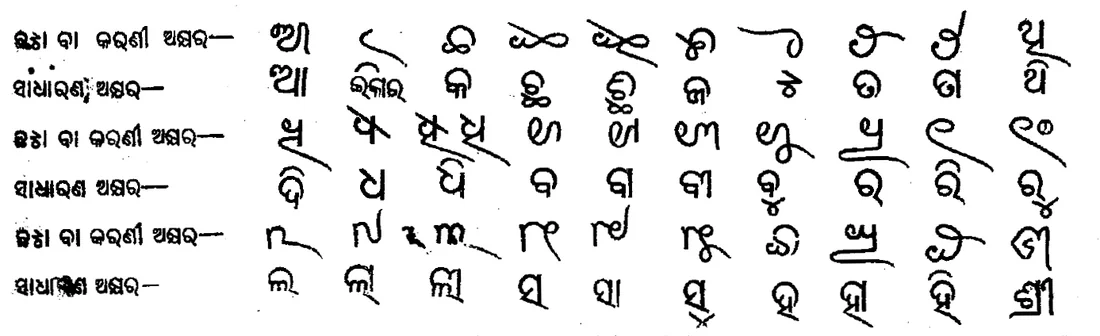
A page of Karani letters from the old Odia dictionary, each row of the running hand set above the ordinary Odia letter

Karani, the running hand

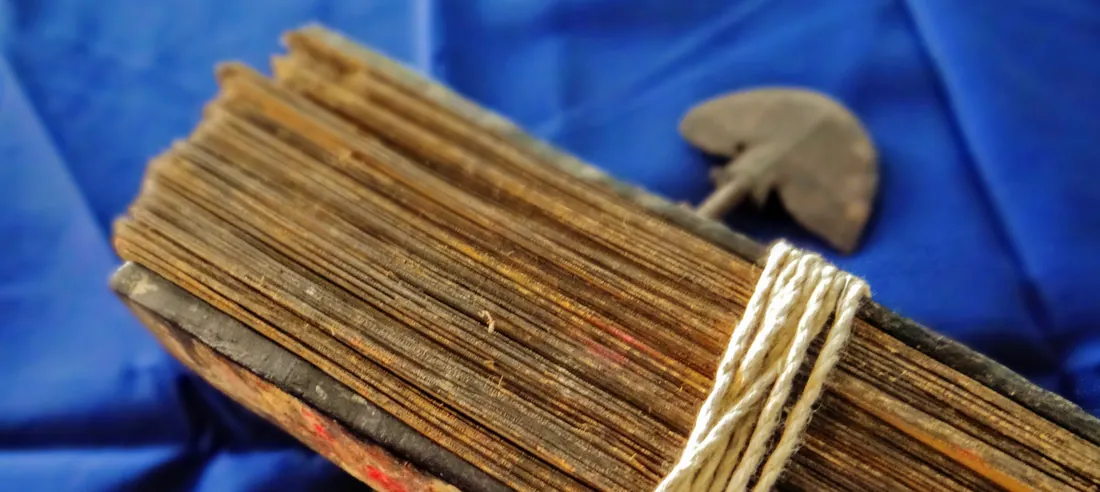
The old records of Odisha were written on palm leaf with an iron lekhani, the letters scratched in and then darkened. For speed there was Karani, a quick running hand with its own shortened letters, which the same dictionary describes as used by Karan writers especially. The Puri district gazetteer notes that most of the old Odia records on palm leaf use its letters.

  • Palm leaf and the iron lekhani
  • Letters shortened for speed
  • Found in most of the old palm-leaf records

A craft is carried differently in every family — this is heritage held with pride, not a single rule book.

The record at Puri

From Sunia to Sunia

At the great temple at Puri, a chronicle of the temple's own life was written year after year — and the offices that kept it carry the Karana name.

The Madala Panji

The temple's chronicle, the Madala Panji, was written on palm leaf with the lekhani, and each year's leaves were bound into a bundle of their own — from Sunia to Sunia, the Odia new year of the old reckoning.

Offices that carry the name

Several temple offices carry the Karana name: the Deula Karana, who keeps the accounts of the temple stores and the deities' wardrobe; the Tadau Karana, who has charge of the Madala Panji; and other Karanas who keep accounts.

Mentioned here with reverence alone; devotional matters rest with each family and its elders.

How a family is known

The gotra, and the names families carry

The line a Karan family marries away from is its gotra, and the surname is a separate matter.

Gotras the old records name

Two households of the same gotra do not make an alliance. Bharadwaja, Kashyapa, Atreya, Parasara, Mudgala, Sankhyayana, Krishnatreya and Nagasa are among the gotras recorded for Karan families over the years — and if your family's is another, it goes on the profile just as your elders say it.

  • Bharadwaja · Kashyapa · Atreya
  • Parasara · Mudgala · Sankhyayana
  • Krishnatreya · Nagasa

Surnames are not communities

Patnaik, Mohanty, Das, Mohapatra and Bohidar are names many Karan families carry — and several of them are carried just as proudly by Odia families of other communities. On this site a surname records a family's name; it never decides which community a family belongs to.

The family deity, if your household keeps one

Beside the gotra there is a place for a family deity or village goddess, if your household keeps one. Leaving it empty closes nothing.

Practice differs from one district and one family to another — this is heritage held with pride, not a single rule book.

The wedding

The farewell songs

Two things from an Odia Karan wedding are worth setting down — one at the groom's arrival, one at the bride's leaving.

The karana saanta

In an old Odia phrase, the karana saanta is the honoured relative who accompanies a Karan bridegroom to the wedding.

The kandana, learned before the day

As at many Odia weddings, the bride leaves her parents' house to the kandana, the farewell songs of the women of her family. An account of Balasore written in 1907 noted Karan mothers teaching the songs to their daughters before the wedding, so that a daughter could take leave of every member of her family in song.

Families keep the wedding day in their own ways, and the songs are sung across Odisha.

Questions families ask

Common questions from Karan families

Will we only see Karan profiles here?

Yes. Registering through this page places your profile in the Karan community, and every profile you see, match with, or contact belongs to it.

How is our family's lineage recorded?

Your gotra is written in your own words, the way your family has always said it — Bharadwaja, Kashyapa, Atreya, Parasara and Nagasa are among those recorded for Karan families, and any other is written the same way. Your native district sits beside it, and nothing is assumed from a surname.

Our family says Odia Kayastha rather than Karan — is this the right place?

Yes. Many Karan families use both names, and this page is for them. Srivastava, Saxena, Nigam, Mathur and the other Kayastha families of the twelve names have their own page here, as do Bengali Kayastha families, and Kayastha families of other traditions can tell us which community to welcome next through the request option in the app.

Patnaik, Mohanty and Das are carried by many Odia families — does our surname decide where we register?

No. These names are carried by Odia families of more than one community, so a surname never places a family anywhere. Your family states its own community when it registers, and that is the word that counts.

Will our phone number be visible to everyone?

It is not shown openly on your profile. A member who wants to take an introduction forward can see your contact through the app's Reveal Contact feature and reach you directly, and Government-ID-verified badges help you know who you are speaking with.

Next step

Register or login when your family is ready to continue

Create your account and step into the Karan space on Sri Guru Raghavendra Matrimony, where your gotra and your native district are part of every profile from the first day — for Odia Karan families of the coastal districts, of Ganjam and beyond, wherever they live today, and your family sets the pace.