Sri Guru Raghavendra Matrimony™ emblem
SRI GURU RAGHAVENDRA MATRIMONY™

The Godavari delta and the coast above it

Raju Matrimony

Raju families belong to the Godavari delta and the coast above it, and to the old southern settlements that grew from them. A household names itself in a particular order — the family name first, then the given name — and it is that first word, with the gotra beside it, that two families check before anything else. So this page begins there, and then with the things that follow: the household deity, and the town your family is from.

Suryavamsa RajuChandravamsa RajuOther Raju community

Begin when you are ready

Register now, or read about the Raju heritage first

Creating an account takes a few minutes. If your family prefers to understand the space first, the sections below walk through the names and the districts, the two lines, the gotra and the family name, the betrothal and its written agreement, and the temple at Simhachalam.

Registrations from this page stay within the Raju community — every profile your family sees and contacts belongs to it.
One community, two lines

A heritage your family carries every day

These are households of coastal Andhra — East and West Godavari, Konaseema and Kakinada, Krishna and Eluru, Visakhapatnam, Anakapalli, Vizianagaram and Srikakulam — with families long settled at Rajapalayam in Tamil Nadu who still carry the same family names and the same gotras as the coast they came from, and others now in Hyderabad and Bengaluru.

A Raju name is read from the front. Gottumukkala Krishna Raju is Krishna of the Gottumukkala house, and it is that first word — the intiperu, the house name — that tells another family who you are. The gotra sits beside it, and the two together are what an elder asks for before any other question is answered.

So an alliance here begins with what a household names first: the gotra, the family name, the deity the house keeps and the town it belongs to — with the dignity your family expects.

What families often ask first

What families often value first

  • Your gotra is chosen from the ones this community names, with a place for one that is not listed and a place for not knowing.
  • Your family name — the intiperu, written first — and the deity your household keeps sit on every profile.
  • Search by native place across East and West Godavari, Konaseema, Kakinada, Krishna, Eluru, Guntur, Visakhapatnam, Anakapalli, Vizianagaram, Srikakulam, Virudhunagar, Hyderabad and beyond.

What your family will find inside

Everything your family checks, before the first phone call

These are the details Raju households settle first — and they are visible before any contact is exchanged.

Government ID verified members stand out

Members who complete Government ID verification carry a clear mark, giving your family added reassurance at a glance.

Gotra and family name, both on the profile

They are two different things and this page keeps them apart. A family marries away from its own gotra; the family name is how a household is known. Neither is worked out from the other, because the old lists themselves disagree.

Filter by native place and family origin

Narrow the search by native place — East and West Godavari, Konaseema, Kakinada, Krishna, Eluru, Guntur, Visakhapatnam, Anakapalli, Vizianagaram, Srikakulam, Virudhunagar and many more.

Education, work, and family background together

Degrees, professions, and family character read clearly on every profile, in the same order elders weigh an alliance.

Contact details are not shown openly

Phone numbers and email are not shown openly on profiles. A member uses the Reveal Contact feature to see another member's details and reach out directly when they are ready to take an introduction forward.

Interest is never lost

Shortlists and the profiles your family has already opened stay saved, so you can return to a promising profile after the household has talked it over.

Built around how Raju alliances actually happen

Whether your family looks within its own circle of towns along the Godavari, or further afield among households whose customs sit well with yours, the details that decide it — the gotra, the family name, the deity of the house and the native town — are always in view.

Why families feel at ease

Why Raju families feel at home

The details that decide an alliance sit together in one place, presented the way your family would present them.

Both lines, and no wall between them

A household names itself Suryavamsa or Chandravamsa, and your profile says which. It is there because families ask for it, not because it divides anyone — a Godavari account from 1907 records households of the two lines marrying each other, and nothing on this page treats the answer as a barrier.

Your family name is read first, as it should be

Pusapati, Penmetsa, Dantuluri, Kalidindi, Vatsavaya — the word that comes at the front of the name is the one another family listens for, so it is on the profile as your family writes it.

Comfortable for parents and members alike

Whether the search is led by a parent, a sibling, or the member themselves, the profile reads clearly for all of them.

Move at your family's pace, with tradition honoured up front and you reach out when your family is ready.

The names, and where the families are

Raju, Razu, and the coast they belong to

Raju households are spread along the Andhra coast and south of it, and they answer to more than one spelling. It is worth setting down which families this page is for.

The spellings you will see

Raju and Razu are the same word written two ways — the older records use Razu, and Rajulu is simply its plural. Suryavamsa Raju and Chandravamsa Raju name the two lines. Whichever spelling your family uses, it leads here.

  • Raju · Razu · Rajulu
  • Suryavamsa Raju · Chandravamsa Raju
  • The Rajapalayam families

Where the households are

The Godavari delta is the heart of it — East and West Godavari, Konaseema, Kakinada — with families through Krishna and Eluru, and up the coast at Visakhapatnam, Anakapalli, Vizianagaram and Srikakulam. Guntur, Hyderabad and Bengaluru hold many households now, and the work of the last two generations has carried families much further than that.

The Rajapalayam families

Some centuries ago a group of these households settled at Rajapalayam, in what is now Virudhunagar district in Tamil Nadu, and they are there still. They carry the same family names and the same gotras as the coastal families, and they have never stopped saying where they came from. If yours is one of them, this is your page too.

The name is shared, and that is an old thing

Raju began as a title, and more than one community carries it, each with its own name, its own story and its own people. This page speaks only for the households described above, and would not presume to speak for any other. If your family carries the name and does not find itself here, please do let us know through the request option in the app — it is the kind of request that decides what we open next.

Practice and emphasis differ from one town, one branch and one family network to another — this is heritage held with pride, not a single rule book.

Two lines, one community

Suryavamsa and Chandravamsa

Many Raju households will tell you which of the two lines they belong to. It is worth knowing what that answer is, and what it is not.

What a family is saying

Suryavamsa families trace their line to the sun, Chandravamsa families to the moon. It is an old way of saying where a household stands in a much longer story, and it is the first thing many families mention after the gotra. Your profile carries it because families ask for it.

It has never been a wall

A Godavari account written down in 1907 records households of the two lines eating together and marrying each other. It is one record rather than a rule, and it does not speak for every household — but it is enough to say the line a family names has never stood as a settled wall between these people. Nothing here narrows your search unless you choose to narrow it.

If your family does not say

Plenty of households simply do not use the word any more, and there is a place on the profile for that too. Leaving it unsaid closes nothing and is not a gap anybody will read into.

Every line named here stands on its own terms. Nothing on this site places one household above another.

How a marriage is guarded

The gotra, and the family name written first

Two things decide whether an alliance can be made, and families keep them quite separate. Getting the difference right is most of what this page is for.

The gotra is the rule

A Raju family marries away from its own gotra. Five are named most often — Vasishta, Dhananjaya, Kasyapa, Kaundinya and Pasupati — and households name others beside them. So the list here is not closed, and there is a place for a gotra that is not on it and a place for not knowing. No family is turned away for either.

  • Vasishta · Dhananjaya · Kasyapa · Kaundinya · Pasupati
  • Atreya · Viswamitra · Bharadwaja · Kaushika
  • And a place for one that is not listed, or not known

The intiperu is the name, not the rule

The house name that comes first — Pusapati, Penmetsa, Dantuluri, Kalidindi, Gottumukkala, Bhupathiraju, Vatsavaya, Sagi, Datla and many more — is how a household is known and remembered. Most of them began as the name of a village. It sits beside the gotra on your profile, and it is written the way your family writes it.

One does not tell you the other

This is worth saying plainly, because it is often assumed. The lists that match family names to gotras do not agree with each other, and the same name appears under different gotras in the same list. So neither is worked out from the other here, and nobody is asked to guess. Write both, as your family says them.

The word to write is the first one

Raju and Varma sit at the end of a name as a title, and they are the same for everyone here, so they tell another family nothing. The word your family is identified by is the one at the front. That is the one to enter.

Nothing here is assumed from a surname, and nothing is assumed from silence. You may leave any of these blank.

How two families settle it

The meal of settlement, and the agreement written out

Of everything set down about a Raju marriage, the parts that read best today are the ones where two households settle something together: a meal that is named for settling it, an agreement put in writing, and an argument that is meant to end in equals.

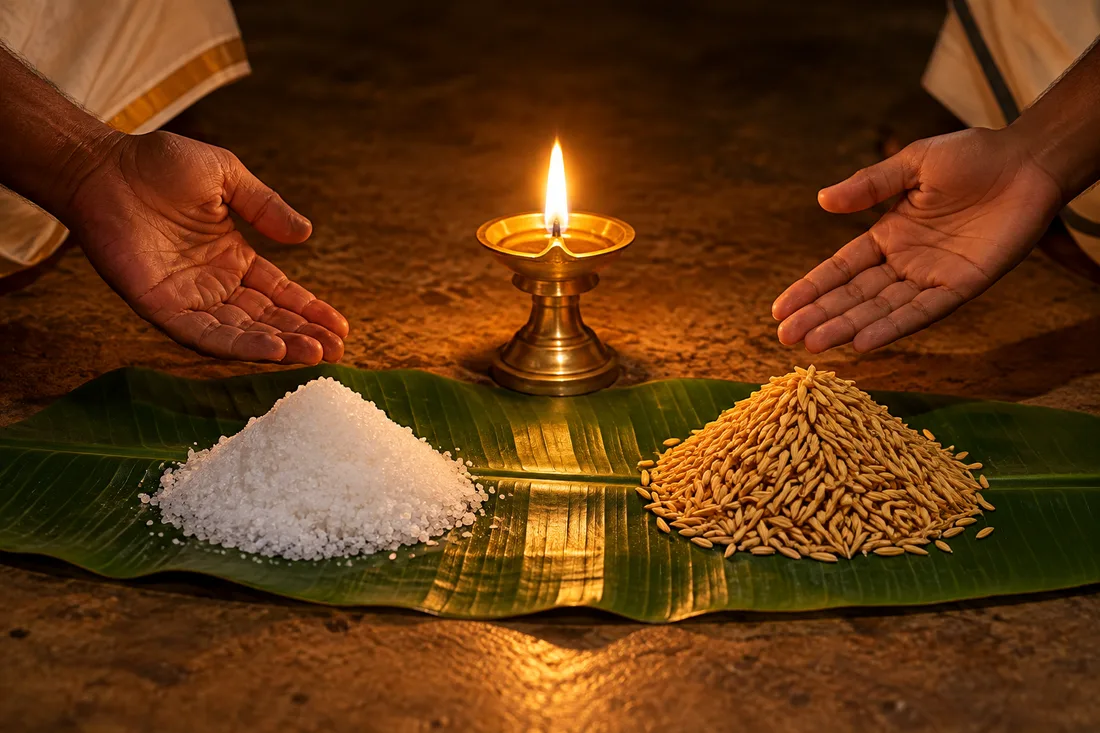
A heap of salt and a heap of paddy laid on a banana leaf with a brass lamp burning between them, and two open hands agreeing that the two are of equal value, on the third day of a Raju wedding

The salt and the paddy

A heap of salt is set down, and a heap of paddy beside it, and the groom and the bride's brother argue over which is worth the more. The argument is meant to be had, and it is meant to end the same way every time: it is decided that the two are of equal value. Two families weighing what each brings, and settling on neither being worth more than the other.

  • A heap of salt, and a heap of paddy
  • The argument, and the agreed answer
  • Recorded among the Rajapalayam households, on the third day

Nirnaya bhojanam, the meal of settlement

The betrothal itself carries a name that says what it is for. Nirnaya bhojanam is the meal at which the matter is settled — the families eat together once the thing is agreed, and the eating is part of the agreeing.

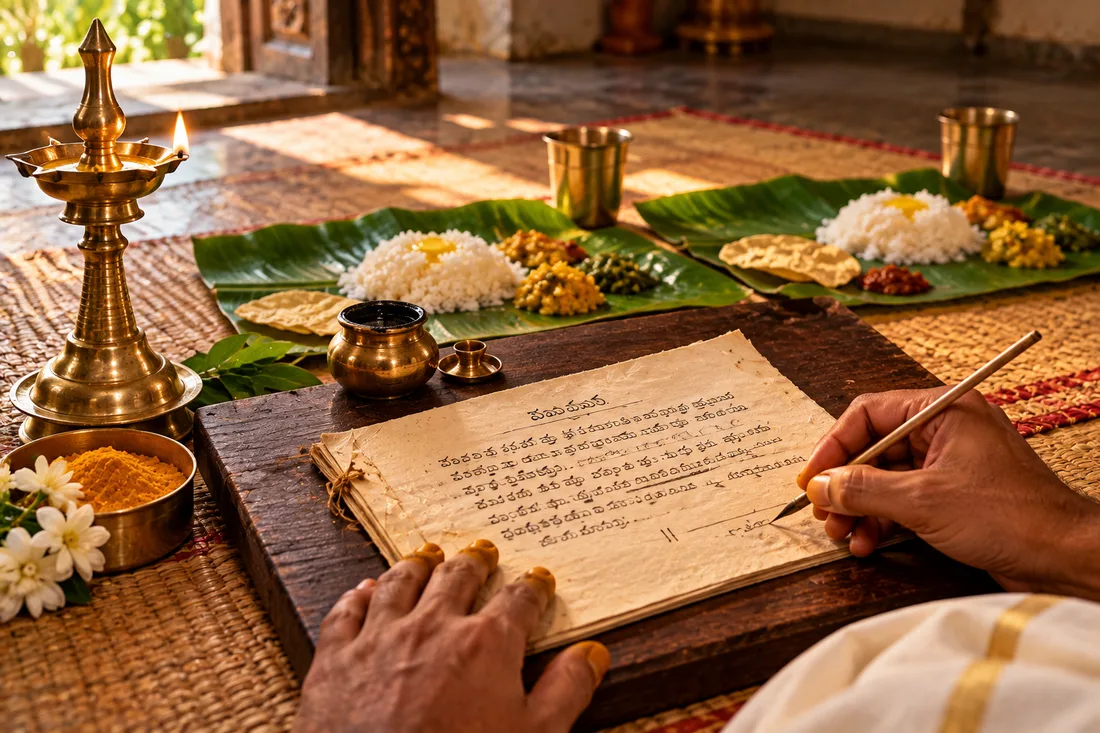
A Raju marriage agreement being written in Telugu on handmade paper with a reed pen, a brass lamp and turmeric beside it, and two plantain leaves laid for the settlement meal behind

Subha reka, the agreement written out

What was decided is then written down. The two households exchange a written contract of marriage — the subha reka — so the agreement leaves the room in a form both families hold. On a page about finding a match it is worth pausing on: a household that puts its promise in writing and hands it across to the other is doing the same thing this site asks of you, only with a reed pen.

Customs vary from one town and one household to another, and none of this is a test anyone has to pass. It is set down so that two families reading it recognise each other.

Before the family's own wedding

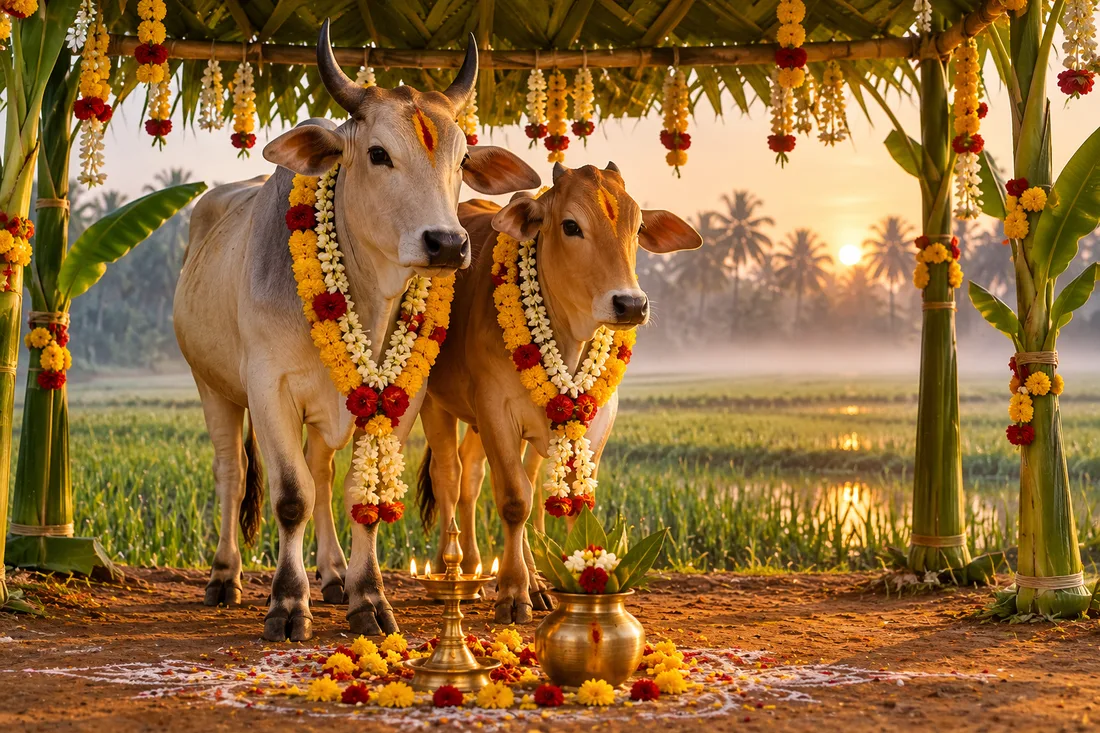
The bull and the cow are married first

Among the Basava Razulu households of the Godavari delta one thing has to happen before any wedding in the family can go ahead, and it is not about the couple at all.

A young bull and a young cow garlanded with marigold and jasmine under a palm-leaf pandal at dawn, turmeric on their foreheads and a brass lamp and kalasha before them, in a Godavari delta field

A wedding before the wedding

A young bull and a young cow are married first, under their own pandal, garlanded and anointed, with a lamp lit before them. Only then may the family's own wedding proceed. Why it is done is a matter these households carry themselves, and this page will not put words in their mouths. What can be said is the shape of it: before a family asks for a blessing on its own marriage, it makes a marriage for two animals, and waits.

Whose custom it is

This belongs to the Basava Razulu families of the delta rather than to every Raju household, and it was written down a little over a century ago. Whether a particular family still keeps it is a question only that family can answer — and many customs of this kind are quietly kept long after the books stop recording them.

Set down here as it was recorded, with reverence, and never as a claim about how any household must live.

Devotion, and a promise a patron kept

Simhachalam, and the play that spoke against selling brides

Two things in this community's keeping sit well on a page about marriage: a hill temple these families have served for three centuries, and a book one of them stood behind.

The Lord under sandalwood

At Simhachalam above Visakhapatnam the image of Varaha Lakshmi Narasimha is covered in sandalwood paste all year, and is seen in its own form on only one day. The Pusapati household has served that temple for some three centuries and holds its hereditary trusteeship still — and the temple's senior priestly offices have long been kept in one family, the Tirumala Peddinti.

The deity your own house keeps

There is no single deity every Raju household keeps, and this page will not invent one. Families name their own — and there is a place on your profile to write it, the way your family says the name. It is often the first thing two households find they have in common.

Kanyasulkam, and what it stood against

In 1892 Gurajada Apparao wrote Kanyasulkam, a play in plain spoken Telugu against the selling of brides and the marrying of children. He dedicated it to Ananda Gajapati of Vizianagaram, who had taken up that cause, and the play is still read and staged today. On a matrimony page it is worth saying plainly: when this community is remembered for something to do with marriage, it is for standing against a bride being bought.

Music, and the language

The music school founded at Vizianagaram in 1919 and the Sanskrit college before it were built to teach, and they still do — singers whose names any Telugu household would know came through them. It is a quiet kind of heritage: not what a family owned, but what it kept open for other people's children.

Devotion is honoured here on its own terms. Nothing on this site ranks one form of it above another.

Questions families ask

Common questions from Raju families

Will we only see Raju profiles here?

Yes. Registering through this page places your profile in the Raju community, and every profile you see, match with, or contact belongs to it. Your gotra, your family name, your line and your native town are on the profile, so a household that wants to look within a familiar circle can see at a glance who a family is.

We are Suryavamsa (or Chandravamsa). Does that narrow who we will see?

Only if you want it to. Your line is named on your profile because families ask for it, but it has not stood as a wall between these households — a Godavari account from 1907 records households of the two lines marrying each other. You will see both unless you choose otherwise, and a family that does not use the word at all can leave it unsaid.

Our gotra is not one of the ones usually named. Can we still register?

Yes, and you are not unusual. The ones named most often are Vasishta, Dhananjaya, Kasyapa, Kaundinya and Pasupati, but households name others beside them and the older lists never agreed on a single set. So there is a place for a gotra that is not listed and a place for not knowing, and neither closes anything.

How is our family's lineage recorded?

By two things kept separate. The gotra is the line your family marries away from, and you choose it from the ones this community names, with room for one that is not listed. The family name — the intiperu, the word written first, Pusapati or Penmetsa or Dantuluri — is how your household is known, and you write it in your own words. One is never worked out from the other, because the old lists themselves disagree. Raju and Varma are titles and are not what we mean by the family name.

Will our phone number be visible to everyone?

It is not shown openly on your profile. A member who wants to take an introduction forward can see your contact through the app's Reveal Contact feature and reach you directly, and Government-ID-verified badges help you know who you are speaking with.

Next step

Register or login when your family is ready to continue

Create your account and step into the Raju space on Sri Guru Raghavendra Matrimony, where your gotra, your family name and your household deity are part of every profile from the first day — and your family sets the pace.