Sri Guru Raghavendra Matrimony™ emblem
SRI GURU RAGHAVENDRA MATRIMONY™

A sehra of roses and jasmine

Khatri Matrimony

Khatri families of Delhi and Chandigarh, of Punjab and Haryana, of the hills of Mandi and Kangra, and of Lucknow and Kanpur each carry a got of their own, and keep it in mind when a match is weighed. This page is for Hindu Khatri families, wherever they live today.

Khatri

Begin when you are ready

Register now, or read about Khatri heritage first

Creating an account takes a few minutes. If your family prefers to understand the space first, the sections below walk through the got and the gotra, the sehra and the milni, and the goddess in the hills.

Registrations from this page stay within the Khatri community — every profile your family sees and contacts belongs to it.
Punjab, the hills, and Lucknow

A heritage your family carries every day

Many Khatri families live in Delhi and Chandigarh, or come from Punjab — Amritsar, Jalandhar, Ludhiana, Patiala — and from Haryana's cities, Ambala and Karnal, Faridabad and Gurugram. Others have long made their homes in Mandi and Kangra, or in Lucknow, Kanpur, Agra and Varanasi, and many now live abroad.

Punjabi is spoken in many homes and Hindi in many others, and the family's got is passed down from one generation to the next.

Many customs belong to the got and the household rather than to the community as a whole, and each family keeps its own.

What families often ask first

What families often value first

  • The got and the gotra each have their own line, with the mother's got and the family deity beside them.
  • Search by native district — Amritsar, Jalandhar, Ludhiana, Patiala, Ambala, Kangra, Mandi, Lucknow, Kanpur Nagar and many more.
  • Punjabi or Hindi, the mother tongue is on every profile, and the search stays among Khatri families.

What your family will find inside

A line for the got, and one for the gotra

In many Khatri homes the got and the gotra are two different things, so each has a line of its own.

Government ID verified members stand out

Members who complete Government ID verification carry a clear mark, giving your family added reassurance at a glance.

Narrow the search by native district

Look for families from Amritsar or Ludhiana, Ambala or Kangra, Lucknow or Kanpur Nagar, and many more.

Lineage recorded your way

The got, the gotra, the mother's got and the family deity are each written as your elders say them — there is no list you have to fit into.

Education, work, and family background together

Degrees, professions, and family character read clearly on every profile, in the same order elders weigh an alliance.

Contact details are not shown openly

Phone numbers and email are not shown openly on profiles. A member uses the Reveal Contact feature to see another member's details and reach out directly when they are ready to take an introduction forward.

Interest is never lost

Shortlists and the profiles your family has already opened stay saved, so you can return to a promising profile after the household has talked it over.

Built around how Khatri alliances are made

The got, the mother's got and the native district are set out plainly, the way the elders weigh them in the first conversation.

Why families feel at ease

Why Khatri families feel at home

The details that decide an alliance sit together in one place, presented the way your family would present them.

Punjabi or Hindi at home

Whichever language the family speaks at home, the mother tongue is there on the profile for the other family to see.

For families abroad, too

A family that has moved abroad keeps its native district in India on the profile, so the elders at home can still place it.

Comfortable for parents and members alike

Whether the search is led by a parent, a sibling, or the member themselves, the profile reads clearly for all of them.

Move at your family's pace, with tradition honoured up front and you reach out when your family is ready.

Heritage

A sabha at Mandi, a home by the Ganga

The hill town of Mandi and the city of Varanasi both have long Khatri histories of their own.

Its beginnings in 1892

In Mandi, home to Khatri families since the early 1600s, the town's Khatri Sabha traces its beginnings to 1892.

Varanasi, for generations

Varanasi's Khatri families already appear in a study of the city's communities published in 1872.

Community institutions are mentioned as heritage and service alone; this space is not affiliated with any association.

Lineage

The got and the gotra

A family's got is its own clan, and usually its own family name. Traditionally, a match within the got is avoided, and many families avoid the mother's got as well.

Within the got

In the old reckoning, two families of one got did not marry, even when no relation between them was known.

A rishi gotra beside it

Many families also keep a rishi gotra, and two different gots can share the same one.

A record kept at Haridwar

Many families have a record at Haridwar, where the family's own priest writes in its births and marriages, generation after generation.

Which gots a family avoids is for its own elders to say.

The wedding

The sehra and the milni

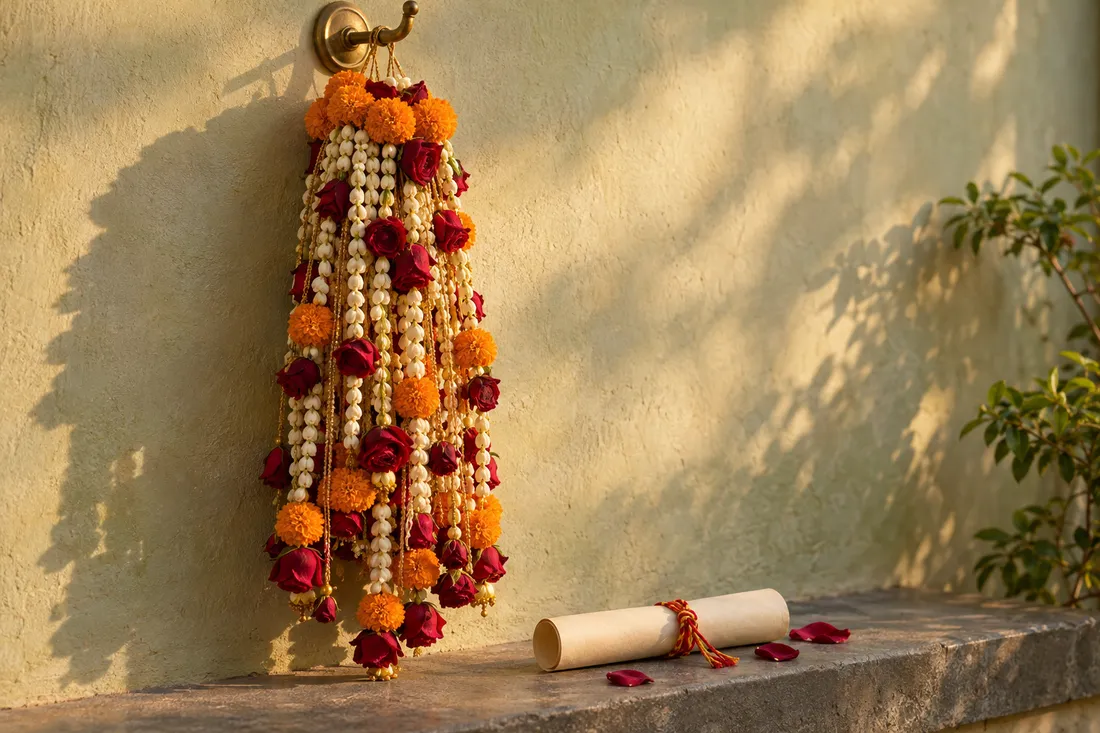
As at many Punjabi weddings, the groom's sisters tie the sehra — strands of roses, jasmine and marigold that fall across his face — and the elders bless it before he sets out.

An illustration of a groom's sehra of marigold, rose and jasmine hanging on a wall, with a rolled poem tied in red thread below it

A poem written for him

A sehra is also a poem, written for the groom by his sisters or a friend of the family. It names his family, near and far, and is read aloud on the day and kept long afterwards.

The milni

At the bride's home, the elders of the two families meet one by one, the eldest first, each greeting his counterpart as they exchange garlands.

Many of these moments are shared across Punjab; the sehra's poem is the one each family writes for itself.

Faith

The goddess in the hills

In the old accounts, several Khatri families took their sons up to the Kangra hills for their first haircut.

The got's patron goddess

The old accounts record a patron goddess for a got, and many families still name a kuldevi of their own.

Up into the hills

The goddess temples of the Kangra hills, Jwalamukhi among them, draw pilgrims from across Punjab, and many bring a red chunri for the goddess.

Not every household keeps a family goddess.

Questions families ask

Common questions from Khatri families

Will we only see Khatri profiles here?

Yes. Registering through this page places your profile in the Khatri community, and every profile you see, match with, or contact belongs to it.

How is our family's lineage recorded?

Your got — often the family name itself — and your gotra are each written in your own words, with a line for your mother's got and one for the family deity. You may leave any line blank.

We know our got but not our gotra — what do we write?

Write what the family knows and leave the rest blank. If the elders find the gotra later, it can be added through Support.

Our family is Khatri, but not from Punjab — is this our page?

This page is written for Punjabi Khatri families, for the Khatri families of Mandi and Kangra, and for those long settled in Lucknow, Kanpur, Agra and Varanasi. The name Khatri is carried by families of other communities too, each with its own customs; if yours is one of them, please tell us through the request option in the app — it is the kind of request that decides what we open next.

Will our phone number be visible to everyone?

It is not shown openly on your profile. A member who wants to take an introduction forward can see your contact through the app's Reveal Contact feature and reach you directly, and Government-ID-verified badges help you know who you are speaking with.

Next step

Register or login when your family is ready to continue

Create your account and step into the Khatri space on Sri Guru Raghavendra Matrimony, where your got, your gotra and your native district are part of every profile from the first day — for Khatri families wherever they live today, and your family sets the pace.