Sri Guru Raghavendra Matrimony™ emblem
SRI GURU RAGHAVENDRA MATRIMONY™

The households of the river, the tank and the net

Bestha / Besta Matrimony

Bestha households belong to inland water — the Cauvery and the Kabini in the old Mysore country, the Tungabhadra, the Bhima and the Krishna to the north, and the tank districts of Telangana. In the old record of the marks each community carried, the mark set down against this name is a net, and in the Mysore list it is a fish. An alliance here begins with the line your family marries away from, and the deity your house keeps.

Bestha / BestaOther / please specify

Begin when you are ready

Register now, or read about the Bestha heritage first

Creating an account takes a few minutes. If your family prefers to understand the space first, the sections below walk through the net and the mark against the name, the worship of Ganga at the flood, the deities the households keep, and the line a family marries away from.

Registrations from this page stay within the Bestha community — every profile your family sees and contacts belongs to it.
The river, the tank and the net

A heritage your family carries every day

These are households of inland water rather than the sea — the Cauvery and the Kabini in old Mysore, the Tungabhadra and the Bhima and the Krishna to the north, and the tank country of the Telangana districts.

In the old district records, and in Karnataka's own list today, several names are written down together: Bestha in the eastern districts, Toreya and Ambiga in the south, Kabbera and Kabbaliga to the west and on the Bombay side, and Boyi among Telugu-speaking households. Whichever of them your family uses is what goes on the profile — and so do the language spoken at home and the district your family belongs to.

So an alliance here begins with what a Bestha household names first: the line it marries away from, the deity it keeps and the town it belongs to — with the dignity your family expects.

What families often ask first

What families often value first

  • Your family's own line — the kula in Kannada, the inti peru in Telugu — is written in your own words, not chosen from a list.
  • Your kula devaru sits on every profile, whether your household keeps Ganga, Kamamma, Vyankatram or the deity of your own village.
  • Search by native place and by the language spoken at home — across Mysuru, Mandya, Bengaluru, Shivamogga, Ballari, Kalaburagi, Hyderabad, Warangal and beyond.

What your family will find inside

Everything your family checks, before the first phone call

These are the details Bestha households settle first — and they are visible before any contact is exchanged.

Government ID verified members stand out

Members who complete Government ID verification carry a clear mark, giving your family added reassurance at a glance.

Your family's own line, in your own words

A Kannada household names a kula, a Telugu household an inti peru, and in the Bombay-Karnatak country it is the bedagu. No two of the old lists agree with one another, so nothing is chosen for you — you write yours as your family says it.

Filter by native place and mother tongue

Narrow the search by native district — Mysuru, Mandya, Bengaluru, Shivamogga, Ballari, Kalaburagi, Hyderabad, Warangal and many more — and by whether Kannada or Telugu is spoken at home.

Education, work, and family background together

Degrees, professions, and family character read clearly on every profile, in the same order elders weigh an alliance.

Contact details are not shown openly

Phone numbers and email are not shown openly on profiles. A member uses the Reveal Contact feature to see another member's details and reach out directly when they are ready to take an introduction forward.

Interest is never lost

Shortlists and the profiles your family has already opened stay saved, so you can return to a promising profile after the household has talked it over.

Built around how Bestha alliances actually happen

Families here have long looked within a familiar circle of districts and a shared language at home, and both of those are on every profile — alongside the line your family marries away from and the deity your house keeps.

Why families feel at ease

Why Bestha families feel at home

The details that decide an alliance sit together in one place, presented the way your family would present them.

The name your household actually uses

Bestha or Besta, Toreya or Ambiga, Kabbera or Kabbaliga, Boyi — whichever name your family has always used is the one on your profile, written as you write it.

Kannada at home or Telugu at home

Mother tongue is asked for plainly and sits on every profile, because for these households it is one of the first things a family wants to know.

Comfortable for parents and members alike

Whether the search is led by a parent, a sibling, or the member themselves, the profile reads clearly for all of them.

Move at your family's pace, with tradition honoured up front and you reach out when your family is ready.

The net, and the mark against the name

What these households were known by

Of everything written down about this community a century ago, the part that has lasted best is the smallest: what was entered beside its name.

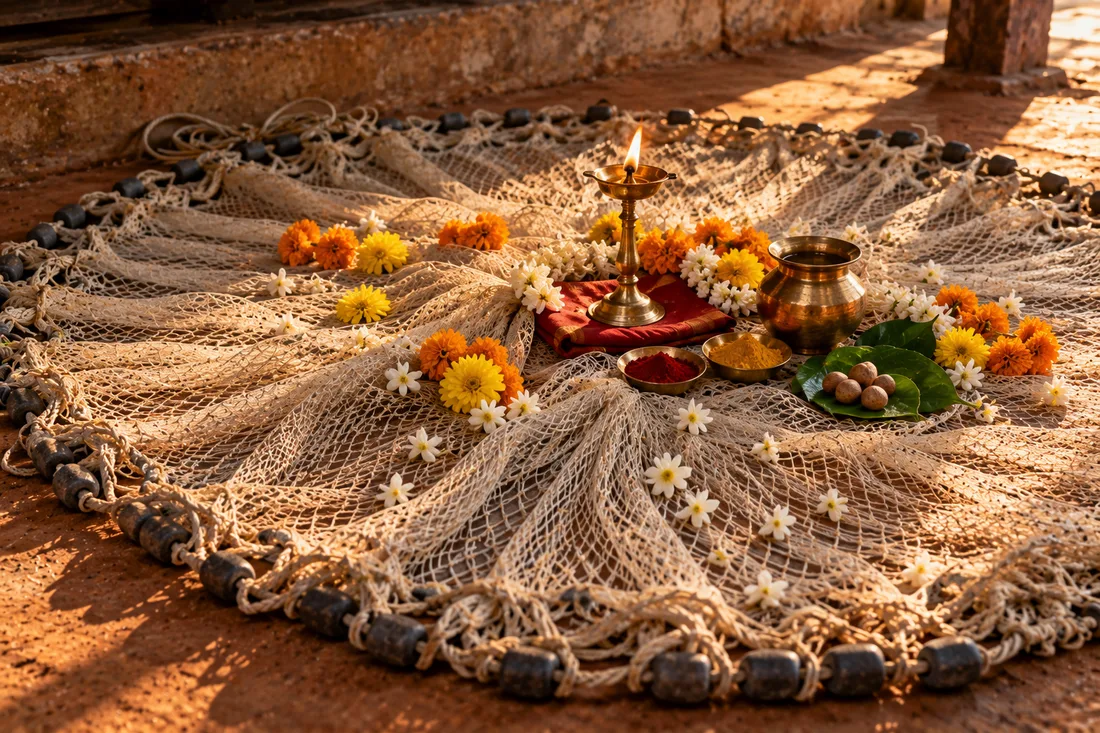
A fisherman's hand-cast net spread open in a wide circle on a swept earthen floor and honoured with a brass lamp at its centre, marigold and jasmine laid along the mesh, turmeric and kumkuma beside it

A net, and a fish

In the old record of the marks each community carried, the mark set down at Conjeeveram against this name is a net. In the Mysore list of caste emblems it is the fish. Several other communities have their own marks in those same lists, each one its own.

  • The net, recorded at Conjeeveram
  • The fish, in the Mysore list

The nets are honoured at Dasara

An account from the Telangana country records that at Dasara these households worship their nets, and hold them always in great reverence. Honouring the tools of a trade on that day is kept widely across the South; what is written here is what was recorded of these families.

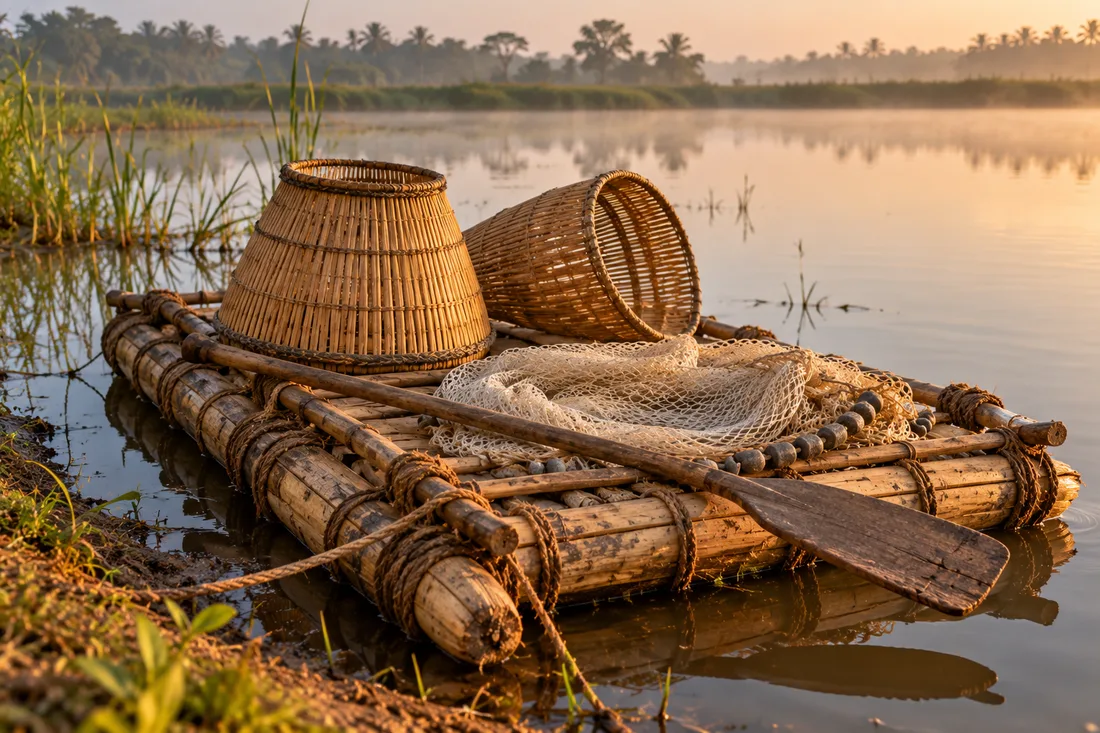
A small lashed fishing raft of poles and cane moored at the edge of an inland village tank at first light, carrying two conical split-bamboo fish baskets, a folded cast net and a worn wooden paddle

The small cast net, and the rafts on the tank

These households used the small cast net rather than the drag-net worked by many hands, which they held brought no luck. And a writer in Mysore records seeing Besthas fishing on the tanks from rafts, with floats of cane or cork-wood holding up their fish-baskets.

Practice and emphasis differ from one district, one branch and one family network to another — this is heritage held with pride, not a single rule book.

When the rivers run full

Ganga, honoured at the coming of the flood

The observance these households are most closely associated with is kept not at a temple but on the bank of the river itself, in the first week the water rises.

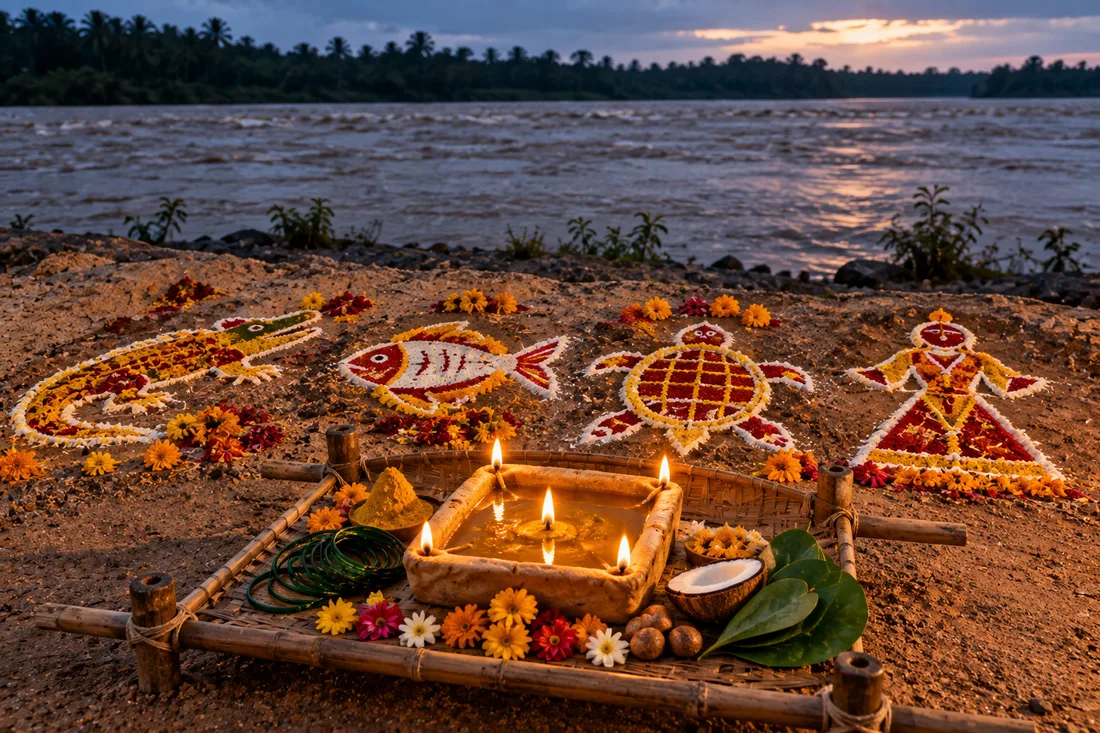
A ground offering on a river bank at dusk in the first flood of the monsoon — a crocodile, a fish, a tortoise and a female figure outlined in flowers and coloured powder on sand, with a bamboo tray carrying a flour pan of five burning lamps

The walk to the water

On the Thursday or the Monday after the monsoon breaks, in Ashada, the household keeps the day as a fast. At about five in the evening the families walk out to a place on the river bank away from the village, and a patch of ground is smeared clean and strewn with river sand.

What is drawn, and what is carried

Four figures are drawn on the sand and filled in with flowers, kunkuma, turmeric and powdered limestone — a crocodile, a fish, a tortoise, and a figure of Mari Mata. A large flat bamboo tray is set down before them on a frame of four short lengths of pangra wood, carrying a shallow square pan made of wheaten flour in which five lamps burn: one at the centre and one at each corner. A turmeric figure of Gouramma is set beside them.

The elders officiate

At this observance it is the elders of the community who officiate as priests. Ganga is described in the old account as the favourite and characteristic deity of these households, worshipped by the whole community together — men, women and children — when the rivers and the streams are in flood.

Devotion is honoured here on its own terms. Nothing on this site ranks one form of it above another.

The deities of the house

Kamamma, Vyankatram, and the deity of your own village

Beyond Ganga, what a Bestha household keeps depends a great deal on which country it belongs to, and the profile is built to take that variety rather than flatten it.

Kamamma

The deity of the Telugu Bestha households is Kamamma. Her name appears exactly once in the whole of the seven volumes of the old survey, in the sentence that names her for these families. The story told of her has not come down in any source that can be checked, and this page will not invent one.

What the households name

Vyankatram, kept on a Saturday; Ganga, above all, at the flood; and among the Kannada households Biligiri Ranga, Mariamma, Uttanahalliamma, Patalamma, Kalamma, Siddappaji and Rajappaji. Many families name a deity of their own village that nobody outside it has heard of, and that is exactly why the profile asks in your own words.

  • Ganga, at the coming of the flood
  • Kamamma, among the Telugu households
  • Vyankatram, kept on a Saturday

At the wedding

The booth is raised on eleven or twelve posts, and the central post is cut from a chosen branch and topped with a lamp that burns through the whole ceremony. On the Kannada side the first pillar is cut by the Chikka Yajaman himself, with drums, and planted on a bed of milk and ghee; the two families recite the names of their forebears before the dhare water is poured over the couple's joined hands. On the fourth day the bridegroom walks round the milk-post with a net in his hand and the bride with a bamboo basket.

Much that is named here is kept across the Deccan by many households, and is written as something these families keep rather than something they hold alone.

How a marriage is guarded

The kula, the inti peru, and why there is no list

A Bestha family marries away from its own line. What that line is called changes with the language of the house, and no two of the old records agree on what the lines are.

One question, four answers

A Mysore household names a kula. A Telangana household names an inti peru. In the Bombay-Karnatak country it is a bedagu, and on the Kanara side a line named for a living thing. The lists written down for each of them share almost nothing, and not one of them was ever a register. So nothing is chosen for you here.

  • Kannada — the kula
  • Telugu — the inti peru
  • The Bombay-Karnatak — the bedagu

Why the field is not called Gotra

On the Telugu side a great many of these households name the same single gotra between them, so it separates nobody. The line that actually decides an alliance is the house name, and that is what the profile asks for. If your family does keep a gotra beside it, there is a place for that too.

The deity of the house sits beside it

Your kula devaru goes on the profile next to your line. It is how a household is known and is honoured as its own — it is not what an alliance is decided by.

Every line named here stands on its own terms. Nothing on this site places one household above another.

Questions families ask

Common questions from Bestha / Besta families

Our family says Toreya, or Ambiga, or Kabbera, not Bestha. Is this our page?

Those names are written down together with Bestha in the old district records and in Karnataka's own list today, and any of them will bring you here. Your own name goes on your profile as your family uses it, and so do your mother tongue and your native district — which for these households are usually the first two things a family wants to know about another.

How is our family's lineage recorded?

By the line your family marries away from — the kula if your household is Kannada-speaking, the inti peru if it is Telugu-speaking, the bedagu on the Bombay-Karnatak side — written in your own words. No list of these lines has ever been agreed, so nothing is chosen for you. Your kula devaru sits beside it, and if your family also keeps a gotra there is a place for that.

We are a Telugu-speaking household. Will we see Kannada-speaking families too?

You will see both unless you choose otherwise. Mother tongue is a field on the profile and you can narrow by it, along with native district — and a great many families do, because that is how these households have always looked. Nothing is narrowed for you.

Will our phone number be visible to everyone?

It is not shown openly on your profile. A member who wants to take an introduction forward can see your contact through the app's Reveal Contact feature and reach you directly, and Government-ID-verified badges help you know who you are speaking with.

Next step

Register or login when your family is ready to continue

Create your account and step into the Bestha space on Sri Guru Raghavendra Matrimony, where your family's own line, your kula devaru and your native district are part of every profile from the first day — and your family sets the pace.