Sri Guru Raghavendra Matrimony™ emblem
SRI GURU RAGHAVENDRA MATRIMONY™

The families of Kerala, known by house, line and shrine

Nair Matrimony

A community whose families have always been known by three things — the house they come from, the line they belong to, and the shrine they have always walked to — deserves a matrimony space that asks the right questions first: sub-community, the taravad, native district, and family character, all on the profile from the start.

KiriyathilIllathuSwaroopathilPurathu Charna

Begin when you are ready

Register now, or read about the Nair heritage first

Creating an account takes a few minutes. If your family prefers to understand the space first, the sections below walk through the taravad and the line it names, the shrine a family keeps, the three great days of the Kerala year, and the arts of the house.

Registrations from this page stay within the Nair community — every profile your family sees and contacts belongs to the community.
A heritage of the house, the line, and the shrine

A heritage your family carries every day

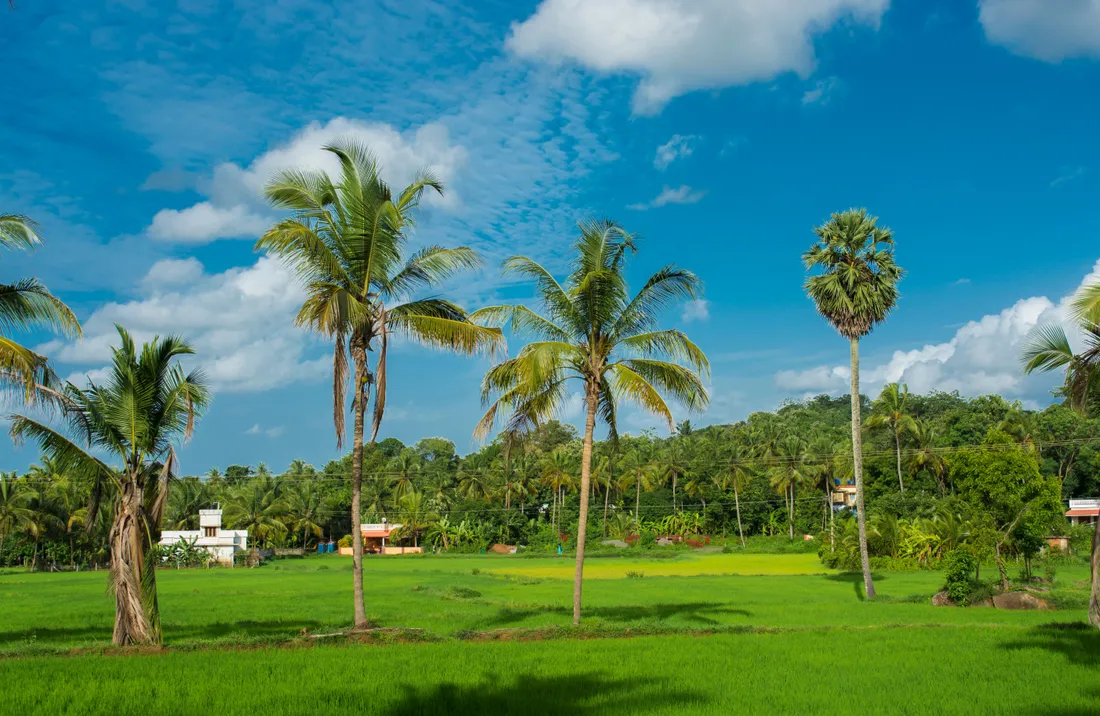
Along the paddy country and palm-shaded backwaters of Kerala, a Nair family has always been known by three things — the house it comes from, the line it belongs to, and the shrine it has always walked to. Nair, also written Nayar, is not one uniform caste but a named group of related Kerala communities, whose customs differ from the north of the state to the south.

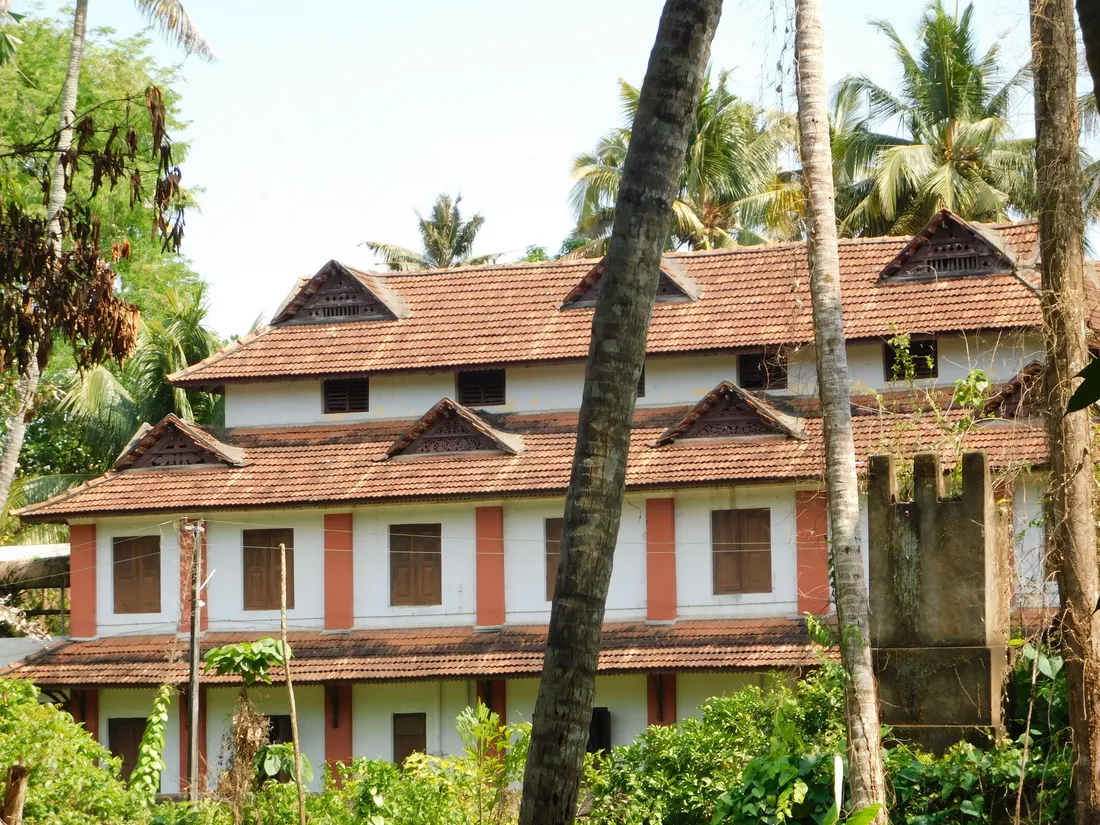
A taravad is more than a household: it is the whole company of kin descended in the female line from one common ancestress, gathered around one house whose name the family carries still. By long tradition a family traced itself through its women, and a child belonged to the mother's taravad; the senior member held the management of its property as a steward and protector for everyone in the house. Where a couple lived after the wedding, and how the family's land was held, differed from one part of Kerala to another — and families still carry the name of the house they came from.

Sri Guru Raghavendra Matrimony presents those details on every profile, in the order your elders actually weigh them — so a Nair alliance begins informed, and with the dignity your family expects.

What families often ask first

What families often value first

  • Profiles state sub-community, the taravad your family is named for, and native district up front, so your family knows the essentials before the first conversation.
  • Kiriyathil and Illathu, Swaroopathil and the Charna divisions, and the many named divisions of Kerala's own ethnographers are each given their own option.
  • Registrations from this page stay within the Nair community, so every profile your family considers belongs to the community.

What your family will find inside

Everything your family checks, before the first phone call

These are the details Nair households settle first — and they are visible before any contact is exchanged.

Government ID verified members stand out

Members who complete Government ID verification carry a clear mark, giving your family added reassurance at a glance.

Filter by sub-community, taravad, and native place

Narrow the search by sub-community — Kiriyathil, Illathu, Swaroopathil and more — and by the family house, native district, and family origin.

Education, work, and family background together

Degrees, professions, and family character read clearly on every profile, in the same order elders weigh an alliance.

Lineage recorded your way

Write your taravad — the family house — in your own words, exactly as your family names it, and North Malabar families can record their kulam alongside it.

Contact details are not shown openly

Phone numbers and email are not shown openly on profiles. A member uses the Reveal Contact feature to see another member's details and reach out directly when they are ready to take an introduction forward.

Interest is never lost

Shortlists and the profiles your family has already opened stay saved, so you can return to a promising profile after the household has talked it over.

Built around how Nair alliances actually happen

Whether your family's search stays within one district of Kerala or reaches to Bengaluru, the Gulf and beyond, the details that matter — sub-community, the family house and native district — are always in view.

Why families feel at ease

Why Nair families feel at home

The details that decide an alliance sit together in one place, presented the way your family would present them.

The taravad your family is named for

Your search stays among Nair families, so every introduction starts from shared roots in Kerala.

Every division at home

Kiriyathil and Illathu, Swaroopathil and the Charna divisions and the rest each stand here under their own name, so a Malabar house and a Travancore house alike find themselves written as they would write themselves, and match within their own group.

Comfortable for parents and members alike

Whether the search is led by a parent, a sibling, or the member themselves, the profile reads clearly for all of them.

Move at your family's pace, with tradition honoured up front and you reach out when your family is ready.

Understanding the heritage

Kerala, and the families who belong to it

Nair, also written Nayar, is not one uniform caste but a named group of related Kerala communities, whose customs differ from the north of the state to the south.

From Travancore to Malabar

Nair families belong to the whole length of Kerala — Travancore in the south, Kochi in the middle, and Malabar in the north — and Malayalam is the mother tongue throughout. Customs that hold in one region are not always those of another, and this space is built to hold that variety rather than flatten it.

  • Travancore — Thiruvananthapuram, Kollam, Kottayam and the south
  • Kochi — Ernakulam and Thrissur in the middle country
  • Malabar — Kozhikode, Kannur and the north

Known by three things

A Nair family has always been known by the house it comes from, the line it belongs to, and the shrine it has always walked to. Those three are what this space asks for first — because they are what your family would ask for first.

Practice and emphasis differ from one region and one family network to another — this is heritage held with pride, not a single rule book.

Understanding the heritage

The taravad: a house, and a line

A taravad is the whole company of kin descended in the female line from one common ancestress, gathered around one house — and the house gives the family its name.

The nalukettu and its courtyard

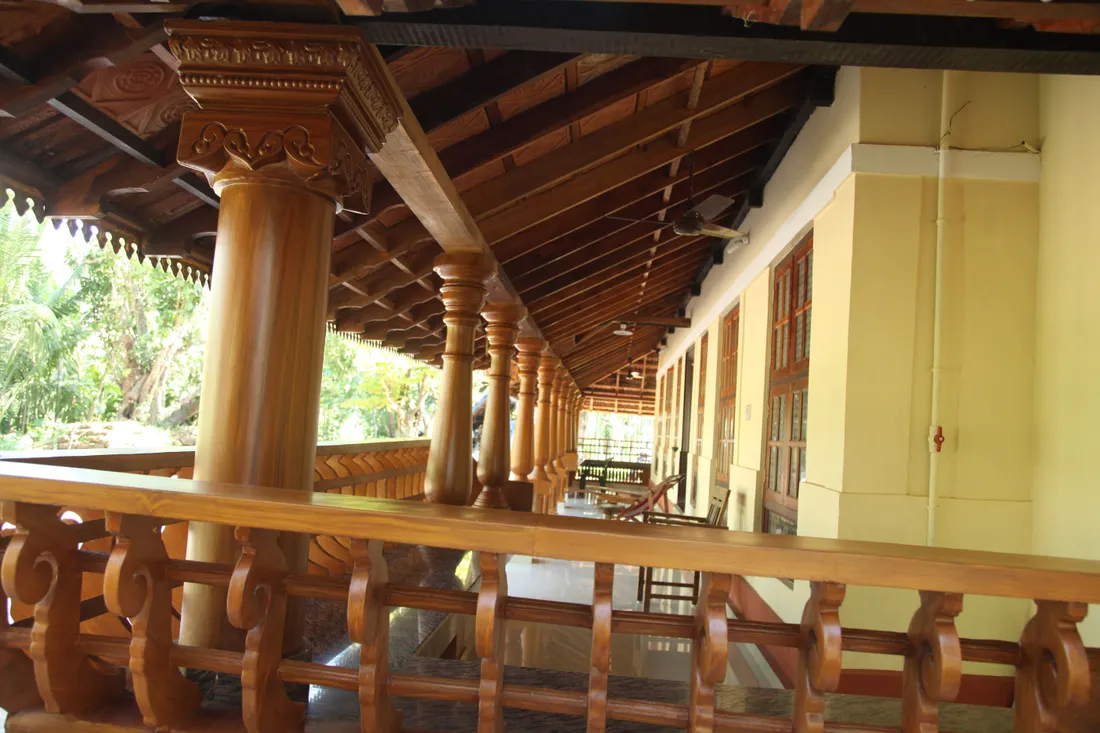
The old house is built to the nalukettu plan — four halls enclosing the nadumuttam, the central courtyard open to the sky, so that light and rain fall into the middle of the home. The verandah pillars and the gable ends carry some of the finest carved woodwork in Kerala.

  • Four halls around the nadumuttam, the open central court
  • Turned wooden pillars and a carved verandah
  • The gable end above the entrance, worked in wood

The karanavan, the steward of the house

By long tradition the senior member of the taravad held the management of its property — a protector and steward for everyone in the house, holding no separate ownership of his own. Where a couple lived after the wedding, and how the family's land was held, differed from one part of Kerala to another.

Practice and emphasis differ from one family network to another — this is heritage held with pride, not a single rule book.

Understanding the traditions

How Nair families trace and match lineage

Nair families do not reckon a gotra, and nothing at all is missing in that — a Nair family's line is named by its taravad, and in North Malabar by its kulam.

The house names the line

Where other communities name a gotra, a Nair family names its taravad — the house it descends from. Families married outside their own taravad line, and in North Malabar the named unit is the kulam, recorded alongside the house.

  • Enter your taravad in your own words
  • North Malabar families may record a kulam as well
  • No list has been drawn up, and nothing is chosen for you
  • Sub-community is usually weighed together with this

Titles and surnames are not communities

Menon and Kaimal are titles rather than separate communities — honours conferred by the rulers of Kerala that a family then carried in the maternal line; a Menon was presented with an ola palm-leaf and an iron stylus, the emblems of the accountant's office he was to fill. Panicker is an honorific title, not a community name — it was conferred on distinguished families across several different Kerala communities, and by itself it tells you nothing about which community a family belongs to.

  • Menon, Kaimal, Kurup, Nambiar, Unnithan, Panicker, Pillai, Kartha and Achan are titles or surnames
  • Several of them are carried by more than one Kerala community
  • A surname does not tell you a family's community
  • Your community and sub-community are what you choose on your profile

Households differ in how they weigh the lineage line — some settle it first, others read it alongside the horoscope and the family's overall comfort.

A heritage of devotion

The shrine the family kept

The Nair house has never looked to a single guru or a community seat. Devotion here is close to home — the kavu, the grove-shrine of the Devi, that a family has walked to for as long as anyone can remember, and the small serpent grove in the corner of its own compound.

The Bhagavati kavu, held in trust

At the Bhagavati shrine of Pishāri kāvu near Quilandy the temple belonged to four taravads together, and the senior member of each of those four houses kept the temple's silver flag in his own keeping from one year's festival to the next — a family's care for its shrine, held in trust and handed on. The festival ran seven days, opening with purification and the hoisting of the flag, and the image of the Devi was carried out morning, noon and night. The same pattern is still visible in North Malabar: at Oorpazhachi Kavu in Edakkad, Kannur, the Bhagavathi shrine has long been held by nine Nambiar houses as its Ooraalar, and its trustees are still the seniormost men in the matrilineal line of those nine families.

  • The kavu — the grove-shrine of the Devi
  • Shrines held and cared for by the families attached to them
  • The seven-day festival, and the flag raised to open it
  • Oorpazhachi Kavu, Edakkad — held by nine Nambiar houses as its Ooraalar

A sage Kerala remembers, born in a Nair house

Kerala remembers Chattampi Swamikal (1853–1924), born Ayyappan Pillai into a Nair family at Kannammoola near Thiruvananthapuram. He studied Sanskrit, Tamil and Vedanta under teachers including Pettayil Raman Pillai Asan, Thycaud Ayyavu Swamikal and Subba Jatapadikal, and lived as a wandering teacher of Advaita Vedanta. He wrote his Vedanta in plain Malayalam so that a reader with no Sanskrit could follow it — the Advaita Chinta Paddhati is still read as an introduction to the subject — and he put Kodakanallur Sundara Swamikal's Nijananda Vilasam into Malayalam for the same reason. He is honoured with the title Vidyadhiraja, and his samadhi is at Panmana in Kollam, beneath a Siva temple consecrated as he had asked. A sage born in a Nair house, revered across Kerala rather than by one community — the community itself has never held a guru of its own.

  • Chattampi Swamikal (1853–1924), born at Kannammoola
  • A teacher of Advaita Vedanta, honoured as Vidyadhiraja
  • Wrote his Vedanta in plain Malayalam for readers without Sanskrit
  • His samadhi is at Panmana in Kollam

At home, and in the books read aloud

The sun is honoured at its rising, and in many houses the elders read the Ramayana, the Bhagavata and the Mahabharata aloud in Ezhuthachan's Malayalam. In Kerala and Malabar homes, including Nair taravads, a sarpakkavu — a small snake grove with its carved granite cobra — is kept at the north-west corner of the compound.

These deities, shrines and sacred places are mentioned with reverence and gratitude alone, as heritage shared across Kerala. No endorsement is implied, and devotional matters rest with each family and its elders.

The year and its great days

Onam, Vishu and Thiruvathira

Onam, Vishu and Thiruvathira are remembered as the three great occasions of Malabar, and Nair households keep all three.

Onam, and the sadya on the leaf

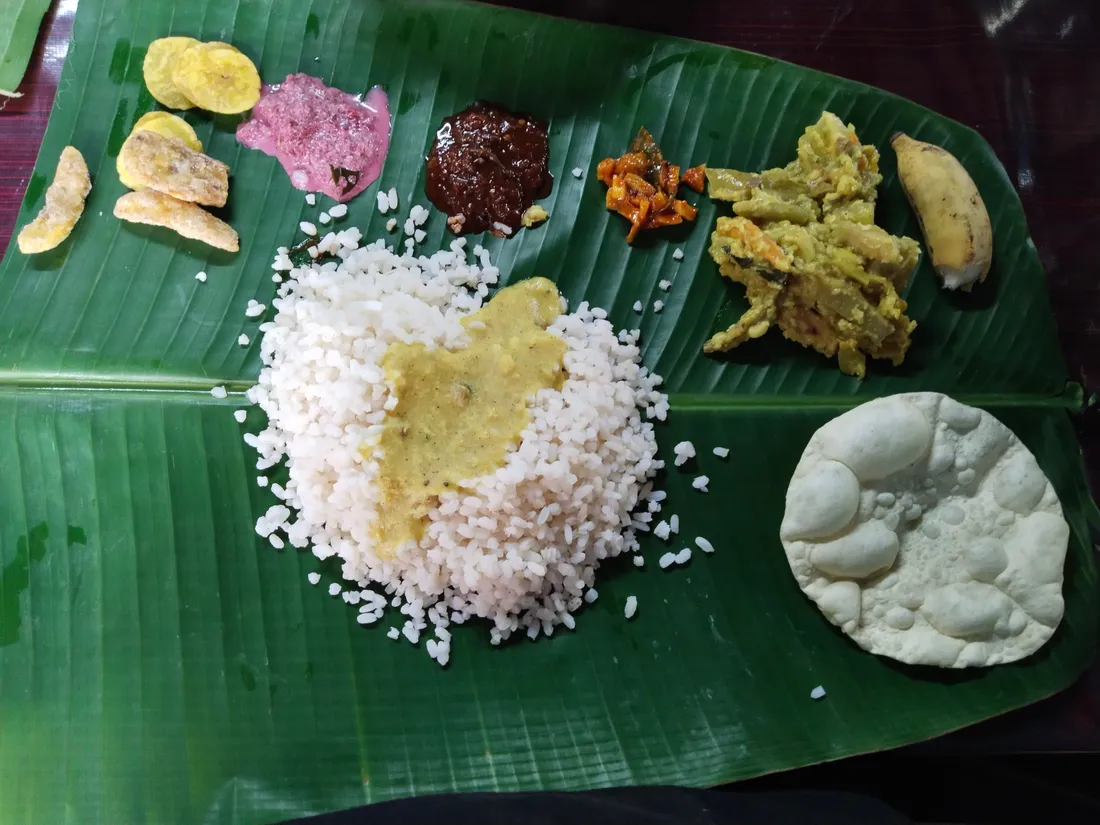
Onam falls in Chingam, over ten days ending on Thiruvonam, with the pookalam laid at the door, the vallam kali on the water, and the sadya spread on a banana leaf — kept in memory of Mahabali descending once a year to see his people happy. Onam belongs to Nair households and to all of Kerala alike; it is kept today across the state and beyond.

  • Ten days in Chingam, ending on Thiruvonam
  • The pookalam of flowers laid at the threshold
  • The sadya, served on a banana leaf

Vishu, and the women's day of Thiruvathira

Vishu falls on the first of Medam in April: the Vishukkani is arranged the night before in a bell-metal vessel so that it is the first thing the household sees on waking, and the elders give the Vishu kaineettam. Thiruvathira, in Dhanu from December into January, is a day that belongs to the women of the house.

Festivals and their customs are cherished differently from one household to another; they are shared here as heritage the community holds dear.

The arts of the house and of Kerala

Thiruvathirakali, and the great arts of the state

Some of these arts belong to the women of the house; others belong to all of Kerala, and Nair families have carried them forward alongside everyone else.

Thiruvathirakali, kept by the women of the house

On Onam and again on Thiruvathira, the women of the house dance the Thiruvathirakali — also called Kaikottikali — circling a lit lamp with the clapping that keeps their own rhythm and singing the praise of Shiva and Parvati. A bride's first Thiruvathira after her wedding has a name of its own, Poothiruvathira.

Kathakali and Mohiniyattam, the shared arts of Kerala

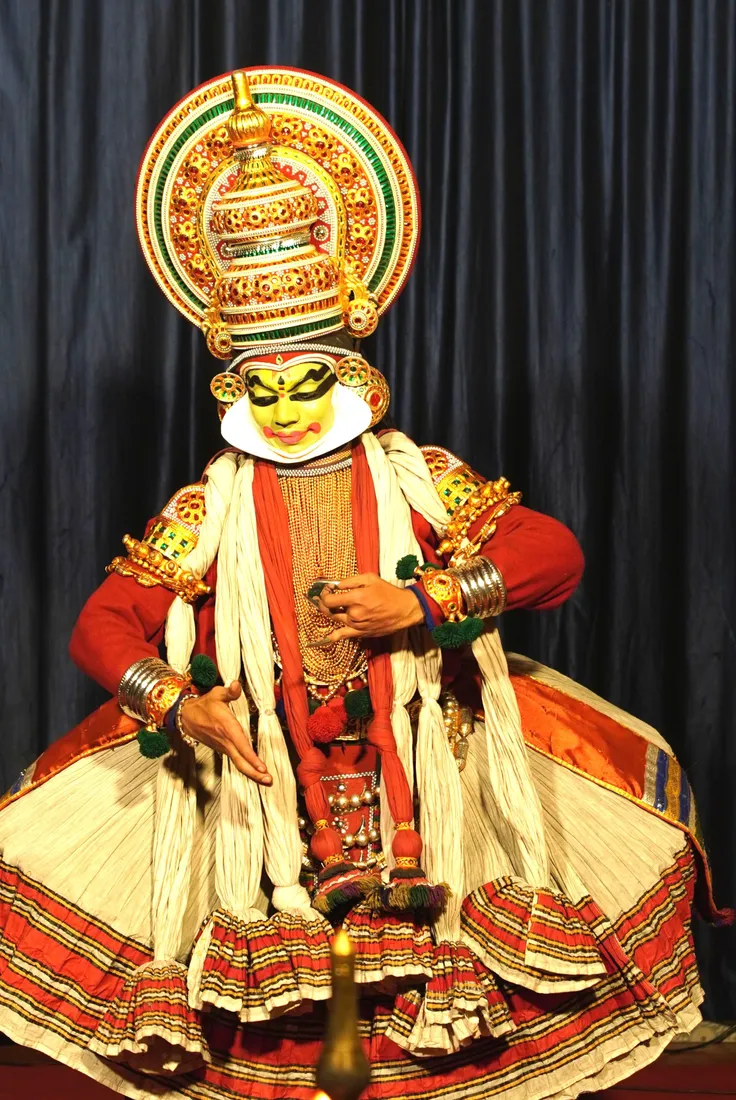
Kathakali, the all-night dance drama with its chutti make-up and its Pachcha, Thaadi and Minukka costumes, and Mohiniyattam in the gentle lasya style with its plain white and gold-bordered sari, belong to all of Kerala and are taught at the Kerala Kalamandalam that Vallathol founded. Nair families have carried them forward alongside every other Malayali family.

Kerala's classical arts are the shared inheritance of the whole state; they are named here as heritage the community shares, not as any one community's possession.

Learning and service

A community that put education first

What the community organised for itself, it organised around learning — schools, colleges, hostels and hospitals.

The Nair Service Society

Founded on 31 October 1914 by Mannathu Padmanabhan and his associates at Perunna in Changanassery, where it is still headquartered, the Society entered higher education after the conference at Mannar in 1916 and set up its first college at Perunna. It runs schools from lower primary through higher secondary, arts, science and commerce colleges, teacher-training institutes, an engineering college and nursing schools, along with hospitals and working women's hostels — a room among her own people for a daughter who has gone to a strange town to study or to work.

A community at home in Bengaluru

Nair families have been part of Bengaluru's life for generations, and Sri Guru Raghavendra Matrimony is based in the city — so a search that begins in Kerala and a search that begins in Bengaluru meet in the same place.

Community institutions are mentioned as heritage and service alone; this space is not affiliated with any association.

Questions families ask

Common questions from Nair families

Will we only see Nair profiles here?

Yes. Registering through this page places your profile in the dedicated Nair section, and every profile you see, match with, or contact belongs to it.

Our family name is Menon, Nambiar, Kurup or Panicker — which community is that?

Those are honoured titles and surnames rather than communities. Menon and Kaimal were honours conferred by the rulers of Kerala; Panicker is an honorific title, not a community name — it was conferred on distinguished families across several different Kerala communities, and by itself it tells you nothing about which community a family belongs to. Your community and sub-community are always what you choose on your profile; a surname is never used to decide them.

How is our family's lineage recorded?

Your taravad — the family house — is written in your own words, exactly as your family names it, and families of North Malabar can record their kulam alongside it. Nair families do not reckon a gotra, so no gotra is asked for here and nothing is missing without it. There is no list drawn up, and nothing is chosen for you.

Our sub-community is not in the list — what do we choose?

Choose Other Nair community, which keeps you within the same community space. The divisions recorded by Kerala's own ethnographers are many, and some families do not use one at all — the field is there to help your family search, never to exclude anyone.

Will our phone number be visible to everyone?

It is not shown openly on your profile. A member who wants to take an introduction forward can see your contact through the app's Reveal Contact feature and reach you directly, and Government-ID-verified badges help you know who you are speaking with.

Next step

Register or login when your family is ready to continue

Create your account and step into the Nair section of Sri Guru Raghavendra Matrimony, where sub-community, the taravad your family is named for, native district and family background are part of every profile — for Nair and Nayar families of Travancore, Kochi and Malabar, and your family sets the pace.