Sri Guru Raghavendra Matrimony™ emblem
SRI GURU RAGHAVENDRA MATRIMONY™

Memu pedda inti vallamu — we are of the big house

Madiga Matrimony

Asked once, a hundred years ago, who they were, a Madiga household answered: memu pedda inti vallamu — we are of the big house. These are Telugu-speaking and Kannada-speaking families across Telangana, Andhra Pradesh and Karnataka, and an alliance among them turns on the house name. So this page begins there, and then with the deity the household keeps and the district it belongs to.

Telugu MadigaKannada MadigaOther / not specified

Begin when you are ready

Register now, or read about the Madiga heritage first

Creating an account takes a few minutes. If your family prefers to understand the space first, the sections below walk through the craft and what the country did with it, Matangi and the pot honoured as her, the dappu and the night theatre, and the house name an alliance turns on.

Registrations from this page stay within the Madiga community — every profile your family sees and contacts belongs to it.
The big house, and the name it goes by

A heritage your family carries every day

These are households of the Telugu country and the Kannada country both — through Telangana and the Andhra districts, and across Karnataka into the old Mysore and Kolar belt — with a great many families now in Hyderabad, Bengaluru, Vijayawada and further afield.

The community's own account of itself begins with Jambavantha, the elder among Rama's allies, who gave the Syamantaka jewel to Krishna and gave his daughter Jambavati to him in marriage. Households here hold that he was made six months before the earth itself, and one old record notes another name for them said to mean exactly that — people older than the world by six months.

So an alliance here begins with what a Madiga household names first: the house name it marries away from, the deity it keeps and the town it belongs to — with the dignity your family expects.

What families often ask first

What families often value first

  • Your house name — the intiperu in Telugu, the kula or bedagu in Kannada — is written in your own words, exactly as your household says it.
  • Your kula devata sits on every profile, and if your family also keeps a gotra there is a place for that beside it.
  • Search by native place and by the language spoken at home — across Hyderabad, Warangal, Nizamabad, Guntur, Kurnool, Bengaluru, Kolar, Mysuru and beyond.

What your family will find inside

Everything your family checks, before the first phone call

These are the details Madiga households settle first — and they are visible before any contact is exchanged.

Government ID verified members stand out

Members who complete Government ID verification carry a clear mark, giving your family added reassurance at a glance.

The house name, written as your family writes it

Two households carrying the same house name are taken to come from one house, so families marry outside it. Yours is written in your own words — the names run into the hundreds, across two languages, and no list of them has ever been agreed.

Filter by sub-community, native place and mother tongue

Narrow the search by native district — Hyderabad, Warangal, Nizamabad, Guntur, Kurnool, Bengaluru, Kolar, Mysuru and many more — and by whether Telugu or Kannada is spoken at home.

Education, work, and family background together

Degrees, professions, and family character read clearly on every profile, in the same order elders weigh an alliance.

Contact details are not shown openly

Phone numbers and email are not shown openly on profiles. A member uses the Reveal Contact feature to see another member's details and reach out directly when they are ready to take an introduction forward.

Interest is never lost

Shortlists and the profiles your family has already opened stay saved, so you can return to a promising profile after the household has talked it over.

Built around how Madiga alliances actually happen

Families here have long looked within a familiar circle of districts and a shared language at home, and both of those are on every profile — alongside the house name your family marries away from and the deity it keeps.

Why families feel at ease

Why Madiga families feel at home

The details that decide an alliance sit together in one place, presented the way your family would present them.

Telugu and Kannada households, each on its own terms

The Telugu-speaking and Kannada-speaking households have long kept their alliances within their own language, and the profile says which yours is so that a family looking that way can see it at once. Nothing is narrowed for you unless you choose it.

Your house name, and a place for a gotra too

The house name is what decides an alliance, and it is asked for first. Some households also keep a gotra, and there is a place for it — offered so that families who have one can write it, never so that anyone else appears to be missing something.

Comfortable for parents and members alike

Whether the search is led by a parent, a sibling, or the member themselves, the profile reads clearly for all of them.

Move at your family's pace, with tradition honoured up front and you reach out when your family is ready.

The craft

What these hands made, and what the country did with it

Before there were pumps in the fields, a great deal of what made farming possible in this country came out of these households.

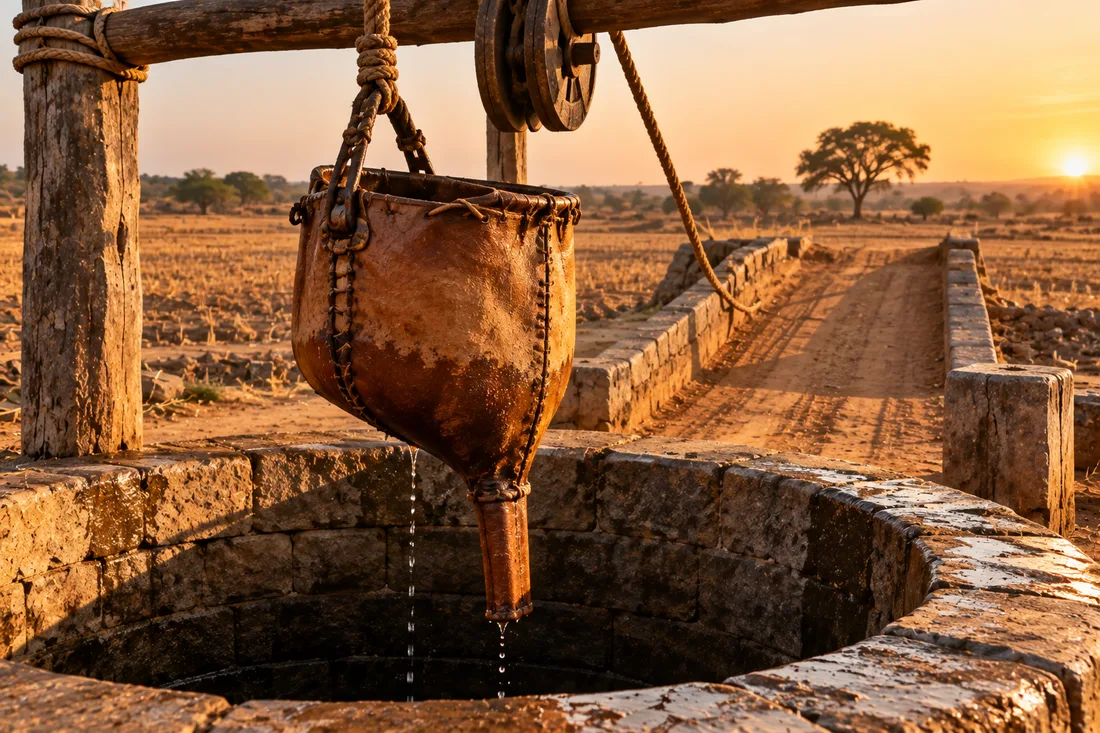
A large hand-stitched leather irrigation bucket — a mota bokkena — hanging on a coir rope over the mouth of an old open stone well in a dry Telugu field, water still beading on the leather

The mota bokkena

The great stitched leather bucket that lifted water from a well to a field, hauled up a packed earth ramp by bullocks. It is the object the old record names first among the things these households made, and there was a time when the rabi crop of whole districts depended on it.

  • Mota bokkena — the well bucket
  • Neella titti — the water bag
  • Patteda — the neck-belt for the plough bullocks
  • Vodisela — the sling that kept birds off the crop

And sandals, described in five words

The sandals these households made were written down a century ago as strong, comfortable, and sometimes highly ornamental. It is a working description from a survey that was rarely generous, and it is worth keeping for that reason.

Tangedu bark and lime

The tanning was done with the bark of the tangedu and with lime, in great earthen pots sunk in a working yard, worked with a long wooden pole. The toolkit is listed in the old Mysore account down to the cutting board, the koddli and the awl.

Practice and emphasis differ from one district, one branch and one family network to another — this is heritage held with pride, not a single rule book.

The goddess, and the pot

Matangi, and a working vessel honoured as her

These households call themselves Matangi Makkalu, the children of Matangi. One of the ways she is honoured is unlike anything recorded for any other community.

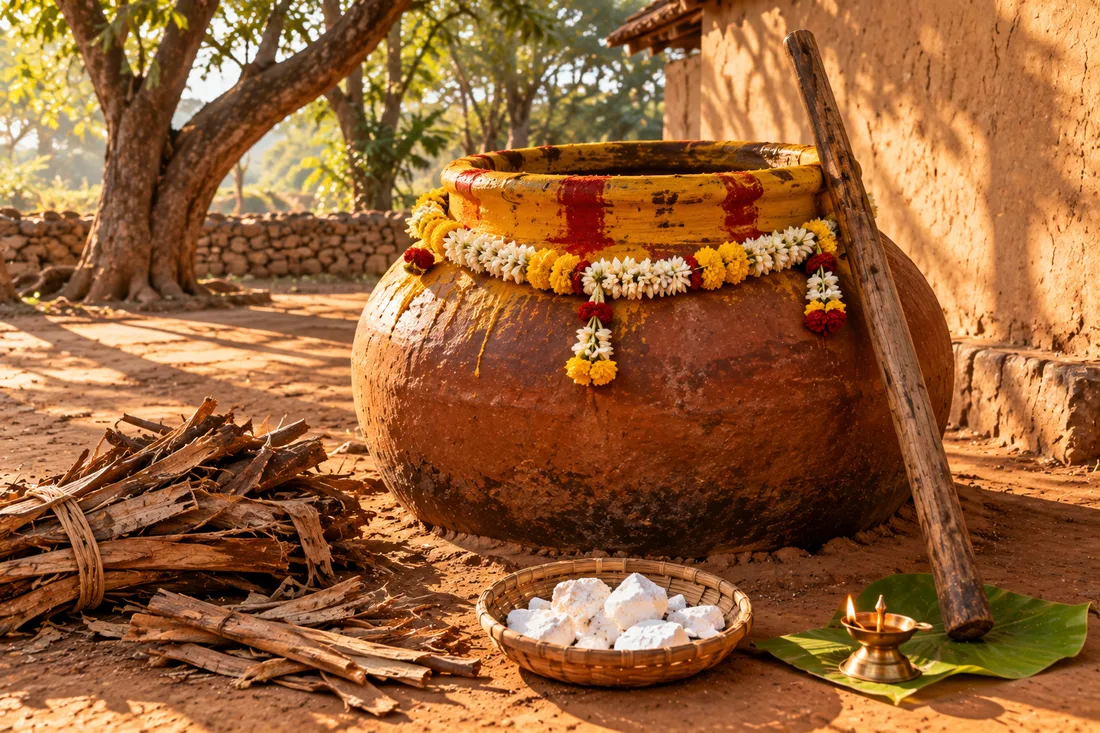
A very large hand-thrown earthenware soaking pot set into the red earth of a village work-yard, its broad rim smeared with turmeric and marked with vermilion, a marigold and jasmine garland at its neck and a long wooden stirring pole leaning against it

The pot on the rim of which she is honoured

The great earthen pot in which the hides were soaked is itself honoured as the goddess. Turmeric and vermilion go on its rim on Tuesdays and on Fridays. A working vessel, in a working yard, kept as the deity of the house — searched across eight volumes of the old surveys, it is recorded for no one else.

The children of Matangi

Matangi is named as this community's own goddess, and the households call themselves her children. The Mysore account adds that she is the one they now call Mahalakshmi, or Adi Sakti, and that is how many families will name her today.

The neem, and the shrines under it

The margosa — the neem — is held sacred as the particular dwelling place of the goddess. The shrines are generally set about with these trees, and the households do not cut them wantonly.

What the houses keep, and the days they keep

Among the deities named in these households are Mathamma, Maramma, Yellamma, Gangamma, Durgamma, Kalamma, Marigamma, Muneswara and Muthyalamma. Several of them are honoured widely across this country by many households. The festivals kept are Ugadi, Dasara, Deepavali and Sankranti, with Holi and Gauri among the Kannada households.

Devotion is honoured here on its own terms. Nothing on this site ranks one form of it above another.

The drum, and the night theatre

The dappu, and Chindu Bhagavatham

Two things these households made and carried, and both of them are still going.

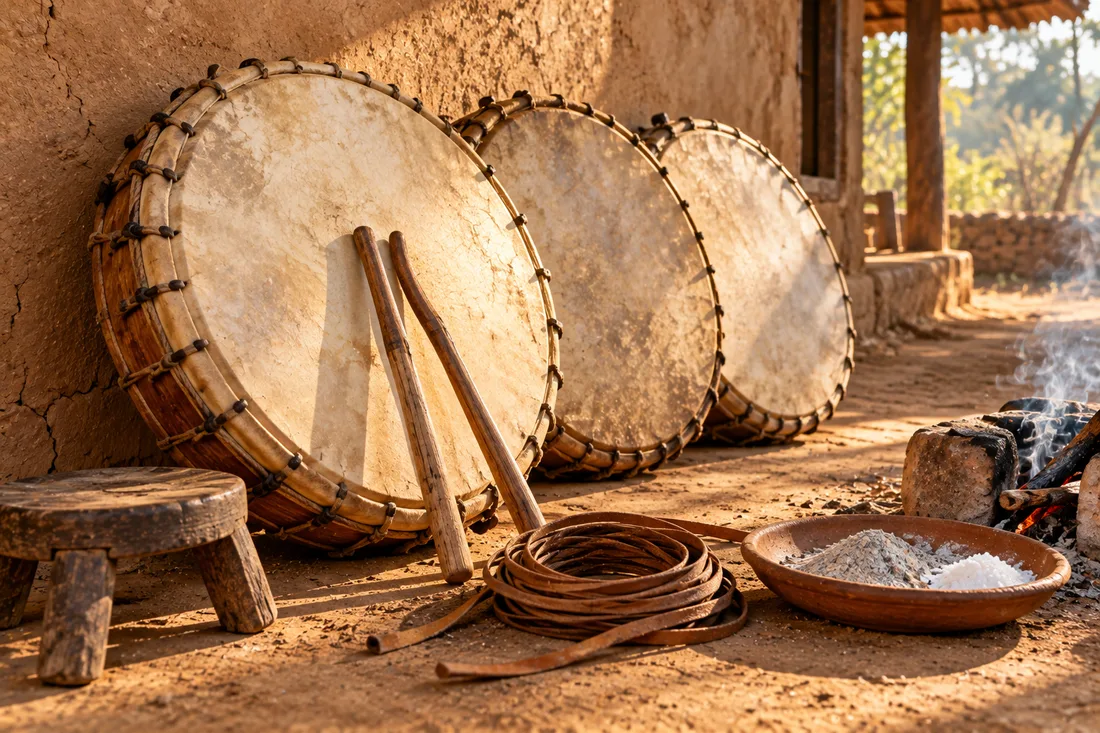
Three finished dappu frame drums leaning against a mud-plastered village wall, their stretched hide heads translucent in the morning light, with beater sticks, a coil of leather thong and a tray of wood ash and salt beside them

Made by the households that play it

The dappu is a shallow frame of tamarind or neem wood with a stretched hide head, cured with ash and salt, tuned over a small fire and played with two sticks. The old Mysore account calls it the characteristic instrument of the community and adds, plainly, that these instruments are made by themselves — which is the part that belongs here.

  • The frame, the hide, the lacing
  • Ash and salt for the curing
  • A small fire to bring it to pitch

The man who beats it

From the drum comes an office: the Tappatiga, the man who beats the tappate, who serves as the pujari within the community. The instrument and the office are named together in the same account.

Chindu Bhagavatham

The night-long village theatre of Telangana, staged from the Bhagavatam and the epics and named from chindu, to leap. It is carried by Chindu Madiga households, whose troupes will camp in a village for weeks at a time and work through a whole cycle of plays, night after night.

Much that is named here is kept across this country by other households too, and is written as something these families keep rather than something they hold alone.

How a marriage is guarded

The house name, and the things the old names are named for

One thing decides whether an alliance can be made, and it is the same thing in both languages under two different words.

Two households of one name do not marry

The house name — the intiperu in Telugu, the kula or bedagu in Kannada — is what an alliance turns on. Two families carrying the same name are taken to descend from one house, and are held to be brother and sister to one another. So a family marries outside its own name.

  • Telugu — the intiperu
  • Kannada — the kula, or the bedagu

Named for ordinary things

A great many of the old house names are the names of everyday things — silver, jasmine, a blanket, a drum, a courtyard, an ant-hill, turmeric, rice. And some houses keep an avoidance with the thing they are named for: the households of the Banni-tree name neither cut nor touch that tree.

Why nothing is chosen for you

Two independent old lists of these names overlap in only a few places and neither is complete. The names run into the hundreds, across two languages and many districts, and no register of them exists or ever will. So you write yours the way your family says it.

And if your family keeps a gotra

Some households do keep one. There is a place on the profile for it, offered so that a family who has one can write it — and never so that a family without one appears to be missing anything. Descent in these households runs in the father's line.

Every line named here stands on its own terms. Nothing on this site places one household above another.

Questions families ask

Common questions from Madiga families

How is our family's lineage recorded?

By the house name — the intiperu if your household is Telugu-speaking, the kula or bedagu if it is Kannada-speaking — written in your own words. Two households of the same house name do not make an alliance, so it is the first thing two families check. Your kula devata sits beside it, and if your family keeps a gotra there is a place for that too.

We are a Kannada-speaking household. Will we see Telugu-speaking families?

Your profile says which, because these households have long kept their alliances within their own language and families ask about it early. You will see both unless you choose to narrow it, and mother tongue and native district are both fields you can search on.

Our family does not keep a gotra. Does that matter?

Not at all, and most households do not. The house name is what an alliance turns on here, and that is what the profile asks for first. The gotra field is there for the families who do keep one, and leaving it empty closes nothing.

Older outside names for the community — are they used here?

No. Only the names families use of themselves are used on this site, and those are the names you will see on every profile and in every search.

Will our phone number be visible to everyone?

It is not shown openly on your profile. A member who wants to take an introduction forward can see your contact through the app's Reveal Contact feature and reach you directly, and Government-ID-verified badges help you know who you are speaking with.

Next step

Register or login when your family is ready to continue

Create your account and step into the Madiga space on Sri Guru Raghavendra Matrimony, where your house name and the deity your household keeps are part of every profile from the first day — and your family sets the pace.