Sri Guru Raghavendra Matrimony™ emblem
SRI GURU RAGHAVENDRA MATRIMONY™

The coast, the garodi, and the mother's line

Billava Matrimony

Billava households belong to the Tulu country of the Karnataka coast. A family here carries a bari, and the bari comes down from the mother — two households of the same bari do not marry, and that is the first thing two families check. So this page begins there, and then with the garodi, the deity the house keeps, and the town the family belongs to.

BillavaOther Billava community

Begin when you are ready

Register now, or read about the Billava heritage first

Creating an account takes a few minutes. If your family prefers to understand the space first, the sections below walk through the garodi and the Baidarkala, the bari and the mother's brother, the offering made at home, and the temple at Kudroli.

Registrations from this page stay within the Billava community — every profile your family sees and contacts belongs to it.
The coast, and the line that comes down from the mother

A heritage your family carries every day

These are households of the Karnataka coast — Mangaluru and the villages up the Netravati and the Kumaradhara, Puttur and Bantwal and Belthangady, Udupi and Karkala, northward to Kundapura and Byndoor, and south across the border into Kasaragod where Tulu is still the language of the house. Kannada is the language of school and of business; Tulu is the language of home.

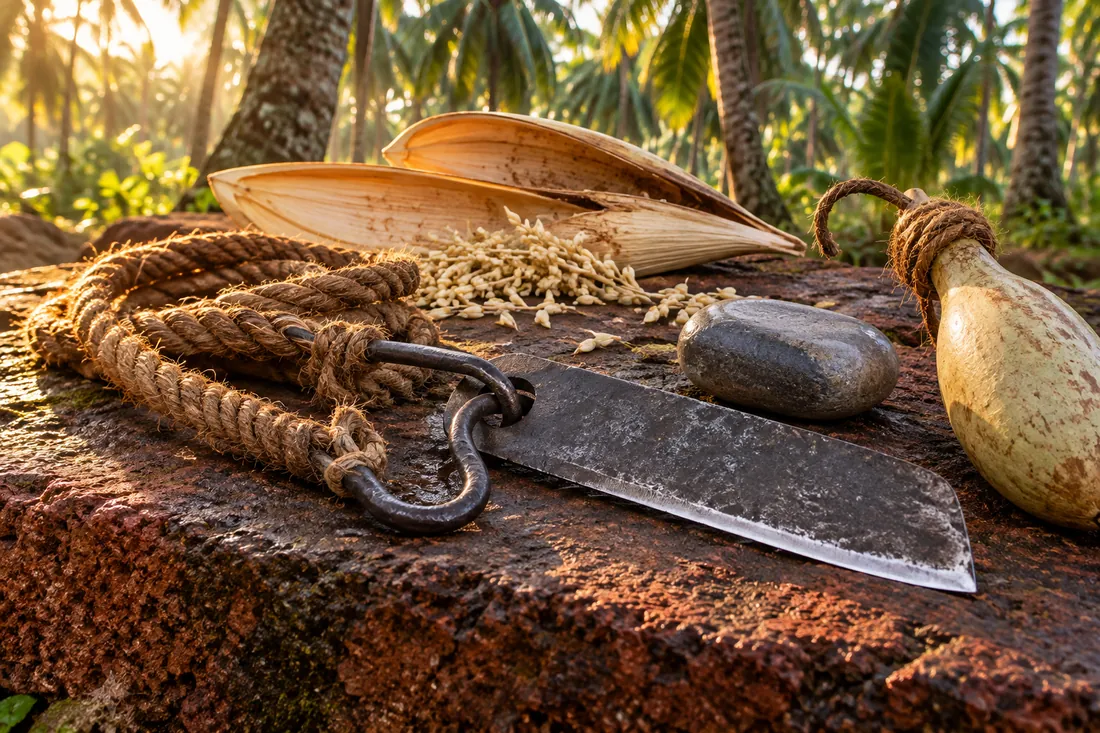
The name carries the bow — billu in Kannada, biru in Tulu, from which Biruva. The calling the heritage names is the palm and the climb: the broad iron knife with a round hole at its base hooked to the rope worn at the waist, the smooth stone, the long gourd. It is a craft of balance and nerve, and the tools of it have not changed in a very long time.

So an alliance here begins with what a Billava household names first: the bari, the deity of the house and the town the family belongs to — with the dignity your family expects.

What families often ask first

What families often value first

  • Your bari is written in your own words, exactly as your family says it — and a household that reckons its line through the father is never asked to leave it blank.
  • Your kula daiva sits on every profile, named as your household names it.
  • Search by native place across Mangaluru, Puttur, Bantwal, Belthangady, Udupi, Karkala, Kundapura, Byndoor, Kasaragod, Bengaluru, Mumbai and beyond.

What your family will find inside

Everything your family checks, before the first phone call

These are the details Billava households settle first — and they are visible before any contact is exchanged.

Government ID verified members stand out

Members who complete Government ID verification carry a clear mark, giving your family added reassurance at a glance.

The bari, written in your own words

Two households of the same bari do not marry, so it is the first thing an elder asks. Write yours exactly as your family says it — there is no list you have to fit into, and a bari is never worked out from a surname.

Filter by native place and family origin

Narrow the search by native place — Mangaluru, Puttur, Bantwal, Belthangady, Udupi, Karkala, Kundapura, Byndoor, Kasaragod and many more.

Education, work, and family background together

Degrees, professions, and family character read clearly on every profile, in the same order elders weigh an alliance.

Contact details are not shown openly

Phone numbers and email are not shown openly on profiles. A member uses the Reveal Contact feature to see another member's details and reach out directly when they are ready to take an introduction forward.

Interest is never lost

Shortlists and the profiles your family has already opened stay saved, so you can return to a promising profile after the household has talked it over.

Built around how Billava alliances actually happen

Whether your family looks within its own circle of villages between the Netravati and the Kumaradhara, or among households now settled in Bengaluru or Mumbai, the things that decide it — the bari, the deity the house keeps and the native town — are always in view.

Why families feel at ease

Why Billava families feel at home

The details that decide an alliance sit together in one place, presented the way your family would present them.

However your family reckons its line

Most Billava households trace the bari through the mother, and some families today reckon it through the father. Both are written here as a family states them, and neither answer is treated as a gap.

The name your household actually uses

Billava, Billawa, Baidya, Poojary, Biruva — a family registers as the name it uses at home, and Other Billava community keeps every household in the same fold. No ranking among these names is intended.

Comfortable for parents and members alike

Whether the search is led by a parent, a sibling, or the member themselves, the profile reads clearly for all of them.

Move at your family's pace, with tradition honoured up front and you reach out when your family is ready.

The palm, and the climb

The tools a climber carried

The calling this community's heritage names is the palm and the grove, and the old survey troubled to write down exactly what a Billava climber carried up the tree.

A palm climber's tools on a laterite slab in a coconut grove at first light — a broad hand-forged iron knife with a round hole at its base, an iron hook spliced to a coil of coir waist-rope, a smooth river stone and a dried bottle gourd

The knife, the hook and the rope

A broad short-bladed iron knife with a round hole punched through the flat of it near the base; through that hole an iron hook; and the hook spliced to a coil of coir rope worn at the waist. That is the whole rig, and it is what holds a person to a tree forty feet up.

  • The knife, with the round hole at its base
  • The hook, and the rope worn at the waist

The stone, and the gourd

A smooth river stone the size of a fist, carried for crushing the flower-buds inside the spathe. And a long dried gourd, bound at the neck with coir. Written down a century ago in the order a climber would reach for them.

Why the detail is worth keeping

The account records these objects in order to distinguish this community's working method from a neighbour's — the other uses a bone where this one uses a stone, and a pot where this one uses a gourd. The difference is small and somebody thought it worth noticing.

Practice and emphasis differ from one village and one family network to another — this is heritage held with pride, not a single rule book.

The garodi, and the brothers

Koti and Chennayya, honoured as the Baidarkala

Of everything this community carries, the garodi is the part that is most plainly its own — and it has never been only a shrine.

The garodi belongs to this community

The old survey says it in one line: the daiva shrines called garodis belong to the Billavas, and the pujari at a garodi is of this community. They stand across Tulu Nadu — at Kankanadi in Mangaluru, at Santyar in Puttur taluk, at Hosamane in Kasaragod where an annual Nemotsava is still kept.

And it was a training hall

The word carries a second meaning, and three separate accounts agree on it: a garodi was the village hall where archery, wrestling and body-building were taught. It is the thing that ties the community's own name — the bowman — to an institution still standing.

  • Archery, wrestling, body-building
  • The shrine and the training hall in one

Koti and Chennayya, and their mother

The twin brothers honoured at the garodi are the Baidarkala, and the old survey records them plainly as two Billava heroes with Billava pujaris. Their mother was Deyi Baidyethi of the Kirodian bari, a healer — and it is a herbal remedy of hers that the story turns on. They are remembered and worshipped as protectors.

Their story is sung

The Koti-Chennayya paddana is one of the long epics of the Tulu language, sung at the garodi and set around the sixteenth century. A. C. Burnell recorded it at length in the Indian Antiquary in the 1890s, so it is a written record as well as a living one.

Practice and emphasis differ from one village, one garodi and one family network to another — this is heritage held with pride, not a single rule book.

How a marriage is guarded

The bari, and the mother's brother

One thing decides whether an alliance can be made here, and it is worth setting down exactly what it is and where it comes from.

The line comes down from the mother

A Billava family carries a bari, and a child takes it from the mother. Two households of the same bari do not marry — they are held to be brother and sister to one another. It is the first question an elder asks and the one the whole conversation waits on.

  • Taken from the mother
  • Two households of one bari do not marry
  • Written in your own words, never worked out from a surname

And the man who raises the sons

In the old reckoning the headman's office passed not to a son but to the aliya, the sister's son. The community's own epic is built on the same shape: Koti and Chennayya were raised and trained by their maternal uncles. The rule a family still keeps when it settles an alliance is the rule the story itself runs on.

Why there is no list

The counts have never agreed — the community's own reckoning is sixteen primary baris and four more, one published list runs to twenty-one, the old survey reports a belief in twenty. And several bari names are shared with other households along this coast. So nothing is chosen for you here.

If your family reckons through the father

Some households today trace the line through the father rather than the mother. There is a place on the profile for that, and it closes nothing and is not a gap anybody will read into.

Every line named here stands on its own terms. Nothing on this site places one household above another.

The house, and the year

Agelu tambila, and the office at the garodi

Two things a Billava household keeps that are worth setting down on their own.

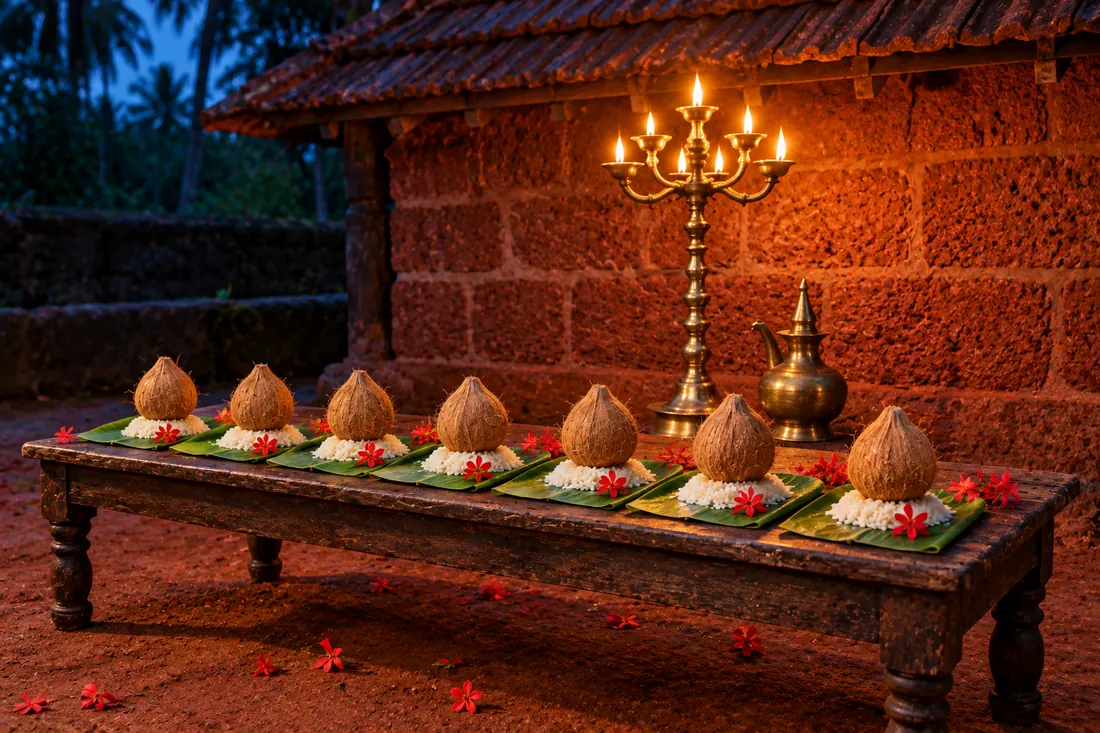
Seven banana leaves laid in a row on a low wooden cot at dusk, a heap of raw rice and a whole coconut on each, with a tall seven-branched brass lamp burning behind them against a laterite wall

The offering made at home

Once a year, in the house, a Billava family sets an offering before the Baidarkala — the agelu tambila, made in the year's own season. The old survey records it twice and records it as offered to the Baidarkala by these households. The daiva aradhane of this coast is kept widely and by many families; this particular offering, to these figures, is the one written down as theirs.

The office comes to the one it comes to

The pujari at a garodi is of this community, and the office is not conferred by appointment — it comes to the one it comes to. It is the community's own religious reality and it is named here plainly and left there.

The deity of the house

Beyond the garodi each household names its own kula daiva, and that goes on the profile as the family names it. It is how a household is known; it is not what an alliance is decided by. The bari is.

Devotion is honoured here on its own terms. Nothing on this site ranks one form of it above another.

Kudroli, and what the community built

The temple at Kudroli, and the schools that followed

The clearest modern thing this community has to say about itself is what it put up with its own hands and its own money, and the dates are on record.

1908, and the invitation

A delegation of Billava elders from Mangaluru, led by Sahukar Koragappa, went to meet Sree Narayana Guru. He came to Mangaluru at their invitation and chose the site at Kudroli himself. He is Kerala's teacher, and he is also the reason a temple stands on this coast.

February 1912

The Guru consecrated the Sri Gokarnanatheshwara temple at Kudroli, installing a Shiva linga he brought with him. Koragappa built it. It was later raised again in the Chola manner with a sixty-foot gopuram, and the trust is led today by Koragappa's grandson.

  • Consecrated February 1912
  • Rebuilt with a sixty-foot gopuram

Mangaluru Dasara

The Navaratri at Kudroli is the city's own now — Sharada Matha and the nine Durgas installed for the nine nights, the Gangavatharana kept flowing from the crown of Shiva through all of them, and on the tenth day a Shobha Yatra that the whole of Mangaluru walks with.

And the schools

The Mumbai association, founded in 1932 out of four older bodies, has acted on one teaching above all — be independent through education. A free night high school in Fort from 1961. The Narayana Guru High School at Padubelle, serving more than a thousand students. Billawa Bhavan opened in April 1995, and a Samudaya Bhavana in Navi Mumbai in June 2024. In Mangaluru a sangha was registered as early as 1925.

If your family carries one of these names and does not find itself described here, please do tell us through the request option in the app — it is the kind of message that decides what we open next.

Questions families ask

Common questions from Billava families

Will we only see Billava profiles here?

Yes. Registering through this page places your profile in the Billava community, and every profile you see, match with, or contact belongs to it. Your bari, your kula daiva and your native town are on the profile, so a household that wants to look within a familiar circle can see at a glance who a family is.

How is our bari recorded?

In your own words, exactly as your family says it. Two households of the same bari do not marry, and that is what the field is for. There is no list you have to fit into — the counts have never agreed and several bari names are shared with other households on this coast, which is also why a bari is never worked out from a surname.

We are Baidya, Poojary or Biruva of Tulu Nadu. Is this the right place?

Yes — it is the same community under the name your family uses. Billava, Billawa, Baidya, Poojary, Biruva and Biruveru all bring you here, and you register as the name your household says at home. No ranking among these names is intended.

Our family reckons its line through the father, not the mother.

That is written on the profile as your family states it, and it puts you nowhere outside this community. The bari is recorded where a household keeps one and is never required of one that does not.

Will our phone number be visible to everyone?

It is not shown openly on your profile. A member who wants to take an introduction forward can see your contact through the app's Reveal Contact feature and reach you directly, and Government-ID-verified badges help you know who you are speaking with.

Next step

Register or login when your family is ready to continue

Create your account and step into the Billava space on Sri Guru Raghavendra Matrimony, where your bari and the deity your household keeps are part of every profile from the first day — and your family sets the pace.