Sri Guru Raghavendra Matrimony™ emblem
SRI GURU RAGHAVENDRA MATRIMONY™

The house name, and the country it comes from

Velama Matrimony

A Velama household names two things before anything else — the gotra and the intiperu, the house name — and it is those two an elder checks first. The country they come from runs from the interior of Telangana to the coast and northward into the old Ganjam settlements. So this page begins with the house name, and then with the deity the family keeps and the district it belongs to.

VelamaOther Velama community

Begin when you are ready

Register now, or read about the Velama heritage first

Creating an account takes a few minutes. If your family prefers to understand the space first, the sections below walk through the titles and what they are, the districts the households belong to, the house name a family marries away from, and the hostels the community built.

Registrations from this page stay within the Velama community — every profile your family sees and contacts belongs to it.
One community, and the names it is addressed by

A heritage your family carries every day

These are Telugu households of Warangal and Karimnagar, Nalgonda and Suryapet, of Srikakulam and Vizianagaram and Visakhapatnam, through the Godavari and the Krishna, at Venkatagiri in Nellore — and in the old settlements that reach north into what is now Ganjam in Odisha.

A Velama family is known by its intiperu, the house name, and it marries away from it. Many households today say gotram when they mean exactly that house name, and many keep both words. Either is welcome, and an elder asks for it before any other question is answered.

So an alliance here begins with what a Velama household names first: the gotra and the house name, the deity the family keeps and the district it belongs to — with the dignity your family expects.

What families often ask first

What families often value first

  • Your gotra and your intiperu — the house name your family marries away from — are both written in your own words, whichever word your household uses.
  • Your kula devata sits on every profile, named as your family names it.
  • Search by native place across Warangal, Karimnagar, Nalgonda, Suryapet, Khammam, Srikakulam, Vizianagaram, Visakhapatnam, the Godavari and Krishna districts, Nellore, Hyderabad and beyond.

What your family will find inside

Everything your family checks, before the first phone call

These are the details Velama households settle first — and they are visible before any contact is exchanged.

Government ID verified members stand out

Members who complete Government ID verification carry a clear mark, giving your family added reassurance at a glance.

Gotra and house name, both on the profile

The intiperu is the line a family marries away from, and a great many households say gotram when they mean exactly that. Either word is welcome and both have a place, written the way your family writes them.

Filter by native place and family origin

Narrow the search by native place — Warangal, Karimnagar, Nalgonda, Suryapet, Khammam, Srikakulam, Vizianagaram, Visakhapatnam, Nellore, Hyderabad and many more.

Education, work, and family background together

Degrees, professions, and family character read clearly on every profile, in the same order elders weigh an alliance.

Contact details are not shown openly

Phone numbers and email are not shown openly on profiles. A member uses the Reveal Contact feature to see another member's details and reach out directly when they are ready to take an introduction forward.

Interest is never lost

Shortlists and the profiles your family has already opened stay saved, so you can return to a promising profile after the household has talked it over.

Built around how Velama alliances actually happen

Whether your family looks within its own circle of districts in the Telangana interior, along the coast, or among households now settled in Hyderabad and further afield, the things that decide it — the gotra, the house name, the deity and the native district — are always in view.

Why families feel at ease

Why Velama families feel at home

The details that decide an alliance sit together in one place, presented the way your family would present them.

However your family is addressed

A household may be addressed as Naidu, as Dora, or carry Rao in its name. These are forms of address, shared with several other communities — a Velama Naidu family and a Velama Dora family are of one and the same community, and both are at home here.

Whichever word your family uses for the line

Some households say intiperu, some say gotram, and many keep both. The profile takes it either way rather than making a family translate itself.

Comfortable for parents and members alike

Whether the search is led by a parent, a sibling, or the member themselves, the profile reads clearly for all of them.

Move at your family's pace, with tradition honoured up front and you reach out when your family is ready.

The names, and what they are

Naidu and Dora are titles, not divisions

This is the question Velama families are asked most often by other people, and it is worth answering plainly at the start.

Forms of address, not communities

A Velama household may be addressed as Naidu or as Dora, and many carry Rao in the name. All of them are titles of address, shared with several other communities across the Telugu country — they say how a family is spoken to, not which community it belongs to.

  • Velama Naidu
  • Velama Dora
  • Rao, carried in the name

And the proof is in the old lists themselves

The clearest evidence that Dora cannot be a division is that the old records gloss more than one Velama grouping with the very same words. A label that both sides of a supposed division carry is not the division — it is a courtesy, and it belongs to the whole community.

Padmanayaka

Padmanayaka is the community's other old name, written in inscriptions from about the sixteenth century and absorbed long since into the broader Velama label. A family that says Padmanayaka at home and a family that says Velama are the same people, and either name finds this page.

The regional names

Koppula Velama, Polinati Velama, Adi Velama — households use these across different parts of the country, and every one of them belongs here. The community's own account is plain about it: marriages between families of different Velama groupings are entirely common and always have been.

  • Koppula · Koppala Velama
  • Polinati · Pollinati Velama
  • Adi Velama

No ranking among these names is intended. Practice and emphasis differ from one district, one branch and one family network to another.

The country

From the Telangana interior to the coast, and north to Ganjam

Velama households are spread across a good deal of country, and it is worth setting down where.

The Telangana districts

Warangal and Karimnagar, Nalgonda and Suryapet, Khammam and the country around them, with a great many households now in Hyderabad.

The coast and the delta

Srikakulam, Vizianagaram and Visakhapatnam up the northern coast; through East and West Godavari and Krishna; and at Venkatagiri in Nellore.

And the old Ganjam settlements

Velama families settled long ago into what is now Ganjam in Odisha, and they are there still. It is an unusual reach for a Telugu community, and it is recorded in the old district accounts rather than only remembered.

If your family carries one of these names and does not find itself described here, please do tell us through the request option in the app — it is the kind of message that decides what we open next.

How a marriage is guarded

The intiperu, and the word your family uses for it

One unit decides whether an alliance can be made, and the only complication is that households call it by two different words.

The house name is the line

The old survey names it directly: Velama families are divided into exogamous house names — intiperulu — and a family marries away from its own. Two households of the same house name do not make an alliance.

  • Written in your own words
  • Two households of one house name do not marry

Gotram, when that is the word your family says

A great many Telugu households say gotram when they mean exactly this house name, and many keep a gotra alongside it as well. Both fields are on the profile and either one is welcome — write whichever your family uses, and there is no need to translate yourself into the other.

Why nothing is chosen for you

No roll of Velama house names has ever been drawn up, and the few the old records print are ordinary words shared widely across the Telugu country. So the field takes your own words rather than offering a list that would misfile real families.

Menarikam, where a family keeps it

The old accounts record menarikam among these households — the match made with the maternal uncle's daughter. Families that keep it and families that do not are equally at home here, and nothing on the profile assumes either.

Every line named here stands on its own terms. Nothing on this site places one household above another.

What a household keeps

The bangles, and how they were worn

One small thing was written down about Velama households a century ago, in enough detail that it can still be pictured exactly.

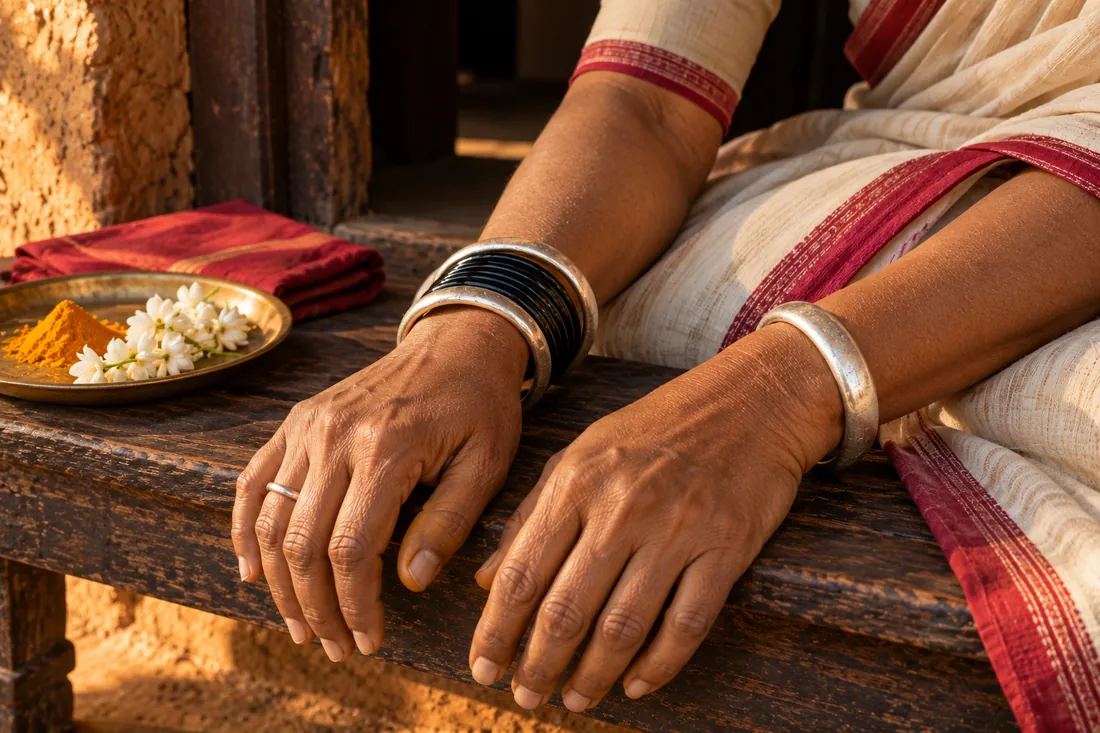
A woman's forearms resting on a low wooden bench at first light — a single heavy plain silver bangle on one wrist, and on the other two silver bangles with slender black glass bangles set between them

A solid silver bangle, and two with black glass between

The old account sets it out plainly: on one wrist a single solid silver bangle, and on the other two bangles of the same plain make with black glass bangles worn between them. Both names are given — the ghatti kadiyam and the sandelu — and the arrangement is recorded for these households and for no other in that whole survey.

Plain, and meant to be worn

Nothing about it is ornate. Heavy silver dulled by decades of wear, and glass that catches the light — the kind of thing a household keeps rather than displays, and passes on without ceremony.

This is recorded of Velama households a century ago. Practice differs from one district, one branch and one family to another.

The older households

The families that built and endowed temples

Some Velama households are named in accounts written a century ago and more, and what they are remembered for on this page is what they gave and what they built.

The names the old accounts carry

Venkatagiri in Nellore, Bobbili and Pithapuram up the northern coast, Nuzvid in the Krishna country, and Jetprole in Nagarkurnool. Two independent accounts written in the early nineteen-hundreds name these households as Velama, and they agree with each other — which is rarer than it sounds.

  • Venkatagiri · Bobbili
  • Pithapuram · Nuzvid
  • Jetprole, in Nagarkurnool

What they endowed

These households gave land to temples and kept them endowed across generations — at Bobbili and at Sitarampur among others. It is the part of the record that has outlasted everything else about them, because a grant to a temple leaves a paper trail and a building.

Pithapuram, and the older stock

The Pithapuram household is described as of the Padma Nayaka Velama stock, with an older connection to the Venkatagiri line — which is the same name this page opens with, carried by ordinary families across the Telugu country to this day.

This heritage is recalled with pride and gratitude. No ranking of any community, and no political association, is intended.

What the community built

The mess in a rented room, and what grew out of it

The warmest thing this community has to say about itself is recent, dated, and entirely its own doing.

It started with feeding students

In the nineteen-fifties and sixties a few Velama elders in Hyderabad began feeding and housing students in rented rooms — the Anantha Vilas Mess of the late Sri J. V. Narsing Rao, and Velama Vigynavardhini, begun by Sri Bonala Kishan Rao, a senior advocate, and Sri R. Madhava Rao, a lecturer. Somebody's elders made sure a poor student got fed.

9 May 1974

On that day it became a formal association under the chairmanship of the late Sri C. Anna Rao, formed mainly to establish hostels and promote education. What grew out of it runs still.

  • Boys' and girls' hostels
  • The Vidyadhana Nidhi scholarship
  • A home for senior citizens

And rest houses for pilgrims

The association keeps rest houses for pilgrims at Srisailam, at Yadadri and at Vemulawada — three of the places a Telugu family is most likely to travel to, and somewhere of their own to stay when they do.

This heritage is recalled with pride and gratitude. No ranking of any community is intended.

Questions families ask

Common questions from Velama families

Will we only see Velama profiles here?

Yes. Registering through this page places your profile in the Velama community, and every profile you see, match with, or contact belongs to it. Your gotra, your house name, your family deity and your native district are on the profile, so a household that wants to look within a familiar circle can see at a glance who a family is.

How is our family's lineage recorded?

By the intiperu, the house name your family marries away from, written in your own words. A great many households say gotram when they mean exactly that, and many keep a gotra beside it — both have a place on the profile and either word is welcome. Nothing is chosen for you from a list, because no roll of these house names has ever been agreed.

We are Velama Naidu, or Velama Dora. Is this our page?

Yes, and so is a household that says Padmanayaka, Koppula Velama, Polinati Velama or Adi Velama. Naidu and Dora are titles of address shared with several other communities — a Velama Naidu family and a Velama Dora family are of one and the same community.

Will our phone number be visible to everyone?

It is not shown openly on your profile. A member who wants to take an introduction forward can see your contact through the app's Reveal Contact feature and reach you directly, and Government-ID-verified badges help you know who you are speaking with.

Next step

Register or login when your family is ready to continue

Create your account and step into the Velama space on Sri Guru Raghavendra Matrimony, where your gotra, your house name and your family deity are part of every profile from the first day — and your family sets the pace.