Sri Guru Raghavendra Matrimony™ emblem
SRI GURU RAGHAVENDRA MATRIMONY™

The Marathi weaving households of the Deccan

Swakula Sali Matrimony

A community that carried its Marathi across three states, that counts the loom-rope itself among the things a marriage is guarded by, and that traces its craft by tradition to a child born of Shiva's own tongue — deserves a matrimony space that asks what its households actually ask: the surname a family marries away from, the devak it keeps, and the kuladaivat it bows to, on every profile from the start.

Swakula SaliOther Swakula Sali community

Begin when you are ready

Register now, or read about the Swakula Sali heritage first

Creating an account takes a few minutes. If your family prefers to understand the space first, the sections below walk through the weaving towns, the names families answer to, Bhagwan Sri Jivheshwara, the days the loom rests, and how a household records its surname and devak.

Registrations from this page stay within the Swakula Sali community — every profile your family sees and contacts belongs to it.
Marathi, kept across three states

A heritage your family carries every day

The Swakula Sali are the Marathi weaving households of the Deccan — of Paithan and Yeola where the silk is worked, of Ahmednagar, Nashik, Sangli, Ichalkaranji and Solapur, and away south and east into Bidar, Kalaburagi and Belagavi, into Hyderabad, and into Bengaluru, where families have long had their place in the cloth trade of the old pete. Wherever the looms went, the Marathi went with them, and in many houses it is still what is spoken at home.

The old district record sets the work down plainly: they bought cotton and silk yarn from the yarn dealers and wove it into sadis and khans — the robe and the bodice cloth, wanted most in the marriage months from January to June. At Yeola, the town where the silver zari was made, they wove the Paithani itself. The craft was learned in the house, from the people in it.

A Swakula Sali household today may have no loom in it at all, and what an alliance begins with has not moved: the surname the family marries away from, the devak it keeps, and the kuladaivat it bows to — asked here with the dignity your family expects.

What families often ask first

What families often value first

  • The surname your family marries away from sits on every profile — the first thing a Swakula Sali household checks, because two families of one surname do not marry.
  • Search by native place across Ahilyanagar (Ahmednagar), Nashik, Sangli, Kolhapur, Solapur, Bidar, Kalaburagi, Belagavi, Hyderabad and Bengaluru Urban.
  • Registrations from this page stay within the Swakula Sali community, so every profile your family considers belongs to it.

What your family will find inside

Everything your family checks, before the first phone call

These are the details Swakula Sali households settle first — and they are visible before any contact is exchanged.

Government ID verified members stand out

Members who complete Government ID verification carry a clear mark, giving your family added reassurance at a glance.

The surname, written first

Your family's surname — the kul — is on the profile from the start, because it is the one thing a Swakula Sali household settles before anything else. Two families carrying the same surname do not marry, and nobody should have to ask.

Filter by native place and family origin

Narrow the search by native place — Ahilyanagar (Ahmednagar), Nashik, Sangli, Kolhapur, Solapur, Chhatrapati Sambhajinagar, Bidar, Kalaburagi, Belagavi, Hyderabad and Bengaluru Urban among them.

Education, work, and family background together

Degrees, professions, and family character read clearly on every profile, in the same order elders weigh an alliance.

Contact details are not shown openly

Phone numbers and email are not shown openly on profiles. A member uses the Reveal Contact feature to see another member's details and reach out directly when they are ready to take an introduction forward.

Interest is never lost

Shortlists and the profiles your family has already opened stay saved, so you can return to a promising profile after the household has talked it over.

Built around how Swakula Sali alliances actually happen

Whether your family's search stays among the weaving towns of Maharashtra or reaches to Hyderabad and Bengaluru, the details that matter — the surname, the devak and the kuladaivat — are always in view.

Why families feel at ease

Why Swakula Sali families feel at home

The details that decide an alliance sit together in one place, presented the way your family would present them.

Your own community, not a wider bracket

Swakula Sali families register as Swakula Sali, and every profile your family opens here belongs to a Swakula Sali household. Padmashali families have a page of their own here, with their own households — nothing is merged, and nothing is assumed from a surname.

Marathi at home, wherever home is now

A household in Bidar, Hyderabad or Bengaluru that has kept its Marathi for generations is not an outlier here. The community has lived across three states for a long time; a family that moved south is as much at home on this page as one that stayed in Nashik, and a household that no longer speaks Marathi is no less of the community.

Comfortable for parents and members alike

Whether the search is led by a parent, a sibling, or the member themselves, the profile reads clearly for all of them.

Move at your family's pace, with tradition honoured up front and you reach out when your family is ready.

The towns the looms went to

Paithan, Yeola, and the road south

This is a community you can follow on a map by its craft. Where there was silk to be worked, Swakula Sali households settled — and in town after town the Marathi went with them.

The older home, and the silk town

By the community's own account the older home is Paithan on the Godavari, and families later moved north to Yeola in Nashik, which became the silk town. Both names still stand for the same cloth. The Marathi went with the looms and stayed.

  • Paithan, on the Godavari in Chhatrapati Sambhajinagar district
  • Yeola in Nashik, where the gold and silver thread was wound
  • Ahmednagar, Sangli, Ichalkaranji, Kolhapur and Solapur

Where Swakula Sali families are found today

Households are settled through the weaving towns of Maharashtra and across the border into Bidar, Kalaburagi and Belagavi, into Hyderabad, and into Bengaluru, where families have long had their place in the cloth trade of the old pete. Sri Anantha Maharaj, the Bengaluru saint born to Swakula parents, is remembered there: the ashram at Gandhinagar grew at the place of his tapas after 1901, and it still feeds and sings every day. Samaj bodies have stood in these towns for decades; the Hyderabad samaja dates from 1961.

Practice and emphasis differ from one town and family network to another — this is heritage held with pride, not a single rule book.

The names families answer to

Whichever name your family uses

A family may have grown up answering to any of these. They are the same people, and every one of them belongs on this page.

Swakula Sali, Swakul Sali, Sakul Sali, Maratha Sali

The Bombay ethnographic survey of 1920 sets them down together as one group under four names — Maratha, Sakul, Sahakul or Swakul Sali. Spellings run together or apart, with or without the a. Whichever your family uses at home is the right one; register under it and your profile sits with the rest of the community.

  • Swakula Sali · Swakulasali · Swakul Sali · Swakulsali
  • Sakul Sali · Sahakul Sali
  • Maratha Sali

Padmashali families have a page of their own here

Both communities weave, and in several towns they have lived side by side for a very long time — but they are not one community. Padmashali households speak Telugu and keep the Bhavana Rishi tradition; Swakula Sali households speak Marathi and keep Jivheshwara. So each has its own page here, and a family should register under the one it names as its own.

Names overlap across weaving communities all over the Deccan. The name alone does not settle which community a household belongs to — the family does.

The tradition the community keeps of itself

Bhagwan Sri Jivheshwara

Every account the community keeps of its own beginning starts here. It is held as tradition, and it is set down here as tradition.

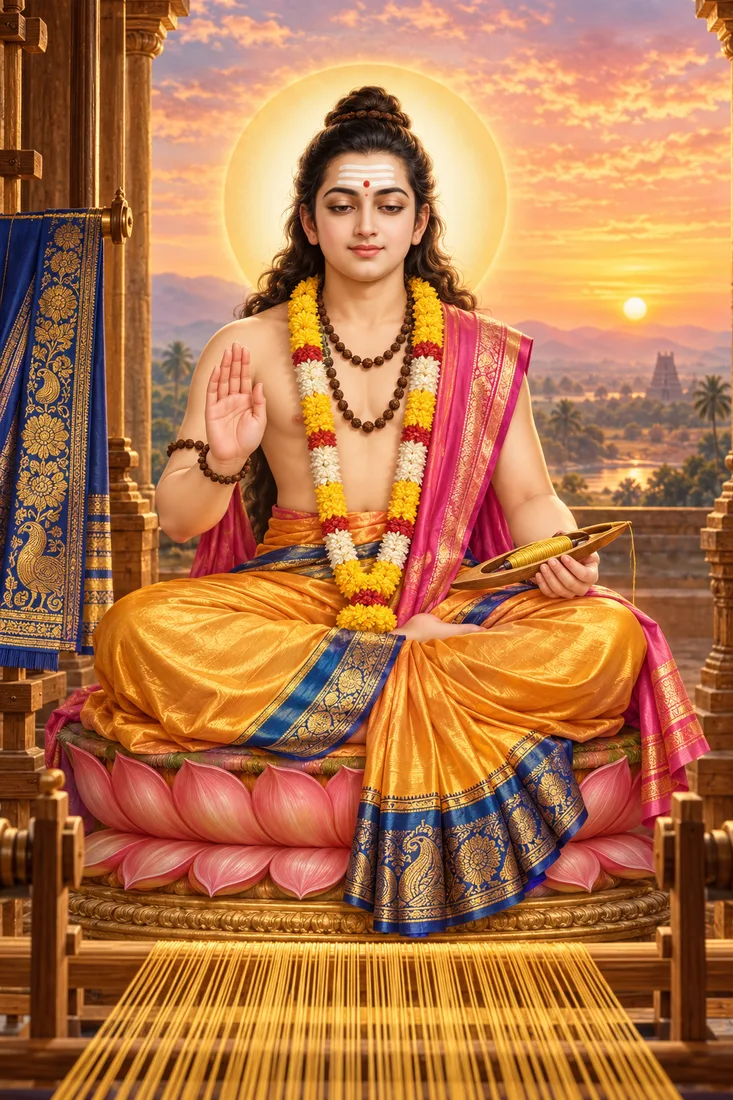
Bhagwan Sri Jivheshwara seated on a lotus at sunrise, one hand raised in blessing and a weaver’s shuttle of gold thread in the other, the warp of a loom running out of the frame before him

A child born of Shiva's tongue

By tradition, at the asking of Adimaya, Shiva brought forth a child from his own tongue — jihva — at first light on a Monday in the month of Shravan. The boy was named Sali and given the work of weaving cloth, and with it the designing and the colouring of it; and because he came from the tongue of Shiva he was called Jihveshwara. By the same tradition Parvati gave his line the name Swakula, and the community has carried it since.

  • Born at first light, on a Monday in Shravan
  • Given the weaving, the design and the colour of cloth
  • Held to have made the tools of the loom as well as the cloth

Kashi, and the road to Benares

The community places Jivheshwara's seat at Kashi. The road was real, whatever its beginning: when the district record of 1884 set down the five places these families went on pilgrimage, Benares was on the list. A seat held in tradition, and a journey households actually made.

Jivheshwar Jayanti, and the temples in the weaving towns

Jivheshwar Jayanti is kept by samaj bodies in Sangli, Pune, Akkalkot, Kalaburagi, Bidar and Surat — with the shodashopachar, the cradle and the lullaby, the reading of the community's own purana, keertan and bhajan, the chariot, and anna prasad for everyone who comes. There are Jivheshwar temples in the weaving towns — at Ichalkaranji, and at Goghat, where the lamp is kept burning and the daily bhajan and puja go on.

The origin account is the community's own tradition, held with reverence and written here as tradition — not as history, and never as a claim over anyone.

The craft, and the calendar it keeps

When the loom is still

The loom is not only how these households earned. It sets the shape of their year, and it stands inside their weddings.

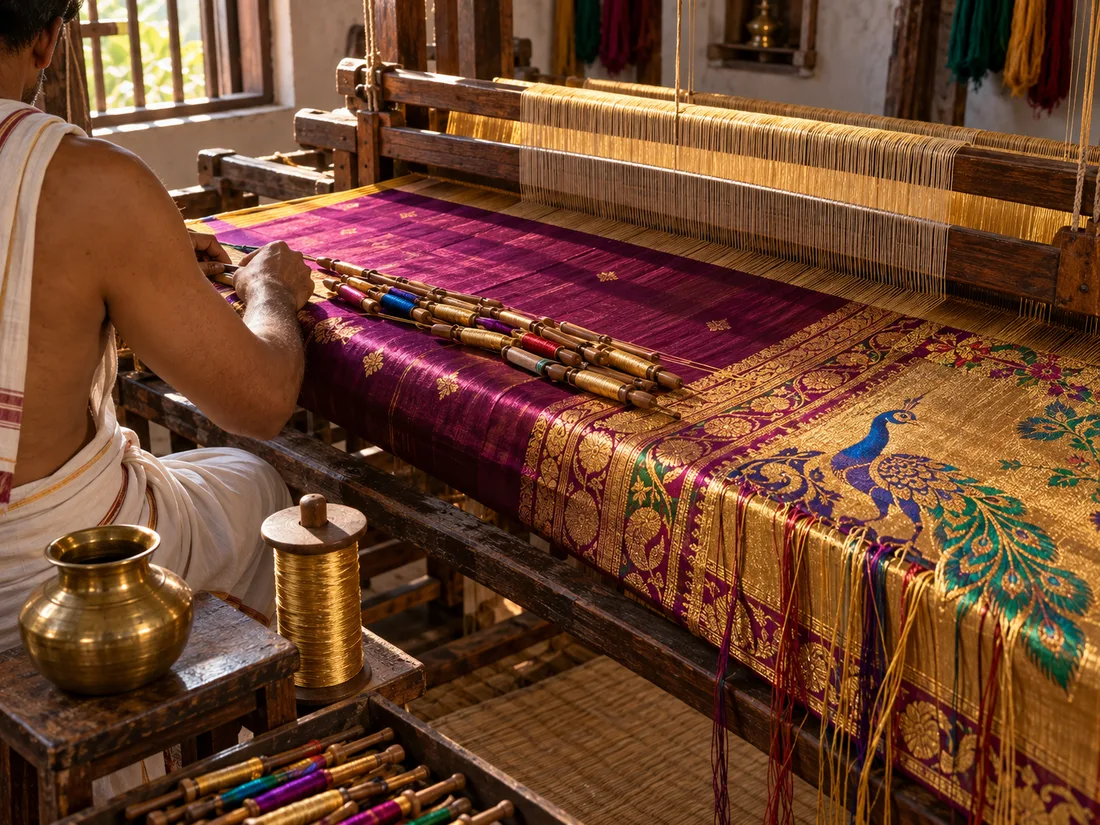
A half-woven Paithani on a pit loom, its gold zari border and peacock pallu worked in tapestry weave, with the small wooden bobbins of coloured silk resting along the cloth

Sadis, khans, and the gold thread at Yeola

They bought cotton and silk yarn from the yarn dealers and gave it back as cloth — sadis and khans, the robe and the bodice cloth, and sheets, quilts, waist-cloths and turbans besides. At Yeola, the town where the silver zari was made, these households wove the Paithani: the saree known by its oblique-square border and its peacock-figured pallu, worked slowly in tapestry weave. The Paithan and Yeola belt is shared ground, worked by more than one community; what is the Swakula Sali's own is a place in it that the earliest records of these communities already take for granted.

The calendar the loom keeps

The district record lists them exactly, and they are the community's own calendar: the day before and the day of Mahashivratra, the first of Phalgun, two days at Shimga, the five days ending on the bright twelfth of Chaitra, every Monday in Shravan, the day before and after Dasara, Divali, and every eclipse of the sun and the moon. That the loom rests on the Mondays of Shravan, and that Jivheshwara is held to have been born on a Monday in Shravan, are recorded quite separately from one another.

  • Mahashivratra, the day before and the day itself
  • The first of Phalgun, and two days at Shimga
  • Every Monday in Shravan
  • Dasara, Divali, and every eclipse

Which days a household keeps varies from town to town and family to family. This is the older record of the practice, not a rule anyone is held to.

The deities of the house

Where a family's devotion goes

Ask a Swakula Sali family where it goes, and the answer is a road with the same stops on it for a century and more.

The family deities

The district record names Bahiroba of Sonari, the Devi of Tuljapur and Khandoba of Jejuri as the family gods of these households; the wider survey adds Jotiba, Narsoba, Mahadeva, Bhavani, Jogai, Satvai and Kedarling. A family keeps its own among them, and it is a real question at the start of an alliance, not a formality.

  • Khandoba of Jejuri
  • Bhavani of Tuljapur
  • Bahiroba of Sonari
  • Jotiba, Narsoba, Jogai, Satvai, Kedarling

Alandi, Pandharpur, Benares

The pilgrimages the district record sets down for these families are Alandi near Poona, Benares, Jejuri, Pandharpur and Tuljapur — and many of the households walk with the Varkaris, which is why Alandi and Pandharpur sit on that list together. It is a devotion the community shares with its Marathi neighbours and has kept for generations.

Satvai, on the fifth day

When a child is born, the fifth day belongs to Satvai. Beside the great pilgrimages it asks very little, and it is the one most families will actually have kept — in the house, for the newest person in it.

Devotion varies from household to household. Naming a family deity here is a way of being known, never a test anyone has to pass.

How a marriage is guarded

The line a family marries away from

In many communities the gotra is the line a family marries away from. In this one it is the surname — and it is the first thing a Swakula Sali household will want to see.

Two families of one surname do not marry

The rule is set down in the old records about as plainly as a rule can be: persons bearing the same surname cannot intermarry. The surname — the kul — is the line a family marries away from, and it is what the elders check first. So it is asked for first here, written the way your family writes it, with no list to fit into and nothing guessed from spelling.

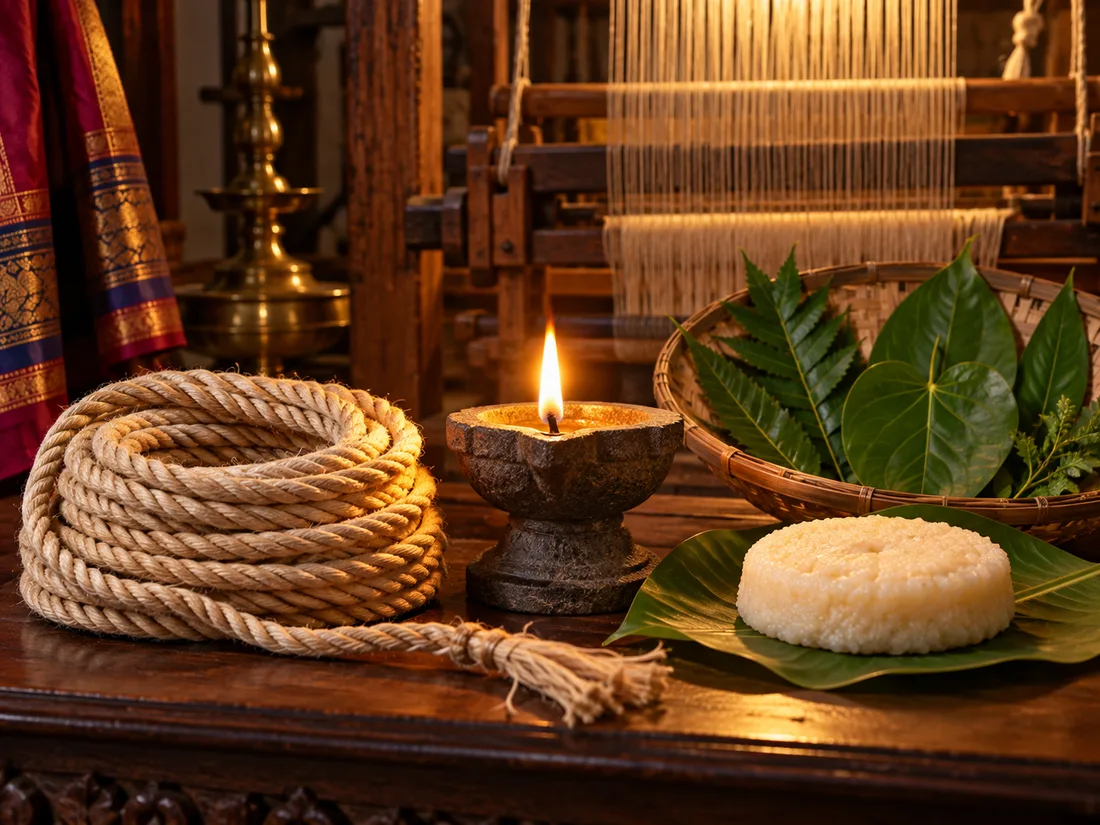
A Swakula Sali devak set out before a loom — a coiled loom-rope, a stone oil lamp burning, and a rice cake on a green leaf, with the panchapallava of five leaves in a winnowing fan

The devak — the loom-rope, the lamp and the cake

At a wedding the devak is installed in a corner of the house or tied to a post of the marriage booth, and it stands guard over the marriage. The survey of 1920 records it across these weaving communities: the panchapallava, the leaves of five trees — or else the loom-rope, a stone lamp and a rice cake set together. That a household would set the cord off its own loom beside the lamp and the cake, and ask it to guard a marriage, says how close the work and the household gods stood. Where a family keeps a devak, there is a place to name it.

  • Panchapallava, the leaves of five trees
  • Or the loom-rope, a stone lamp and a rice cake together
  • Installed in the house, or tied to the post of the booth

If your household keeps a gotra, there is a place for it

Where a household keeps a gotra it belongs here too. The survey of 1920 records Swakula Sali families keeping rishi gotras alongside the surname — Bharadwaja, Dhaumya, Gautam, Kashyap, Kaundinya and Vashishtha among them — and adds that where the gotra is not known, the surname alone settles it. So the surname is asked for first, and the gotra has its own place for the families who keep one. Neither is guessed from the other, and either may be left blank.

Your kuladaivat and your native place sit beside these on the profile. Nothing here is assumed from a surname, and nothing is assumed from silence.

Questions families ask

Common questions from Swakula Sali families

Will we only see Swakula Sali profiles here?

Yes. Registering through this page places your profile in the Swakula Sali community, and every profile you see, match with, or contact belongs to it.

We say Swakul Sali at home — or Sakul Sali, or Maratha Sali. Is this our page?

Yes, all of them. Swakula Sali, Swakulasali, Swakul Sali, Swakulsali, Sakul Sali, Sahakul Sali and Maratha Sali are the same community under names that vary by town and by family. Register under the one your family uses and your profile sits with the rest of the community.

Are Swakula Sali and Padmashali the same community?

No. Both weave, and in several towns the two have lived alongside each other for generations, but they are separate communities — Padmashali households speak Telugu and keep the Bhavana Rishi tradition, and Swakula Sali households speak Marathi and keep Jivheshwara. Padmashali families have their own page here. Please register under the community your family names as its own.

How is our family's lineage recorded?

By your surname — the kul — written the way your family writes it, because two families of one surname do not marry and that is what elders check first. Beside it there is a place for the devak your household keeps, for your kuladaivat, and for your gotra if your family keeps one. Nothing is assumed from a surname, and you may leave any of these blank.

Will our phone number be visible to everyone?

It is not shown openly on your profile. A member who wants to take an introduction forward can see your contact through the app's Reveal Contact feature and reach you directly, and Government-ID-verified badges help you know who you are speaking with.

Next step

Register or login when your family is ready to continue

Create your account and step into the Swakula Sali section of Sri Guru Raghavendra Matrimony, where the surname your family marries away from, the devak it keeps and its kuladaivat are part of every profile — for households across Maharashtra, Karnataka and Telangana, and your family sets the pace.