Sri Guru Raghavendra Matrimony™ emblem
SRI GURU RAGHAVENDRA MATRIMONY™

The loom, the goddess, and the family

Devanga Matrimony

A community whose looms have clothed the South for centuries — devoted to Chowdeshwari Devi, tracing its descent to the sage Devala, and weaving from Karnataka's hills to Kerala's temple towns — deserves a matrimony space that asks the right questions first: sub-community, gotra and family name, native region, and family character, all on the profile from the start.

DevangaKulachar DevangaShivachar Devanga (Lingayat observance)Hatagar Devanga

Begin when you are ready

Register now, or read about the Devanga heritage first

Creating an account takes a few minutes. If your family prefers to understand the space first, the sections below walk through the community's heritage at the loom, its regional names, the gotra and family-name system, the devotion it holds dear, and five centuries of handloom craft.

Registrations from this page stay within the Devanga community — every profile your family sees and contacts belongs to the community.
A heritage of the thread, the goddess, and the land

A heritage your family carries every day

The Devanga are one of the great weaving communities of the South — known as Devangar and Sedar in the Tamil land, as Devanga Chettiar and Devanga Shetty by their old title, and as Dewanga and Dera in Odisha. Their name is traditionally explained as Deva-angam, the limb or body of God, and their calling is remembered as a sacred one: to clothe gods and men alike.

Devanga families are found across Karnataka, generally regarded as the community's principal centre, and across Andhra Pradesh, Telangana, Tamil Nadu, Kerala, Maharashtra and Odisha — a genuinely multilingual community, at home in Kannada, Telugu and Tamil. By tradition an alliance opens with the family's gotra and family name, and the native region that holds its roots.

Sri Guru Raghavendra Matrimony presents those details on every profile, in the order your elders actually weigh them — so a Devanga alliance begins informed, and with the dignity your family expects.

What families often ask first

What families often value first

  • Profiles state sub-community, gotra and family name, and native region up front, so your family knows the essentials before the first conversation.
  • Devanga families across Karnataka, the Telugu country, Tamil Nadu and Kerala — Devangar, Sedar, Devanga Chettiar and Hatagar alike — will find their own people here, under the name their household uses.
  • Registrations from this page stay within the Devanga community, so every profile your family considers belongs to the community.

What your family will find inside

Everything your family checks, before the first phone call

These are the details Devanga households settle first — and they are visible before any contact is exchanged.

Government ID verified members stand out

Members who complete Government ID verification carry a clear mark, giving your family added reassurance at a glance.

Filter by gotra, family name, and native place

Narrow the search by gotra and family name, native place, and family origin — the lineage checks a Devanga family weighs first.

Education, work, and family background together

Degrees, professions, and family character read clearly on every profile, in the same order elders weigh an alliance.

Lineage recorded your way

Write your family's gotra and family name in your own words, exactly as your family says them — whether that is a rishi gotra or your own house name — so the same-lineage check your elders rely on is settled up front.

Contact details are not shown openly

Phone numbers and email are not shown openly on profiles. A member uses the Reveal Contact feature to see another member's details and reach out directly when they are ready to take an introduction forward.

Interest is never lost

Shortlists and the profiles your family has already opened stay saved, so you can return to a promising profile after the household has talked it over.

Built around how Devanga alliances actually happen

Whether your family's search stays within one district or reaches across Karnataka, the Telugu country, Tamil Nadu and Kerala, the details that matter — gotra, family name, and native region — are always in view.

Why families feel at ease

Why Devanga families feel at home

The details that decide an alliance sit together in one place, presented the way your family would present them.

Houses of Devala's line

Your search stays among Devanga families, so every introduction starts from shared roots.

Gotra and family name, honoured up front

The same-lineage check a Devanga family relies on is settled on the profile itself, before any conversation begins.

Comfortable for parents and members alike

Whether the search is led by a parent, a sibling, or the member themselves, the profile reads clearly for all of them.

Move at your family's pace, with tradition honoured up front and you reach out when your family is ready.

Understanding the heritage

A calling remembered as sacred

The Devanga heritage begins at the loom. The community's name is traditionally explained as Deva-angam — the limb, or body, of God — and its craft is remembered not as a trade alone but as a service: to clothe gods and men.

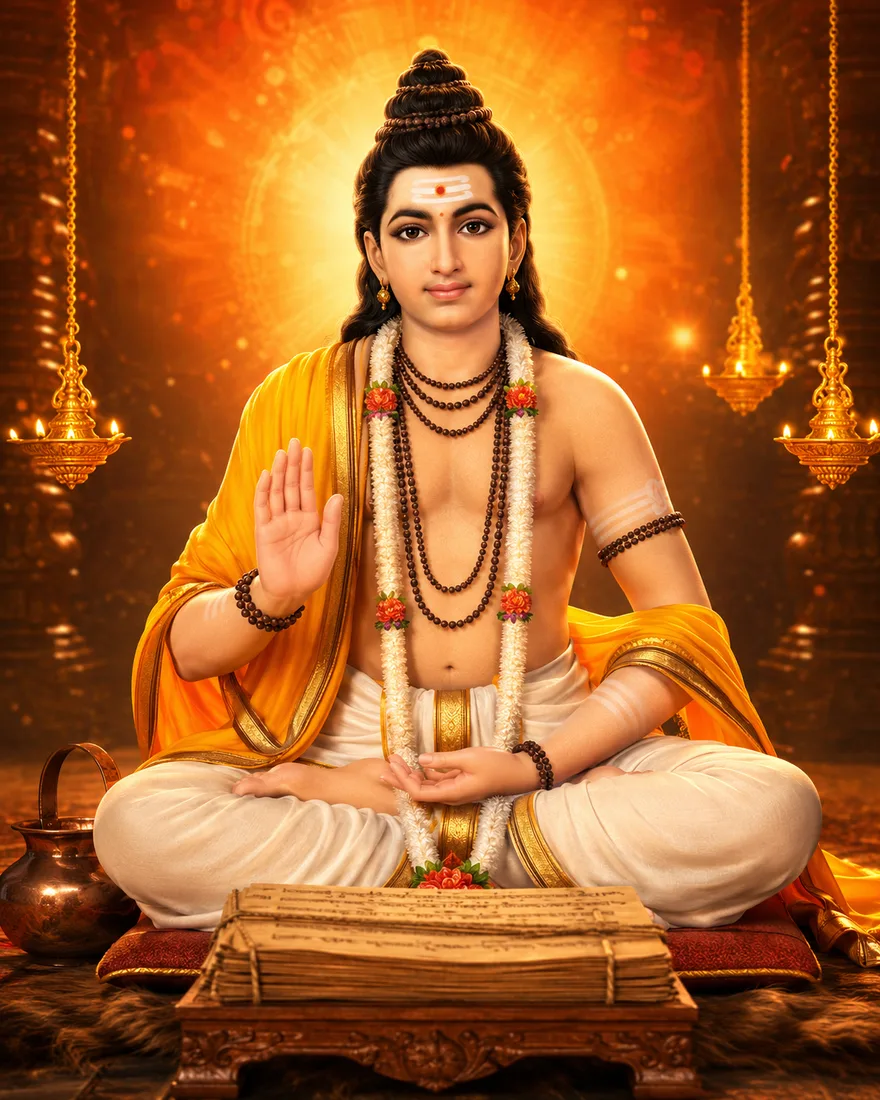
Devala Maharshi, revered by the Devanga community as its ancestral sage and the first weaver, who by tradition drew his thread from the lotus

The sage Devala and the first thread

As the community's tradition tells it, Lord Shiva created a lustrous spirit named Devala, who drew his thread from the lotus stalks springing from the navel of Lord Vishnu, and wove cloth for gods and men alike. The Devanga honour him as the sage of their line. Traditions vary in the telling from region to region, and are shared here in that spirit of reverence.

One community, many names

Across the South the same community is known by the names its region gave it — Devanga and Devang in Karnataka, where families are also known simply as Nekaararu, the Kannada word for weavers; Devangar and Sedar in Tamil Nadu; Devanga Chettiar and Devanga Shetty by the old title of honour; Hatagar in parts of Karnataka; and Dewanga or Dera in the Odisha country.

  • Karnataka — Devanga, Devang, Nekaararu (Nekar), Hatagar, Lingayat Devanga
  • Tamil Nadu — Devangar, Sedar, Sedan, Devanga Chettiar
  • Andhra Pradesh & Telangana — Devanga, Devanga Setty
  • Odisha (Ganjam / Berhampur) — Dewanga, Dera

These names are the community's own, gathered from the many regions it has made home. Nekaararu is the Kannada word for weavers, and is shared with the other weaving communities of Karnataka — it is a name of honour, not a claim on any craft. No ranking of any community is intended, and today Devanga families serve across farming, business, education, government, engineering, medicine and technology — the loom is a proud root, not the whole of the story.

One community, the names families know

Who the Devanga community is

This space is for the Devanga community and the families who belong to it. A household may call itself simply Devanga, or Kulachar, or Shivachar, or Hatagar — every one of those names is welcome here on its own terms.

The Devanga family

Most families simply register as Devanga. Within the community, and mainly in the northern Karnataka country, families also know themselves by their form of observance — the Kulachar households, who keep the sacred thread and the older domestic rite, and the Shivachar households, who wear the linga in the Veerashaiva way. Both are Devanga, and whichever name a family uses stays on its profile so that elders can weigh an alliance for themselves.

  • Devanga — the community's common name, and the usual choice
  • Kulachar Devanga — households of the older domestic observance
  • Shivachar Devanga — households of the Lingayat / Veerashaiva observance
  • Hatagar Devanga — the Hatagar or Hutgar families of Karnataka

Your own name, honoured

Whichever name your family uses, you register as your own — and if your household names itself differently, Other Devanga community keeps you among your own people, alongside every other Devanga family here.

  • Register as the name your family uses
  • Devanga Chettiar and Devanga Shetty are titles of the whole community
  • Other Devanga community keeps every family together

Kulachar and Shivachar describe a family's form of worship, not a rank, and no ranking among these names is intended. Whether families of different observances or regional names make alliances with one another is not for a website to declare — that is each family's own matter, and this space simply shows the name and leaves the decision with your elders.

Understanding the traditions

Gotra and family name: how Devanga families trace lineage

Before education, often before the horoscope itself, a Devanga alliance turns to the family's gotra and its family name. These are the markers households use to keep an alliance outside the same ancestral line.

Marriage outside the same line

Two families of the same gotra are traditionally treated as one ancestral line, so alliances are sought outside it, while the match stays within the Devanga community. Older Devanga households traced this line through the family's own house name — its sept — and many families today name a rishi gotra instead. Both are honoured here as your family's own answer.

  • Same gotra or same house name is avoided, as one ancestral line
  • A rishi gotra and an old family house name are equally valid answers
  • The match stays within the Devanga community

How we record it

Each part of the lineage sits in its own place, written in your own words, exactly the way your family already says it — because no single list has ever been drawn up for the community, and nothing is chosen for you here. Nothing is guessed from anything else: a gotra is never inferred from a surname, and a surname is never read as a house name.

  • Gotra — in your family's own words
  • Family or house name — kept as its own detail, not merged with the gotra
  • Surname, native place and kuladevaru — each recorded separately alongside
  • Your family reads these and decides; a spelling never rules anyone out

Households differ in how strictly they weigh the lineage line — some settle it first, others read it alongside the horoscope and the family's overall comfort. A gotra is never inferred from a surname; each family names its own.

A heritage of devotion

Chowdeshwari Devi, the presiding deity

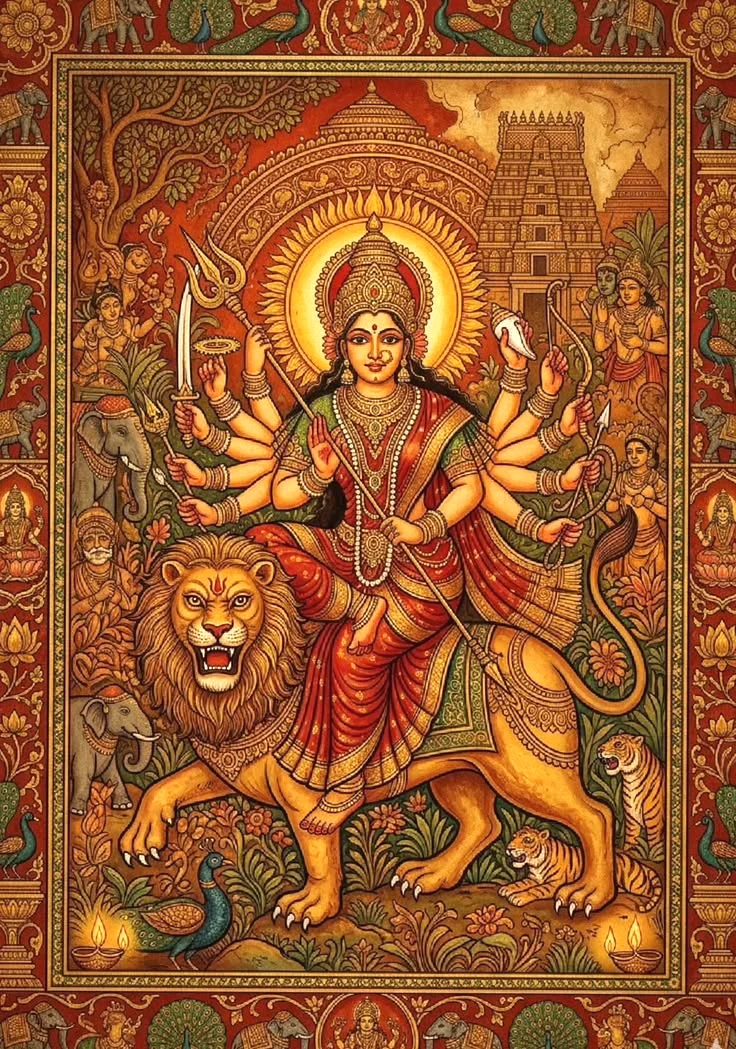
Devanga devotion turns to Chowdeshwari Devi, honoured as the community's presiding deity — she who is remembered as coming riding upon her lion, trishula in hand, to the aid of the sage Devala.

Chowdeshwari Devi, the presiding deity of the Devanga community, seated upon her lion with the trishula in hand, in a devotional painting bordered with peacocks, elephants and lotuses

The goddess, and the colours of the thread

Chowdeshwari — honoured also as Sowdeshwari and, in the south, as Sri Ramalinga Sowdeswari Amman — is the deity Devanga households hold dearest; in the Kannada country many Devanga families have long revered her as Banashankari, a goddess much loved across Karnataka. The tradition tells that when she came to the sage Devala's aid, the blood of the five asuras ran yellow, red, white, green and black, and Devala dipped his threads in them — and so the community's cloth first took on its colours. Tradition offers more than one telling of her name and her story.

The festival, and the loom that rests

Her festival is the community's own — kept once a year at the temple, or in a house or grove made ready for it, and for as long as it lasts the looms stand still. In the Kannada country it is remembered as her Shakambhari festival, when a hundred and eight vegetables are cooked and offered to her. And in many Devanga homes there is a quieter observance still: on the new-moon day, on Amavasya, the loom falls silent and the family offers its prayers.

These deities, sages and sacred places are mentioned with reverence and gratitude alone, as the community's living tradition. No single deity is the compulsory deity of every family — devotional matters rest with each family and its elders.

A heritage of guidance

The community's spiritual seat at Hampi

Beyond the family shrine, the Devanga community looks to its own monastic seat — the Sri Gayathri Peetha Mahasamsthana at Hemakuta in Hampi, standing among the granite hills of the old Vijayanagara country.

The Sri Gayathri Peetha Mahasamsthana

The Hampi Hemakuta Sri Gayathri Peetha Mahasamsthana, on Hemakuta Hill in Hampi, is widely regarded as the Devanga community's principal spiritual seat — a monastic seat of the old Vijayanagara country to which Devanga families across the South look for guidance in matters of tradition, ritual and community life. Sri Ramalingeswara, Sri Sowdeshwari Amman and Sri Gayatri Devi are honoured there.

  • Hemakuta Hill, Hampi — in the Vijayanagara district of Karnataka
  • A seat of the community's own, honoured across the South
  • Devanga families in Tamil Nadu and the Telugu country also keep their own seats

The Jagadguru of the peetha

The seat is presently held by Jagadguru Sri Sri Sri Dayanandapuri Mahaswamiji, who was installed as its Peethadhipathi in 1990 after the peetha had long stood vacant. He is named here only in respect and gratitude, as the head of the community's own seat.

This seat and its Jagadguru are mentioned with reverence and gratitude alone, as part of the community's living tradition — no endorsement of this matrimony service by the peetha or its Jagadguru is implied or claimed. Devanga religious practice is not uniform, and matters of faith rest with each family and its elders.

A heritage of the handloom

Five centuries at the loom

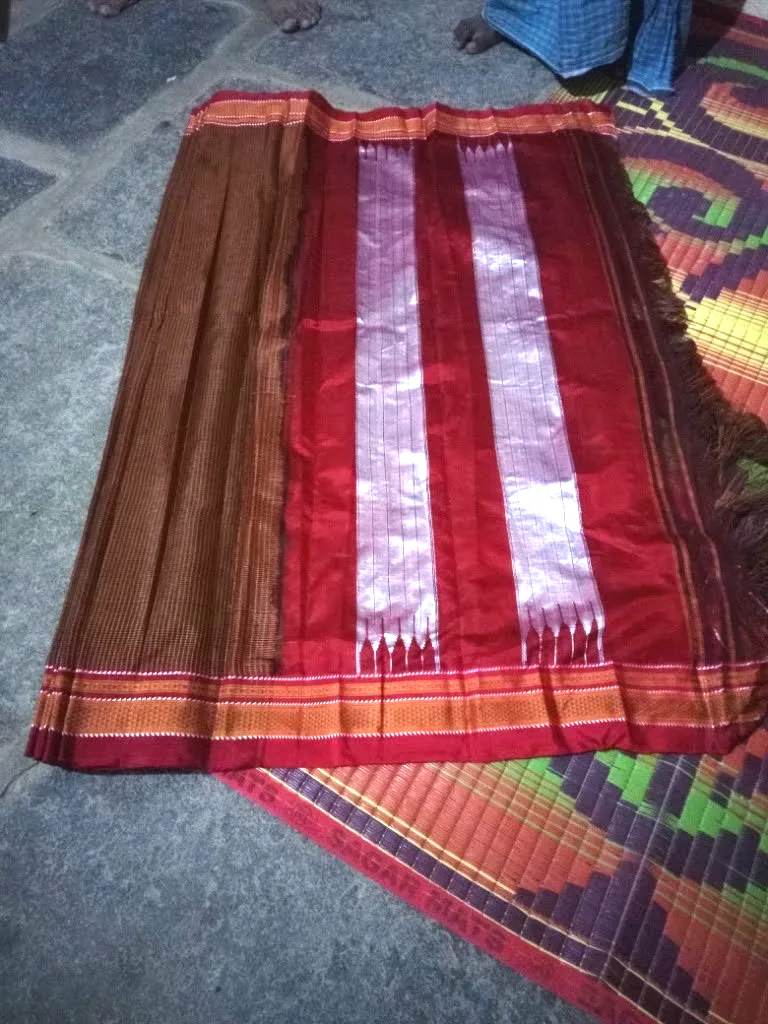
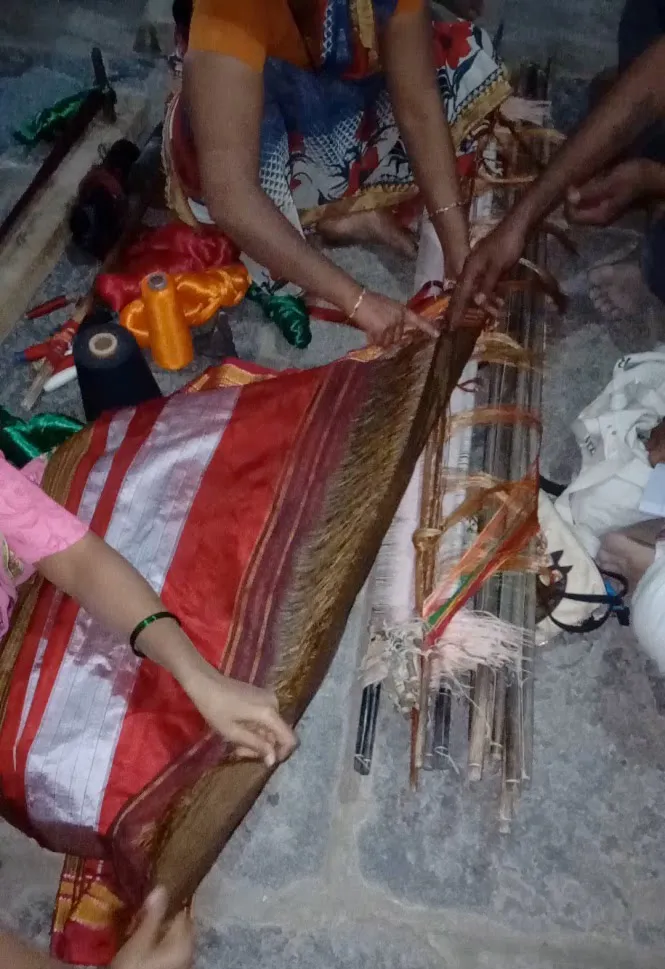
The Devanga legacy is written in cloth — from the handloom towns of Karnataka to a Kerala village where a Kannada-speaking community has woven the state's most beloved saree for five hundred years.

Kuthampully — Kerala's kasavu, woven by a Kannada community

Perhaps the community's proudest story: some five centuries ago Devanga Chettiar families were invited from the Bangalore and Mysore country by the Maharaja of Kochi to weave for his household. Their descendants at Kuthampully in Thrissur — around three hundred weaving families — still produce the cream-and-gold kasavu saree that Kerala wears at its festivals, honoured with a Geographical Indication in 2011. A Sowdeshwari Amma temple stands in the village to this day.

  • Kuthampully, Thrissur — the kasavu saree, GI-honoured in 2011
  • Chendamangalam, Ernakulam — a sixteenth-century settlement whose fine muslin dhotis were said to pass through a ring
  • A Sowdeshwari Amma temple in the weaving village itself

The handloom country of Karnataka and the Deccan

Closer to home, Devanga families have long worked in North Karnataka's celebrated handloom belt — among the weavers of the Ilkal saree and the Guledgudd khana, crafts shared with the Padmasali, Veerashaiva and Muslim weaving families of the same towns — and in the Molakalmuru silk tradition. In old Bengaluru, the textile merchants of the community gave their name to Aralepete, in the Pete laid out around Kempe Gowda's fort.

  • The Ilkal and Guledgudd handloom belt of North Karnataka
  • The Molakalmuru silk tradition
  • Aralepete in old Bengaluru — the community's textile merchants
  • Berhampur in the Ganjam country — the Dera families and their tussar silk patta

These handloom traditions are the shared inheritance of several weaving communities working side by side — they are recalled here with pride and gratitude, and no exclusive claim on any craft is intended.

A heritage of learning and enterprise

From the loom into every walk of life

From its roots at the loom, the Devanga community has carried its habits of skill, thrift and self-reliance into every field of modern life — and into a long tradition of building institutions for its young.

A community that builds and educates

The community has a long record of endowing schools and colleges for its young — the Devanga Arts College at Aruppukottai in Tamil Nadu, founded in 1970, is one well-known example among many. Devanga families today serve across business and trade, education, government, engineering, medicine and technology, carrying the same care for craft into new work.

A trilingual inheritance

Few communities carry their journey so plainly in their speech. Scholars note that Devanga weavers of the Kongu country of northern Tamil Nadu still speak Kannada and Telugu — the languages of their older homes in Karnataka and the Telugu country — alongside Tamil. Historians record that the community moved south and east through the Vijayanagara period, and its households have been at home in several tongues ever since.

This heritage is recalled with pride and gratitude alone, as the community's own contribution to the life of the land. No ranking of any community is intended.

Questions families ask

Common questions from Devanga families

Will we only see Devanga profiles here?

Yes. Registering through this page places your profile in the dedicated Devanga section — the Devanga, Devangar, Sedar, Devanga Chettiar and Hatagar families — and every profile you see, match with, or contact belongs to it.

How is our family's lineage recorded?

Each part sits in its own place, written in your own words, exactly as your family says it — your gotra, your family or house name, your surname, your kuladevaru and your native place. A rishi gotra and an older family house name are both valid answers, and they are kept as separate details rather than merged into one. Alliances traditionally avoid the same line, no list has been drawn up for the community, and a gotra is never inferred from a surname.

We are Devangar or Sedar from Tamil Nadu — is this our section?

Yes. Devangar and Sedar are the community's own names in the Tamil land, and those families are at home in this Devanga section — as are Devanga Chettiar, Devanga Shetty, Hatagar and Dewanga families. You can register as the name your family uses, with your gotra and native region on every profile.

Will our phone number be visible to everyone?

It is not shown openly on your profile. A member who wants to take an introduction forward can see your contact through the app's Reveal Contact feature and reach you directly, and Government-ID-verified badges help you know who you are speaking with.

Next step

Register or login when your family is ready to continue

Create your account and step into the Devanga section of Sri Guru Raghavendra Matrimony, where your gotra and family name, native region, and family background are part of every profile — for the Devanga families of Karnataka, the Telugu country and beyond, and your family sets the pace.