Sri Guru Raghavendra Matrimony™ emblem
SRI GURU RAGHAVENDRA MATRIMONY™

The kul, the kuldevi and the village

Rajput Matrimony

A Rajput family introduces itself the way it always has: by its kul, often by the branch within it, by the kuldevi the household keeps, and by the village it comes from. This page is for Hindu Rajput families of Rajasthan and Gujarat, Malwa and Uttar Pradesh, Garhwal and Kumaon, Himachal and Jammu — wherever they live today.

Rajput

Begin when you are ready

Register now, or read about Rajput heritage first

Creating an account takes a few minutes. If your family prefers to understand the space first, the sections below walk through the kuldevi of every kul, a bride's first dhok, marrying outside the kul, Navratri, Gangaur and Teej, and the poshak.

Registrations from this page stay within the Rajput community — every profile your family sees and contacts belongs to it.
Kul, kuldevi and village

A heritage your family carries every day

A Rajput household names itself by its kul and by its kuldevi, the goddess who protects the kul, and many families name the branch within the kul as well — the shakh or khanp. Ask a family who it is, and the kul is the first thing you will hear, with the name of the village close behind.

Rajput families live across Rajasthan, across Gujarat from Kutch to Saurashtra, through Malwa and the rest of Madhya Pradesh, in Uttar Pradesh, Haryana and Delhi, and in the hills of Garhwal, Kumaon, Himachal and Jammu.

The language at home follows the region — Marwari, Mewari, Dhundhari or Hadoti in Rajasthan, Gujarati or Kutchi, Malvi, Hindi, Garhwali, Kumaoni or Dogri — and the native district on the profile lets a family look close to home or across the whole community.

What families often ask first

What families often value first

  • Your kul and its branch sit on the profile in the words your elders use, with the kuldevi your household keeps beside them.
  • Search by native district — Jaipur, Jodhpur, Udaipur, Ahmedabad, Indore, Gwalior, Lucknow, Dehradun, Jammu and many more.
  • Registrations stay among Rajput families; your native district narrows the search, and the kul and the kuldevi have their place on every profile for your elders to read.

What your family will find inside

Kul, kuldevi and district — on the profile

These are the questions a Rajput household settles first, and the answers are there before any contact is exchanged.

Government ID verified members stand out

Members who complete Government ID verification carry a clear mark, giving your family added reassurance at a glance.

Narrow the search by native district

Look close to home or across the whole community, and narrow by native district: Jaipur, Jodhpur, Udaipur, Ahmedabad, Indore, Gwalior, Lucknow, Dehradun, Jammu and many more.

Lineage recorded your way

The kul and its branch, the kuldevi, the gotra and your family's region or samaj are each written as your elders say them — there is no list you have to fit into.

Education, work, and family background together

Degrees, professions, and family character read clearly on every profile, in the same order elders weigh an alliance.

Contact details are not shown openly

Phone numbers and email are not shown openly on profiles. A member uses the Reveal Contact feature to see another member's details and reach out directly when they are ready to take an introduction forward.

Interest is never lost

Shortlists and the profiles your family has already opened stay saved, so you can return to a promising profile after the household has talked it over.

Built around how Rajput alliances are made

Whether your family looks close to home in Jodhpur or Indore, or among Rajput households in Delhi, Ahmedabad and Dehradun, the things that decide an alliance — the kul, the kuldevi, the district and the family itself — stay in view.

Why families feel at ease

Why Rajput families feel at home

The details that decide an alliance sit together in one place, presented the way your family would present them.

Known by your own kul

However your family names its kul and its branch, that is exactly how they are written — with the kuldevi your household keeps right beside them.

From the desert to the hills

Families of Jodhpur and Udaipur, Indore and Lucknow, Dehradun and Jammu each keep their native district on the profile, so your family can look as close to home as your elders wish, or further afield.

Comfortable for parents and members alike

Whether the search is led by a parent, a sibling, or the member themselves, the profile reads clearly for all of them.

Move at your family's pace, with tradition honoured up front and you reach out when your family is ready.

Faith

The kuldevi of every kul

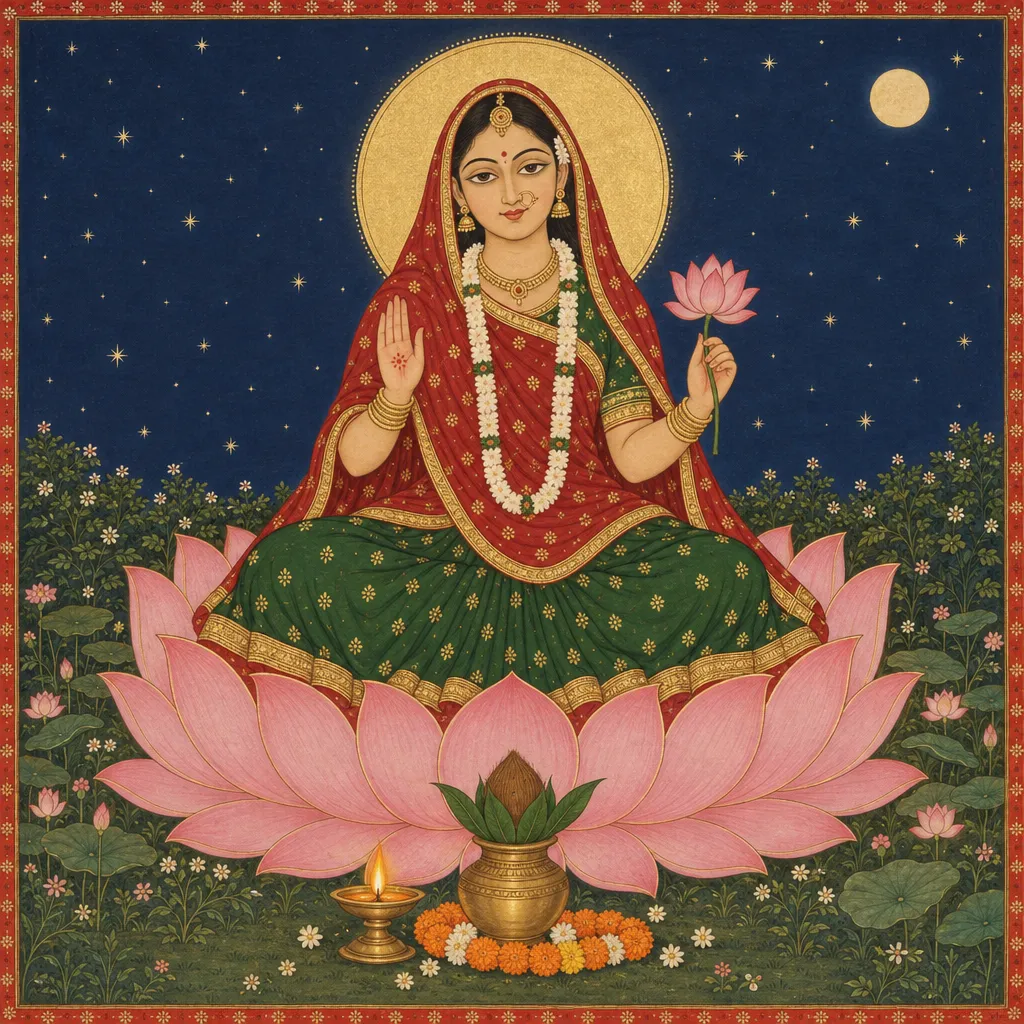
Each kul is protected by its own goddess, the kuldevi, and a Rajput household keeps her close.

A devotional painting in the Rajasthani miniature style of a kuldevi seated on a pink lotus in a red odhni and green ghagra, one hand raised in blessing, with a lit brass diya, a kalash and marigolds before her

A goddess for each kul

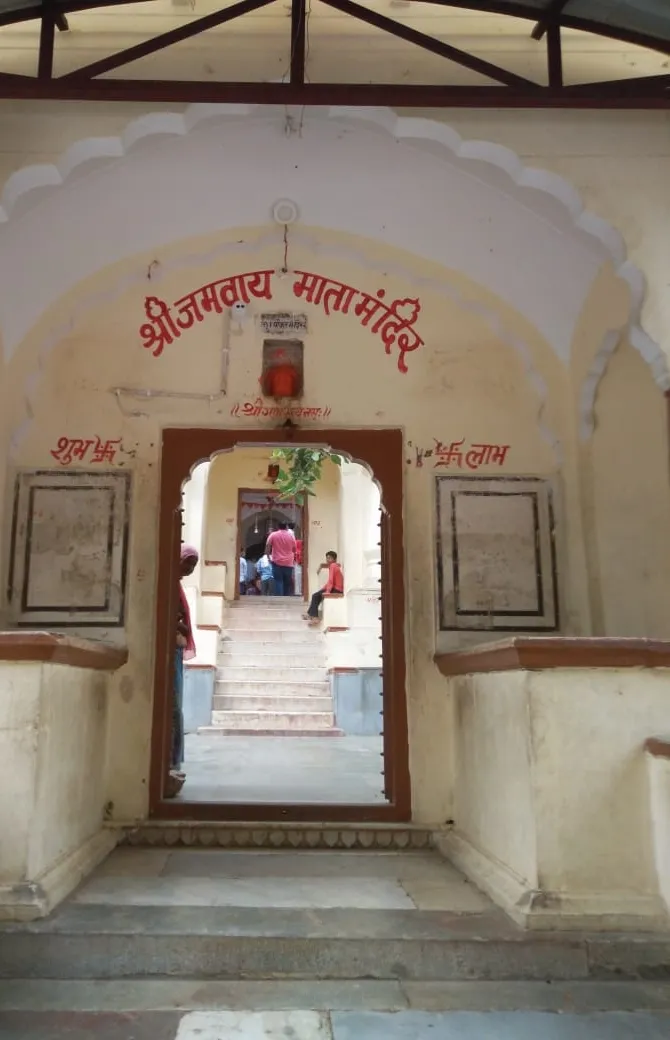
Among Rajput families, Sisodia households keep Ban Mata, Rathore households Naganecha Ji, Kachhwaha households Jamvai Mata, Jhala households Ad Mata, whom many call Shakti Mata, and Chauhan households Ashapura. Whichever goddess your family keeps, there is a place to name her on the profile.

  • Sisodia — Ban Mata
  • Rathore — Naganecha Ji
  • Kachhwaha — Jamvai Mata
  • Jhala — Ad Mata (Shakti Mata)
  • Chauhan — Ashapura

In the hills, a kuldevta too

In Garhwal, Kumaon, Himachal and Jammu many households speak of a kuldevta, a family deity, and the profile has a place for whichever your family keeps.

Mentioned here with reverence alone; devotional matters rest with each family and its elders.

The new home

A bride's first dhok

When a bride enters her husband's household, the very first thing she does is give respect — dhok — to the kuldevi of his family.

His family's goddess becomes hers

Once married, a woman takes part fully in the traditions of her husband's family, and his kuldevi becomes the goddess she honours in her new home.

The goddess she grew up with

Many women keep the goddess of the home they grew up in close to their hearts as well, as a goddess of their own.

Each family keeps these customs in its own way — this is heritage held with pride, not a single rule book.

Kul and branch

Marrying outside the kul

A Rajput daughter marries into another kul, and a son's bride comes from one — which is why the kul is the first thing an elder asks about.

The branch within the kul

Many families also name their branch — the shakh or khanp. Jodha, Champawat and Mertiya are branches of the Rathore kul, and Hada of the Chauhan. Where a family names one, it is written beside the kul.

A gotra, where one is kept

Many families keep a gotra too, often the same name as their khanp, and there is a place for it on the profile.

Kul names are often surnames as well, carried by families of many communities — so each family records its own kul, and nothing is read from a surname.

Festivals

Navratri, Gangaur and Teej

Navratri, the nine nights of the Goddess, is for many Rajput households the most important celebration of the year. Gangaur and Teej, the women's festivals of Rajasthan, are kept in Rajput homes too.

Navratri

Through the nine nights the Goddess is honoured at home, and the family's kuldevi is honoured with her.

Gangaur

Kept across Rajasthan in spring: unmarried girls pray to Gauri for a good husband, and married women pray for their husbands' long life.

Painted by the old schools

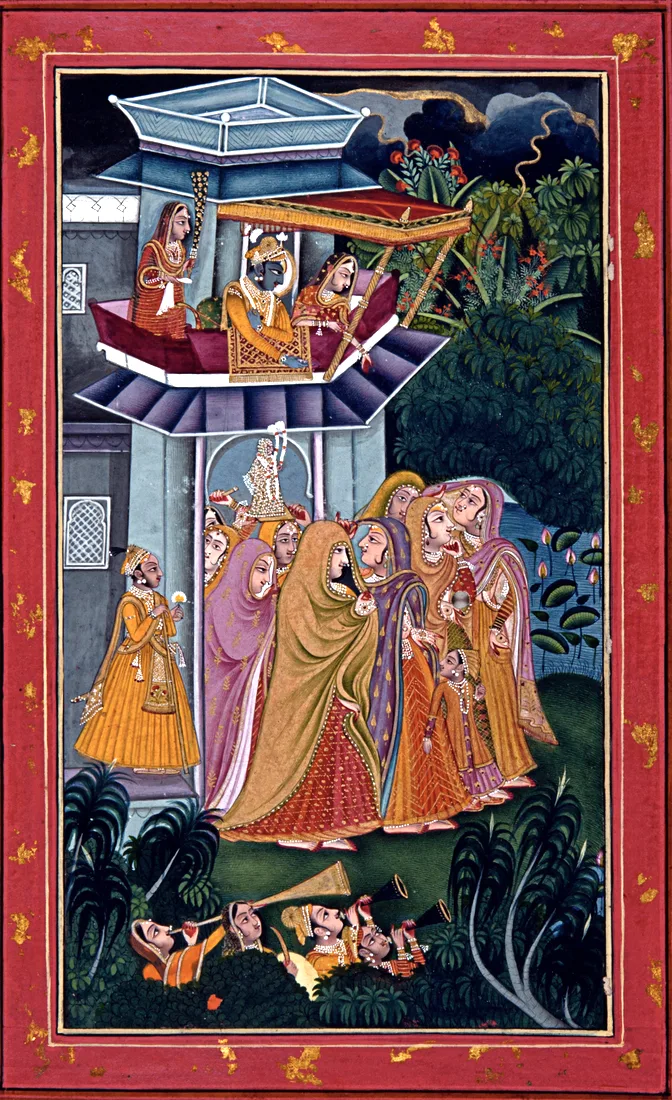
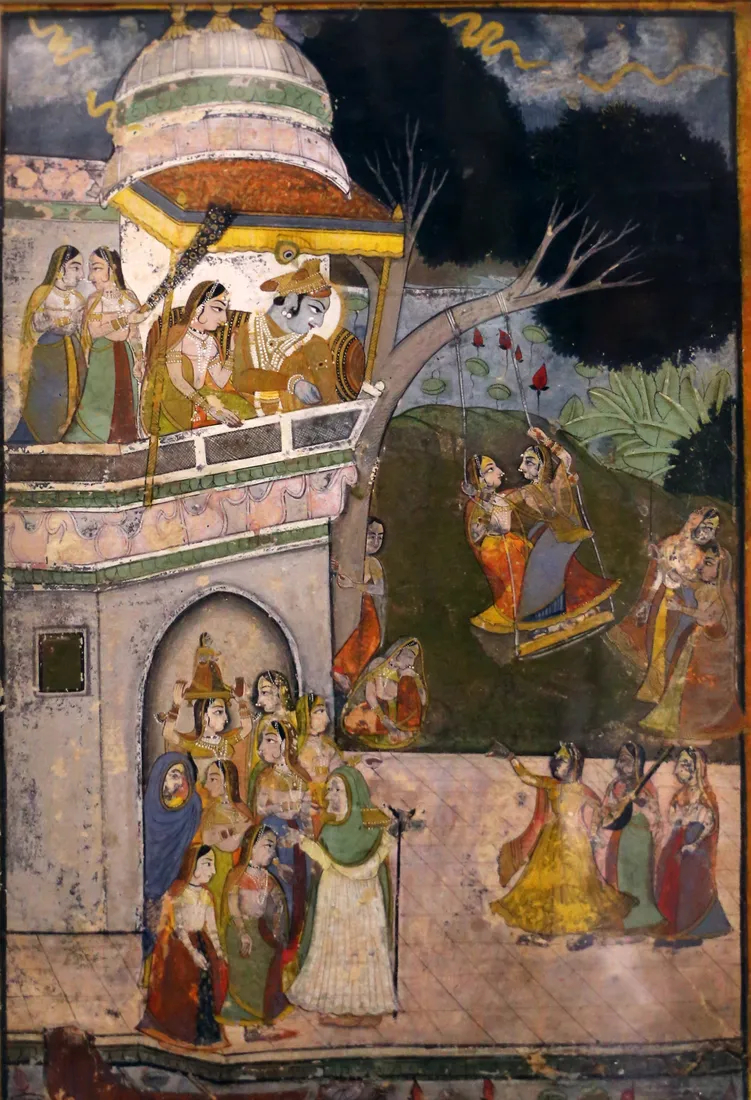
The painters of Kota, Bundi, Mewar and Marwar turned often to these festivals — the swing hung for Teej, and Gauri carried in procession.

Gangaur and Teej belong to the whole of Rajasthan and its neighbours, and Rajput homes keep them in their own way.

Attire

The poshak

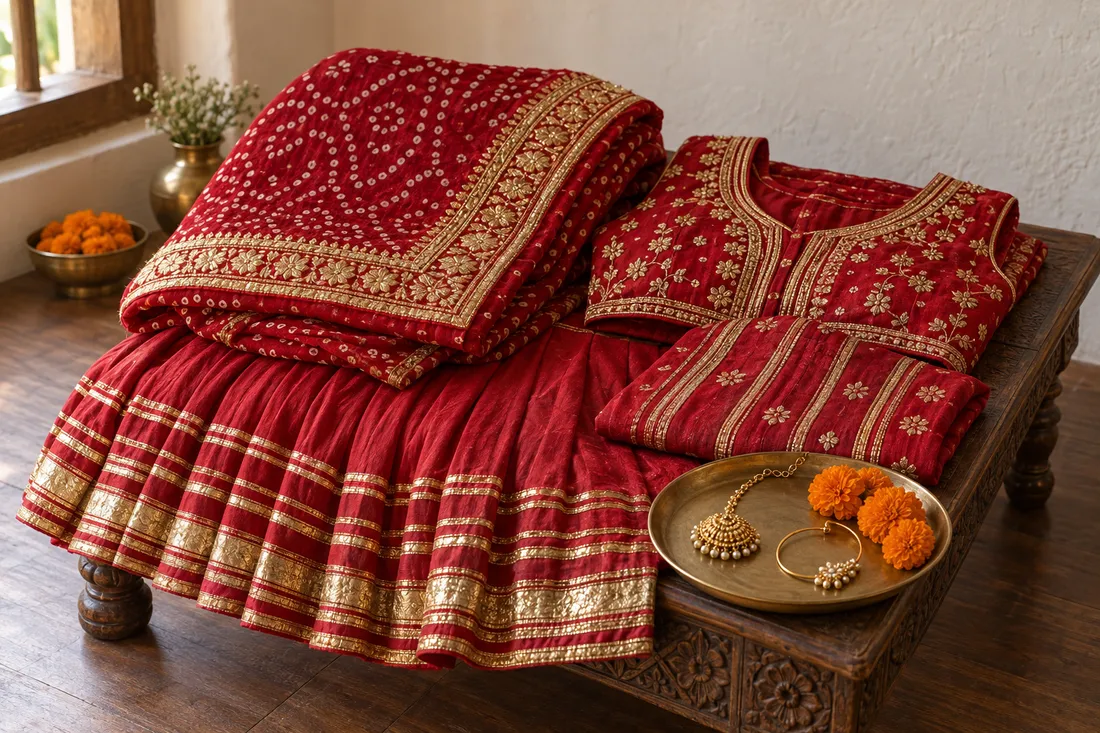
The Rajputi poshak — ghagra, odhni, kanchli and kurti — is the dress of a Rajput bride, and of the festivals kept at home.

A Rajputi poshak laid out on a carved wooden chowki: a red bandhani odhni with a gold gota-patti border, a red ghagra with gold gota stripes, the kanchli and kurti, and a brass plate holding a borla on its chain and a nath, with marigolds

The four pieces

A ghagra, the full skirt; an odhni, the long scarf worn over the head and shoulders; and a kanchli bodice worn with a kurti — bordered in gota-patti, in cloth dyed as bandhani or leheriya.

Colours for the occasion

Red for a bride and for married women, and leheriya, dyed in waves of colour, at Teej.

The borla

The borla, also called the rakhdi, is the forehead ornament married women wear across Rajasthan.

Every family keeps its own ways with the poshak — this is heritage held with pride, not a uniform.

Questions families ask

Common questions from Rajput families

Will we only see Rajput profiles here?

Yes. Registering through this page places your profile in the Rajput community, and every profile you see, match with, or contact belongs to it.

How is our family's lineage recorded?

Your kul, and its shakh or khanp if your family names one, are written in your own words, the way your family has always said them, with a place for the kuldevi your household keeps, the gotra, and your family's region or samaj. Nothing is assumed from a surname, and you may leave any of it blank.

Our family is from the hills, or from Gujarat — is this our place?

Yes. This page is for Hindu Rajput families wherever their roots are — Rajasthan, Gujarat, Madhya Pradesh, Uttar Pradesh, Garhwal, Kumaon, Himachal or Jammu. Your region or samaj is written on your profile for other families to read, and your native district lets a family look close to home or across the whole community.

Will our phone number be visible to everyone?

It is not shown openly on your profile. A member who wants to take an introduction forward can see your contact through the app's Reveal Contact feature and reach you directly, and Government-ID-verified badges help you know who you are speaking with.

Next step

Register or login when your family is ready to continue

Create your account and step into the Rajput space on Sri Guru Raghavendra Matrimony, where your kul, your kuldevi and your native district are part of every profile from the first day — for Rajput families of Rajasthan, Gujarat, Madhya Pradesh, Uttar Pradesh and the hills, wherever they live today, and your family sets the pace.