Sri Guru Raghavendra Matrimony™ emblem
SRI GURU RAGHAVENDRA MATRIMONY™

The households of the oil, in Maharashtra and Odisha

Teli Matrimony

Teli is a name that comes from the oil — tel, and before it til, the sesame seed. The families this page is for are the Marathi Teli households of Maharashtra and the Odia Teli households of Odisha, two homelands with a language each — and this page begins with what each family asks first: the kul or the gotra, the native district, and the household behind the profile.

Marathi Teli (Maharashtra)Odia Teli (Odisha)

Begin when you are ready

Register now, or read about Teli heritage first

Creating an account takes a few minutes. If your family prefers to understand the space first, the sections below walk through Santaji Jagnade and the kirtan, the two homelands, the kul and the gotra, and the devak boughs of a Marathi wedding and the two white pots of an Odia one, a century ago.

Registrations from this page stay within the Teli community — every profile your family sees and contacts belongs to it.
From Chakan to Balasore

A heritage your family carries every day

In Maharashtra many Teli households keep the memory of Sant Santaji Jagnade, Tukaram's companion; and on the Odisha coast, a century ago, Teli families were also known as Kuberaputra, the sons of Kubera.

Marathi Teli families are at home across Maharashtra, from Nagpur, Wardha and Chandrapur to Jalgaon, Pune, Satara and Solapur, and Odia Teli families in Cuttack, Puri, Balasore, Khordha and Ganjam — and both far beyond.

So an alliance here begins with what a Teli household names first — the kul or the gotra, the native district and the family itself — with the dignity your family expects.

What families often ask first

What families often value first

  • Your kul — or your gotra, in Odisha — sits on the profile in your own words.
  • Search by native district — Nagpur, Wardha, Chandrapur, Pune, Satara, Jalgaon and the rest of Maharashtra; Cuttack, Puri, Balasore and Ganjam in Odisha — and beyond.
  • Each family chooses Marathi Teli or Odia Teli, and registrations stay within the Teli community.

What your family will find inside

What a Teli household weighs first, set out on the profile

These are the details Teli households settle first — and they are visible before any contact is exchanged.

Government ID verified members stand out

Members who complete Government ID verification carry a clear mark, giving your family added reassurance at a glance.

Your kul or gotra, in your own words

A Marathi Teli profile carries the kul, usually the surname the line goes by, and an Odia Teli profile the gotra or the line your elders name — each written the way your family says it.

Filter by native place and family origin

Narrow the search by native place — Nagpur, Wardha, Chandrapur, Amravati, Jalgaon, Pune, Satara, Sangli, Solapur, Cuttack, Puri, Balasore, Khordha, Ganjam and many more.

Education, work, and family background together

Degrees, professions, and family character read clearly on every profile, in the same order elders weigh an alliance.

Contact details are not shown openly

Phone numbers and email are not shown openly on profiles. A member uses the Reveal Contact feature to see another member's details and reach out directly when they are ready to take an introduction forward.

Interest is never lost

Shortlists and the profiles your family has already opened stay saved, so you can return to a promising profile after the household has talked it over.

Built around how Teli alliances actually happen

Whether your family looks close to home in Nagpur or Cuttack or among Teli households in Pune, Mumbai or far beyond, the things that decide it — the kul or the gotra, the native district and the family itself — are always in view.

Why families feel at ease

Why Teli families feel at home

The details that decide an alliance sit together in one place, presented the way your family would present them.

Marathi and Odia households, each among its own

Every family names Marathi Teli or Odia Teli when it registers, so a household in Wardha and a household in Puri can each keep the search among families of its own language.

When several surnames make one kul

Where your elders count a few surnames as one kul, write them all, and the families reading your profile will see the line exactly as your household knows it.

Comfortable for parents and members alike

Whether the search is led by a parent, a sibling, or the member themselves, the profile reads clearly for all of them.

Move at your family's pace, with tradition honoured up front and you reach out when your family is ready.

Sant Santaji Jagnade

Santaji Jagnade, who kept Tukaram's words

Many Marathi Teli households begin their story with one of their own, who stayed at Tukaram's side.

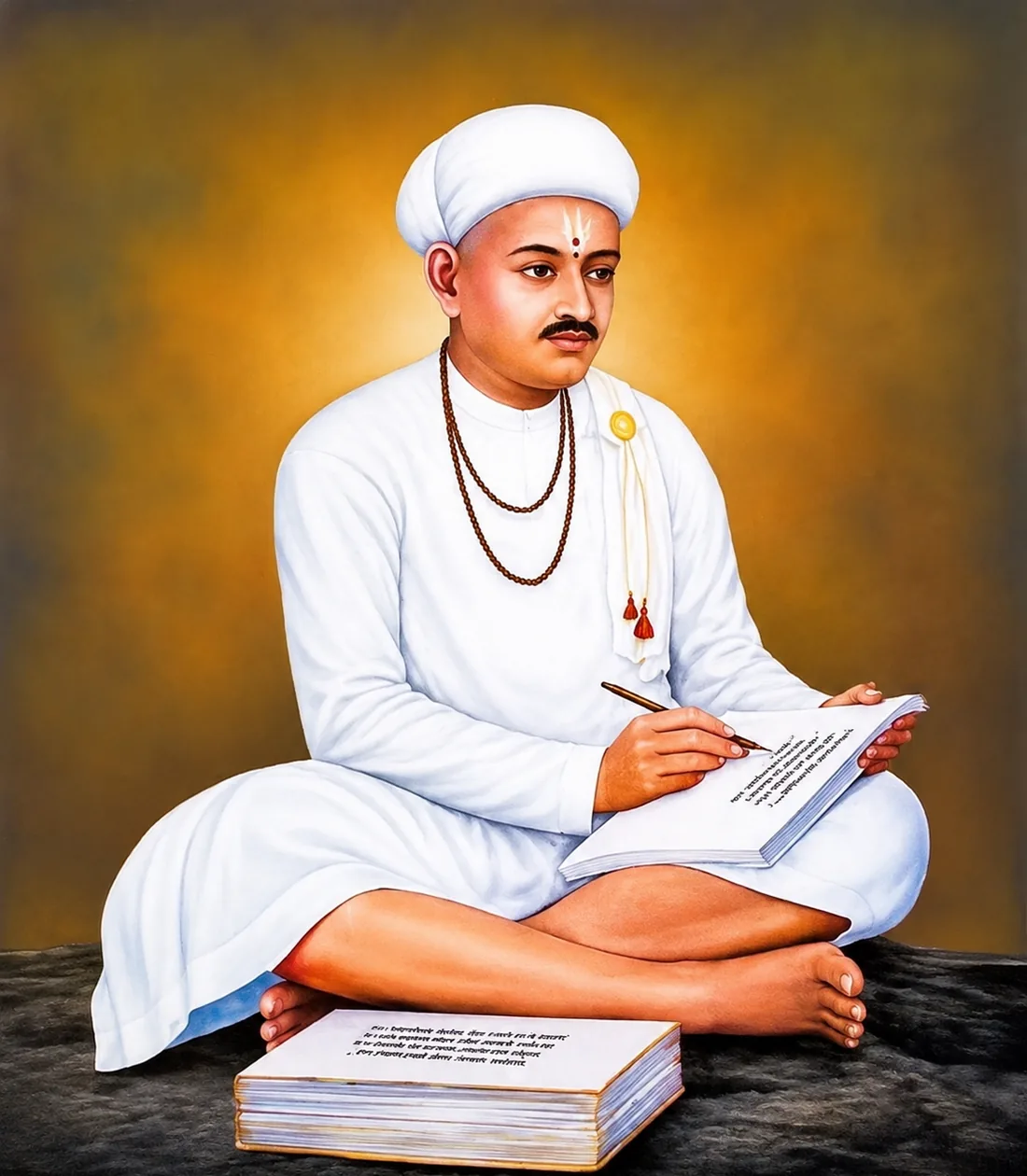
A devotional painting of Sant Santaji Jagnade seated cross-legged in white, writing with a pen in an open book, a bound book before him

The cymbals and the pen

Santaji was born in about 1624 at Chakan, near Pune, to Vithoba and Mathabai, devotees of Vitthal, in a household that pressed oil. He sat in Tukaram's kirtan as one of the companions who kept the beat on the cymbals, and he wrote the abhangs down as they were sung. His own verses, Shankar Dipika, Yogachi Wat and Tel Sindhu among them, are remembered with his name.

Sudumbare

His samadhi is kept at Sudumbare, in Maval near Pune, where he is remembered to have spent his last years. Each year his palkhi sets out from there and walks with the pilgrims to Pandharpur, and his Jayanti, on 8 December, is kept by Teli households across Maharashtra.

  • Born at Chakan, in about 1624
  • His samadhi at Sudumbare, in Maval
  • Jayanti on 8 December
  • A postage stamp in his name, 2009

Devotion is honoured here on its own terms. Nothing on this site ranks one form of it above another.

Two homelands

One name, two homelands

One homeland speaks Marathi, from the Konkan to Vidarbha; the other speaks Odia, from Balasore down to Ganjam.

Marathi Teli households

Marathi Teli families are at home across Maharashtra — Vidarbha, Khandesh, Marathwada, the Pune and Satara country and the Konkan — and well beyond. Many households have long gone by the name Tilwan, and in the old Bombay records by Somvar, because they did not work on Monday. In the Nagpur country, another account adds, the mill rested that day because Monday is Mahadev's day.

Odia Teli households

Odia Teli families are at home in Cuttack, Puri, Balasore and Khordha and south in Ganjam, and well beyond. The old district books of Balasore and Puri recorded another name for them, Kuberaputra, the sons of Kubera, the god of wealth, and noted that many were traders as well as pressers of oil. In Ganjam a century ago most Odia Teli households followed the Chaitanya way of devotion, and all worshipped the village goddesses. Many households carry the title Sahu, as Odia families of several communities do.

Lingayat Teli households

A Marathi Teli household that keeps the Lingayat observance — Lingayat Teli, as many say — finds its way here, and will also find the Veerashaiva Lingayat community's own page on this site. Which of the two it registers through is the family's own choice.

Ganiga, Gandla and Telikula households

Oil-pressing families of the Kannada and Telugu country who say Ganiga, Gandla or Telikula have a page of their own on this site, written for them.

From Wardha to Puri the name is the same, and so is the oil it comes from; the rest each family tells in its own language.

The name the elders keep

The kul, and the gotra in Odisha

In a Marathi Teli household, the line that decides a match is the kul.

The kul, most often the surname

The kul is usually the family's surname, and sometimes a small group of surnames the elders count as one, and a marriage is traditionally made outside it. Write your kul as your elders reckon it, with any surnames they count alongside it, and the kuldaivat beside it if your household names one.

The gotra, or the line your elders name

Odia Teli families write the gotra or the line their elders name, and the family deity if the house keeps one. Each is set down in your own words, and any of them may be left blank.

However your elders reckon the kul or the gotra, the profile sets it down just that way.

As the wedding was readied

The devak boughs and the two white pots

Two old accounts, one from each homeland, set down how a Teli wedding was readied a century ago.

The devak, honoured at the wedding

In a Marathi Teli wedding the devak is honoured. In the Nashik country, a century ago, the boughs of five devak trees — mango, umbar, shami, jambhul and rui — were first placed in a temple of Maruti; a married couple went to fetch them, to music, and the boughs were tied to a post of the wedding pandal. In the Pune country the devak was the stone oil mill itself, together with an iron bar.

Two white pots, carried on one cloth

In Ganjam, a century ago, the day before an Odia Teli wedding was marked by two young married women carrying two new pots, painted white, on their heads — held up by a single cloth whose two ends were rolled into head-pads. With a third married woman bearing a new winnowing basket and the forehead chaplet, they walked to a temple to the sound of the conch and pipes, and worshipped there.

Both accounts are a century old; how a wedding is readied today differs from one household to the next.

Questions families ask

Common questions from Teli families

Will we only see Teli profiles here?

Yes. Registering through this page places your profile in the Teli community — the Marathi Teli households of Maharashtra and the Odia Teli households of Odisha — and every profile you see, match with, or contact belongs to it. When you register you name which of the two your family is, and you can keep your search within it.

How is our family's lineage recorded?

In your own words. Marathi Teli families write their kul — usually the surname the line goes by, and any surnames the elders count as one with it — and the devak and kuldaivat if they keep them. Odia Teli families write the gotra or the line their elders name. A marriage is traditionally made outside the same kul, and only your family says what your kul is; the profile never fills it in from a surname.

We are a Teli family, but neither Marathi nor Odia. Is there a place for us?

This page is written for Marathi Teli and Odia Teli households, wherever they live today. If your family belongs to the Teli community of another region or language, please tell us through the request option in the app — it is the kind of request that decides what we open next.

Will our phone number be visible to everyone?

It is not shown openly on your profile. A member who wants to take an introduction forward can see your contact through the app's Reveal Contact feature and reach you directly, and Government-ID-verified badges help you know who you are speaking with.

Next step

Register or login when your family is ready to continue

Create your account and step into the Teli space on Sri Guru Raghavendra Matrimony, where Marathi Teli or Odia Teli, your kul or gotra and your native district are part of every profile from the first day — and your family sets the pace.