Sri Guru Raghavendra Matrimony™ emblem
SRI GURU RAGHAVENDRA MATRIMONY™

Gauray Bay, the dhavalas, and Agri boli

Agri Matrimony

In the Gauri songs of Agri women, the goddess comes home each Bhadrapad as Gauray Bay, a married daughter with two days in her mother's house, and the women walk her as far as the sea-shore when she leaves. This page is for Hindu Agri families of Raigad, Thane, Palghar and Mumbai, wherever they live today.

Agri

Begin when you are ready

Register now, or read about Agri heritage first

Creating an account takes a few minutes. If your family prefers to understand the space first, the sections below walk through who the Agri families are, Gauray Bay, the dhavalas, and the family line.

Registrations from this page stay within the Agri community — every profile your family sees and contacts belongs to it.
Mumbai and the north Konkan

A heritage your family carries every day

Agri families are at home in Mumbai and Navi Mumbai, in Thane and Palghar, and in Raigad, around Panvel, Uran, Pen, Alibag and Roha.

Many Agri homes speak Agri boli as well as Marathi.

At the heart of many Agri villages stands the shrine of the gaondevi, the village goddess.

What families often ask first

What families often value first

  • Your kul, your gaon and your kuldaivat each have a line of their own, written just as they are said at home.
  • Search by native district — Mumbai Suburban, Thane, Palghar, Raigad and many more.
  • Every profile here is an Agri family's, with the native district on each one and the gaon where the family has added it.

What your family will find inside

The district, the gaon and the kul

On every profile an elder can see which district a family comes from, and its kul, gaon and kuldaivat wherever the family has written them in.

Government ID verified members stand out

Members who complete Government ID verification carry a clear mark, giving your family added reassurance at a glance.

Narrow the search by native district

Raigad, Thane, Palghar, Mumbai City or Mumbai Suburban: a family can search by its own native district, or across Maharashtra.

Lineage recorded your way

Your family writes the kul, the gaon and the kuldaivat as it says them at home; none of them is ever filled in from your surname.

Education, work, and family background together

Degrees, professions, and family character read clearly on every profile, in the same order elders weigh an alliance.

Contact details are not shown openly

Phone numbers and email are not shown openly on profiles. A member uses the Reveal Contact feature to see another member's details and reach out directly when they are ready to take an introduction forward.

Interest is never lost

Shortlists and the profiles your family has already opened stay saved, so you can return to a promising profile after the household has talked it over.

Built around how Agri alliances are made

A profile here shows the native district, and the gaon too where the family has written it in, for elders who would like an alliance close to home.

Why families feel at ease

Why Agri families feel at home

The details that decide an alliance sit together in one place, presented the way your family would present them.

From the village or the city

Panvel or Pen, Thane or Mumbai: wherever a family lives today, the native district on its profile still points home.

Among Marathi-speaking homes

Each profile states its mother tongue, so a family can keep to Marathi-speaking homes if it wishes.

Comfortable for parents and members alike

Whether the search is led by a parent, a sibling, or the member themselves, the profile reads clearly for all of them.

Move at your family's pace, with tradition honoured up front and you reach out when your family is ready.

Heritage

Who the Agri families are

Agri families are rooted in the villages along the creeks of the north Konkan, from the edges of Mumbai down to Raigad.

Along the creeks

Agri families have their villages on both banks of the creeks of Kalyan, Vasai, Nagothane, Panvel, Roha and Mhasla.

A speech of their own

For most of its history Agri boli was spoken and sung rather than written, and in the 1940s, 284 of its songs were written down in the villages of Alibag, with a sketch of its grammar.

Ekvira Aai of Karla

Ekvira Aai of Karla is revered in many Agri homes, as she is in many other homes along this coast.

Where your family's roots are, and which of these it keeps, is for your family to tell.

Festival

Gauray Bay, home for two days

Agri women's songs for Gauri, as recorded at Alibag in the 1940s, call her "Gauray Bay", the daughter of the house, and follow her short visit from arrival to farewell.

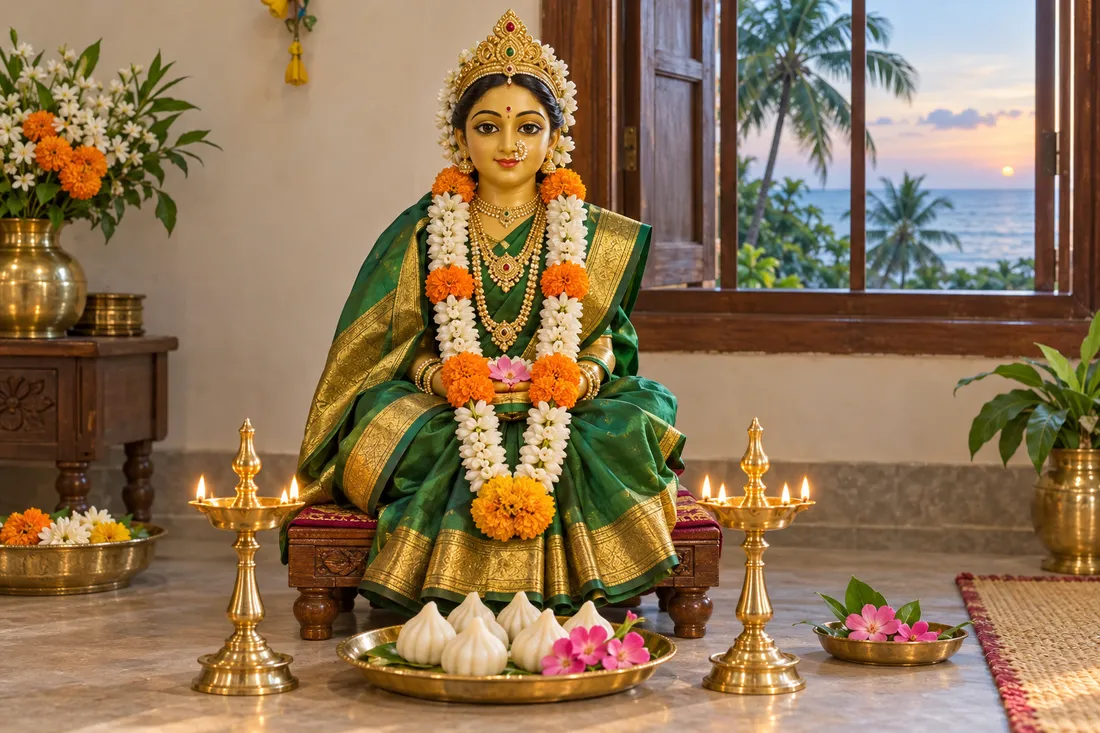
An illustration of the goddess Gauri in a green and gold saree, garlanded with marigolds and jasmine and holding a pink flower, seated on a low carved wooden seat, with two lit brass lamps and a brass plate of modaks before her and the sea at sunset through an open window beside her

A daughter come home

In the songs she has come from her husband's home beyond the hills, and her brother promises to carry her on his shoulders if the river is in flood on the way.

A gift from the bazaar

Her mother goes from bazaar to bazaar looking for the right gift for her, a winnowing basket or a cow, and promises to send for her again.

Songs from house to house

For those two days courtyards were drawn with designs, and women of every age sang and danced before Gauri and went from house to house to see each family's Gauri.

As far as the sea-shore

On the day she leaves, the songs say, all the women of the village walk with her as far as the sea-shore, and from there she goes on alone.

Your family may know these songs in other words.

Weddings

The dhavalas

Where an Agri wedding keeps the dhavalas, the woman who sings them, the dhavalarin, leads the rites with the village elders beside her, from the haldi until the procession comes home.

Over three days

An Agri wedding can run over three days: the utane paste rubbed on the bride and groom on the first, then the haldi, and the wedding on the third.

From the utane to the farewell

There are dhavalas for the utane and the haldi, for raising the mandap and seating the gods, for tying the bashing, the wedding crown, and for the bride setting out for her new home.

Passed on at Neral

At a workshop in Neral, in Raigad, two senior singers sang a whole three-day wedding through, rite by rite, for the women who came to learn.

The rites and their songs differ from village to village and from family to family.

The family line

More than a surname

Three things have helped Agri elders place a family: the kul, the home village, and the family's gods.

A surname is shared

A surname held in common by many families does not, by itself, show how those families are related.

Gods that travel for a wedding

In one Alibag village in the 1940s, nineteen families kept a single set of family gods, Khanderao and Bhavani among them; the images went to whichever family was holding a wedding and stayed there until the next family with a wedding asked for them. That was one village's custom.

Three lines, all optional

Write each one just as the elders say it, and leave any of them empty.

How each line is written is the family's own choice.

Questions families ask

Common questions from Agri families

Will we only see Agri profiles here?

Yes. Registering through this page places your profile in the Agri community, and every profile you see, match with, or contact belongs to it.

How is our family's lineage recorded?

There is a line for your kul, one for your gaon, the home village, and one for your kuldaivat, each written as your family says it. The kul is the line Agri elders have traditionally looked at before an alliance; none of the three is ever filled in from your surname, and any of them can stay empty.

We write Aagri, or Agari — is this our page?

Yes, if your family's roots are among the Agri families of Raigad, Thane, Palghar and Mumbai. Agri, Aagri and Agari are one name in three spellings, and आगरी in Marathi.

Will our phone number be visible to everyone?

It is not shown openly on your profile. A member who wants to take an introduction forward can see your contact through the app's Reveal Contact feature and reach you directly, and Government-ID-verified badges help you know who you are speaking with.

Next step

Register or login when your family is ready to continue

Create your account and step into the Agri space on Sri Guru Raghavendra Matrimony, where your native district, and your kul, gaon and kuldaivat if your family keeps them, are part of your profile from the first day — for Agri families of Raigad, Thane, Palghar and Mumbai, wherever they live today, and your family sets the pace.